 Add to Chrome
 Add to Firefox
 Add to Edge
Towards Surgical World-Action Modeling: A Preliminary Joint Visual-Trajectory Forecasting for Surgical Motion Planning
Aug 20, 2026
Reliable surgical planning requires models to anticipate not only how instruments will move, but also how the operative visual state will evolve together with such motion. Existing approaches typically treat future scene generation and instrument trajectory prediction as two separate tasks. Scene-only models cannot directly evaluate the accuracy of future instrument motion at the trajectory level, while trajectory-only models fail to capture the visual consequences of instrument movement, leaving the consistency between predicted trajectories and future scene evolution unaddressed. Jointly forecasting both provides a more complete account of surgical action-scene dynamics by enabling explicit trajectory-level evaluation while simultaneously modeling the corresponding visual evolution. To bridge this gap, we present a preliminary joint visual-trajectory world-action model that simultaneously forecasts future visual states and instrument trajectories from historical surgical observations. Specifically, we encode historical video frames and tool trajectories into latent representations, which are processed by a temporal-spatial encoder and subsequently decoded through separate visual-state and trajectory prediction heads. Based on this preliminary architecture, a chunked autoregressive rollout is repeatedly applied to predict fifteen future steps. The chunked strategy consistently outperforms direct one-shot prediction across all evaluated horizons, improving first-segment PSNR from 18.86 to 23.11 dB and reducing ADE from 45.77 to 22.22 pixels. These results demonstrate the initial feasibility of joint visual-motion forecasting. However, we observe progressive visual degradation and accumulated trajectory errors over longer prediction horizons, which remain important challenges for future surgical world-action modeling.

SurgWMBench: A Vision-Based Benchmark for World-Modeling Surgical Instrument Motion Planning
Aug 08, 2026Reliable surgical planning requires models that move beyond recognizing the current surgical step or imitating expert demonstrations, and instead anticipate how instrument motion reshapes subsequent operative states. Most surgical video understanding methods focus on recognizing phases, actions, or workflow states, while providing limited support for explicitly modeling instrument motion. Conversely, existing tool motion prediction methods can forecast instrument trajectories, but they generally do not capture the coupled evolution of future surgical video states. World models offer a natural framework for jointly modeling visual state transitions and instrument motion dynamics. However, existing surgical world model studies remain largely centered on visual generation quality, relying on generation-oriented metrics such as FVD and CD-FVD. These metrics are poorly aligned with instrument motion planning, as they do not directly measure whether predicted trajectories are geometrically accurate, temporally coherent, or actionable for downstream planning. This limitation is partly structural, since the field lacks public datasets and standardized evaluation protocols that provide the benchmarking infrastructure needed to assess motion-centric capabilities in surgical world models. In this paper, we introduce SurgWMBench, a vision-based benchmark for short-horizon surgical motion planning and dynamics prediction. Given intraoperative image sequences and historical instrument trajectory, SurgWMBench evaluates both near-future instrument motion prediction and stability under continuous rollout or input perturbations.
Fine-Grained Action Segmentation for Renorrhaphy in Robot-Assisted Partial Nephrectomy
Apr 10, 2026Fine-grained action segmentation during renorrhaphy in robot-assisted partial nephrectomy requires frame-level recognition of visually similar suturing gestures with variable duration and substantial class imbalance. The SIA-RAPN benchmark defines this problem on 50 clinical videos acquired with the da Vinci Xi system and annotated with 12 frame-level labels. The benchmark compares four temporal models built on I3D features: MS-TCN++, AsFormer, TUT, and DiffAct. Evaluation uses balanced accuracy, edit score, segmental F1 at overlap thresholds of 10, 25, and 50, frame-wise accuracy, and frame-wise mean average precision. In addition to the primary evaluation across five released split configurations on SIA-RAPN, the benchmark reports cross-domain results on a separate single-port RAPN dataset. Across the strongest reported values over those five runs on the primary dataset, DiffAct achieves the highest F1, frame-wise accuracy, edit score, and frame mAP, while MS-TCN++ attains the highest balanced accuracy.
RAP: Runtime-Adaptive Pruning for LLM Inference
May 26, 2025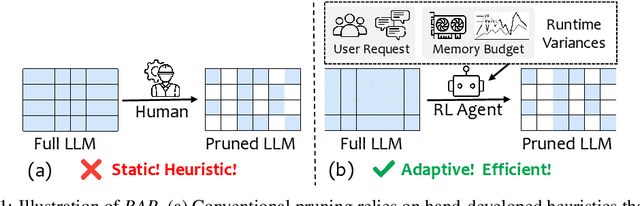
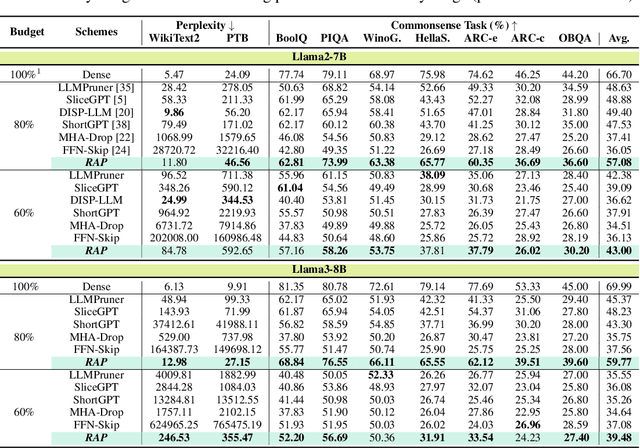
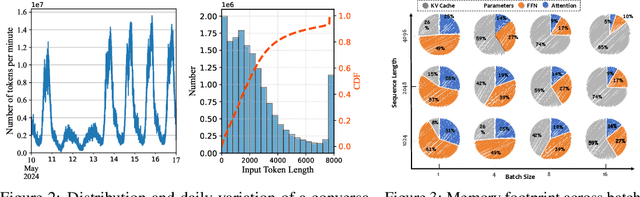
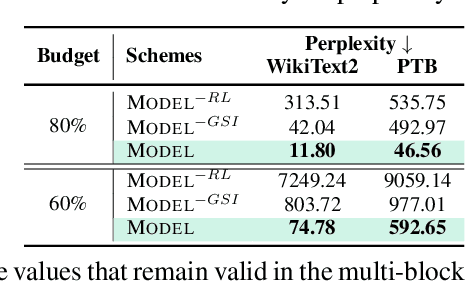
Large language models (LLMs) excel at language understanding and generation, but their enormous computational and memory requirements hinder deployment. Compression offers a potential solution to mitigate these constraints. However, most existing methods rely on fixed heuristics and thus fail to adapt to runtime memory variations or heterogeneous KV-cache demands arising from diverse user requests. To address these limitations, we propose RAP, an elastic pruning framework driven by reinforcement learning (RL) that dynamically adjusts compression strategies in a runtime-aware manner. Specifically, RAP dynamically tracks the evolving ratio between model parameters and KV-cache across practical execution. Recognizing that FFNs house most parameters, whereas parameter -light attention layers dominate KV-cache formation, the RL agent retains only those components that maximize utility within the current memory budget, conditioned on instantaneous workload and device state. Extensive experiments results demonstrate that RAP outperforms state-of-the-art baselines, marking the first time to jointly consider model weights and KV-cache on the fly.