 Add to Chrome
 Add to Firefox
 Add to Edge
What Did They Mean? How LLMs Resolve Ambiguous Social Situations across Perspectives and Roles
Apr 27, 2026
People increasingly turn to large language models (LLMs) to interpret ambiguous social situations: a delayed text reply, an unusually cold supervisor, a teacher's mixed signals, or a boundary-crossing friend. Yet in many such cases, no stable interpretation can be verified from the available evidence alone. We study how LLMs respond to these situations across four domains: early-stage romantic relationships, teacher--student dynamics, workplace hierarchies, and ambiguous friendships. Across 72 responses from GPT, Claude, and Gemini, only 9 (12.5\%) genuinely preserved uncertainty. The remaining 87.5% produced interpretive closure through recurring pathways including narrative alignment, narrative reversal, normative advice under uncertainty, and hedged language that still supported a single conclusion. We further find that narrator perspective shapes the path to closure: first-person accounts more often elicited alignment, while third-person accounts invited more detached interpretation, even when the underlying situation remained comparable. Together, these findings show that LLMs do not simply assist interpersonal sensemaking; they tend to resolve ambiguity into coherent and actionable narratives. These results suggest that the central risk is not only that LLMs may misinterpret social situations, but that they may make unresolved situations feel prematurely settled. We frame this tendency as a design challenge for uncertainty-preserving social AI.

From Pixels to Nucleotides: End-to-End Token-Based Video Compression for DNA Storage
Apr 15, 2026DNA-based storage has emerged as a promising approach to the global data crisis, offering molecular-scale density and millennial-scale stability at low maintenance cost. Over the past decade, substantial progress has been made in storing text, images, and files in DNA -- yet video remains an open challenge. The difficulty is not merely technical: effective video DNA storage requires co-designing compression and molecular encoding from the ground up, a challenge that sits at the intersection of two fields that have largely evolved independently. In this work, we present HELIX, the first end-to-end neural network jointly optimizing video compression and DNA encoding -- prior approaches treat the two stages independently, leaving biochemical constraints and compression objectives fundamentally misaligned. Our key insight: token-based representations naturally align with DNA's quaternary alphabet -- discrete semantic units map directly to ATCG bases. We introduce TK-SCONE (Token-Kronecker Structured Constraint-Optimized Neural Encoding), which achieves 1.91 bits per nucleotide through Kronecker-structured mixing that breaks spatial correlations and FSM-based mapping that guarantees biochemical constraints. Unlike two-stage approaches, HELIX learns token distributions simultaneously optimized for visual quality, prediction under masking, and DNA synthesis efficiency. This work demonstrates for the first time that learned compression and molecular storage converge naturally at token representations -- suggesting a new paradigm where neural video codecs are designed for biological substrates from the ground up.
OpenAI GPT-5 System Card
Dec 19, 2025This is the system card published alongside the OpenAI GPT-5 launch, August 2025. GPT-5 is a unified system with a smart and fast model that answers most questions, a deeper reasoning model for harder problems, and a real-time router that quickly decides which model to use based on conversation type, complexity, tool needs, and explicit intent (for example, if you say 'think hard about this' in the prompt). The router is continuously trained on real signals, including when users switch models, preference rates for responses, and measured correctness, improving over time. Once usage limits are reached, a mini version of each model handles remaining queries. This system card focuses primarily on gpt-5-thinking and gpt-5-main, while evaluations for other models are available in the appendix. The GPT-5 system not only outperforms previous models on benchmarks and answers questions more quickly, but -- more importantly -- is more useful for real-world queries. We've made significant advances in reducing hallucinations, improving instruction following, and minimizing sycophancy, and have leveled up GPT-5's performance in three of ChatGPT's most common uses: writing, coding, and health. All of the GPT-5 models additionally feature safe-completions, our latest approach to safety training to prevent disallowed content. Similarly to ChatGPT agent, we have decided to treat gpt-5-thinking as High capability in the Biological and Chemical domain under our Preparedness Framework, activating the associated safeguards. While we do not have definitive evidence that this model could meaningfully help a novice to create severe biological harm -- our defined threshold for High capability -- we have chosen to take a precautionary approach.
GPT-4o System Card
Oct 25, 2024GPT-4o is an autoregressive omni model that accepts as input any combination of text, audio, image, and video, and generates any combination of text, audio, and image outputs. It's trained end-to-end across text, vision, and audio, meaning all inputs and outputs are processed by the same neural network. GPT-4o can respond to audio inputs in as little as 232 milliseconds, with an average of 320 milliseconds, which is similar to human response time in conversation. It matches GPT-4 Turbo performance on text in English and code, with significant improvement on text in non-English languages, while also being much faster and 50\% cheaper in the API. GPT-4o is especially better at vision and audio understanding compared to existing models. In line with our commitment to building AI safely and consistent with our voluntary commitments to the White House, we are sharing the GPT-4o System Card, which includes our Preparedness Framework evaluations. In this System Card, we provide a detailed look at GPT-4o's capabilities, limitations, and safety evaluations across multiple categories, focusing on speech-to-speech while also evaluating text and image capabilities, and measures we've implemented to ensure the model is safe and aligned. We also include third-party assessments on dangerous capabilities, as well as discussion of potential societal impacts of GPT-4o's text and vision capabilities.
DIANES: A DEI Audit Toolkit for News Sources
Mar 21, 2022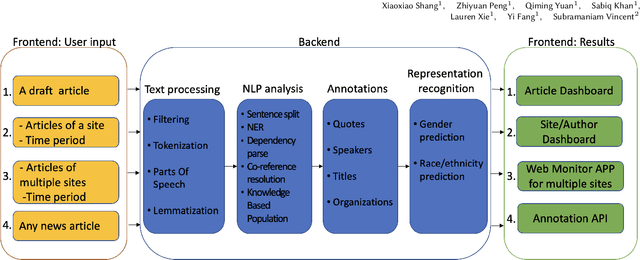
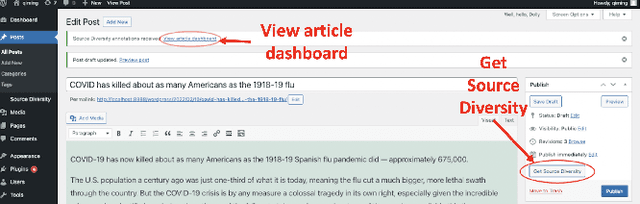
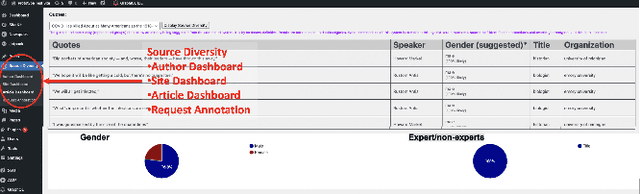
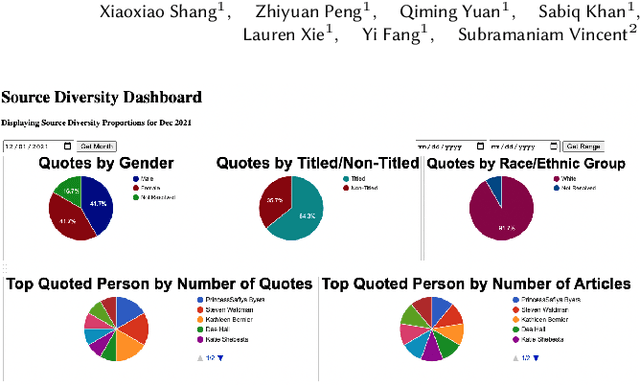
Professional news media organizations have always touted the importance that they give to multiple perspectives. However, in practice the traditional approach to all-sides has favored people in the dominant culture. Hence it has come under ethical critique under the new norms of diversity, equity, and inclusion (DEI). When DEI is applied to journalism, it goes beyond conventional notions of impartiality and bias and instead democratizes the journalistic practice of sourcing -- who is quoted or interviewed, who is not, how often, from which demographic group, gender, and so forth. There is currently no real-time or on-demand tool in the hands of reporters to analyze the persons they quote. In this paper, we present DIANES, a DEI Audit Toolkit for News Sources. It consists of a natural language processing pipeline on the backend to extract quotes, speakers, titles, and organizations from news articles in real time. On the frontend, DIANES offers the WordPress plugins, a Web monitor, and a DEI annotation API service, to help news media monitor their own quoting patterns and push themselves towards DEI norms.
Text and Code Embeddings by Contrastive Pre-Training
Jan 24, 2022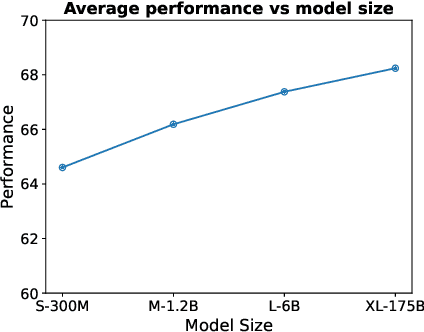
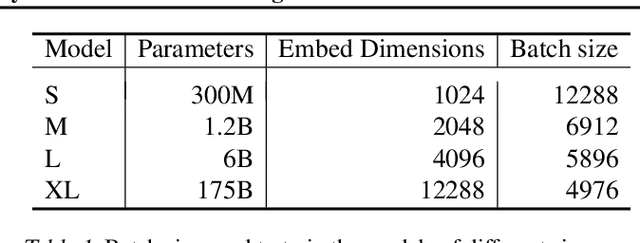
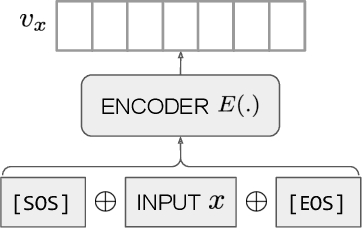
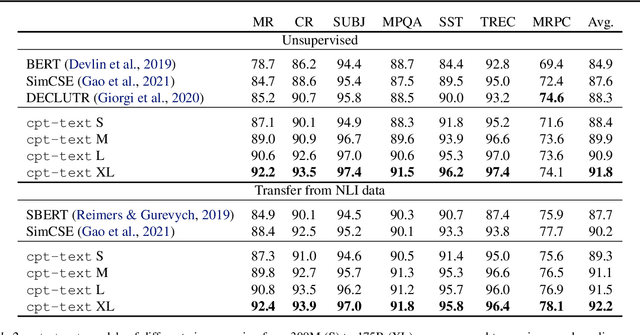
Text embeddings are useful features in many applications such as semantic search and computing text similarity. Previous work typically trains models customized for different use cases, varying in dataset choice, training objective and model architecture. In this work, we show that contrastive pre-training on unsupervised data at scale leads to high quality vector representations of text and code. The same unsupervised text embeddings that achieve new state-of-the-art results in linear-probe classification also display impressive semantic search capabilities and sometimes even perform competitively with fine-tuned models. On linear-probe classification accuracy averaging over 7 tasks, our best unsupervised model achieves a relative improvement of 4% and 1.8% over previous best unsupervised and supervised text embedding models respectively. The same text embeddings when evaluated on large-scale semantic search attains a relative improvement of 23.4%, 14.7%, and 10.6% over previous best unsupervised methods on MSMARCO, Natural Questions and TriviaQA benchmarks, respectively. Similarly to text embeddings, we train code embedding models on (text, code) pairs, obtaining a 20.8% relative improvement over prior best work on code search.
Evaluating Large Language Models Trained on Code
Jul 14, 2021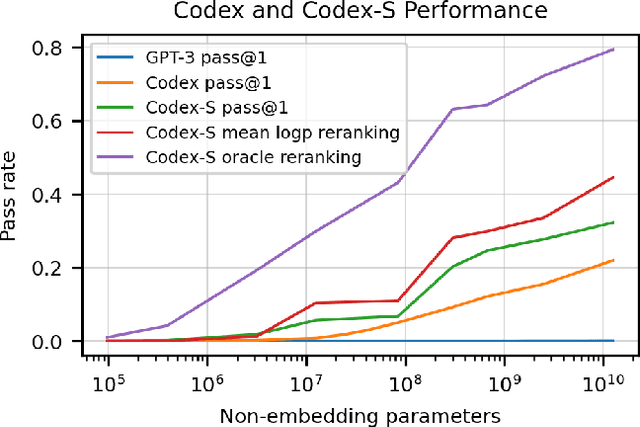
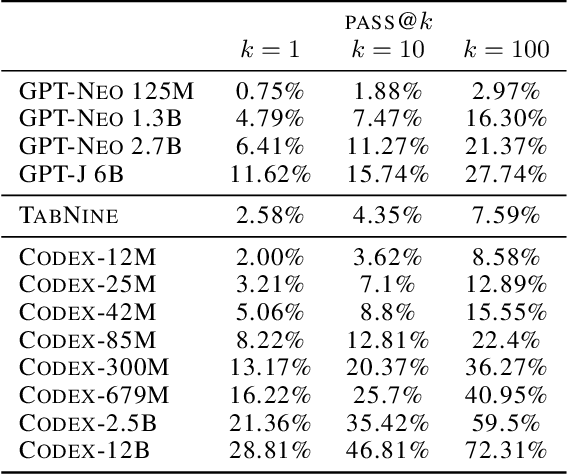
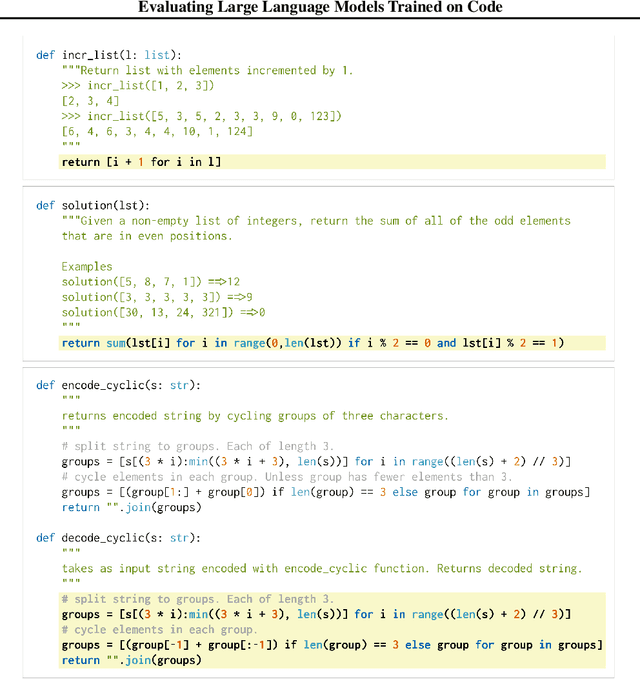
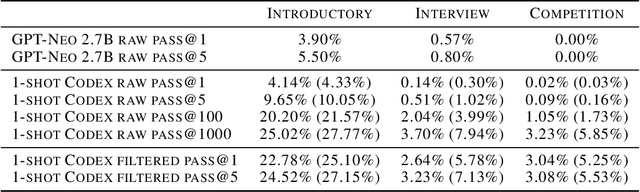
We introduce Codex, a GPT language model fine-tuned on publicly available code from GitHub, and study its Python code-writing capabilities. A distinct production version of Codex powers GitHub Copilot. On HumanEval, a new evaluation set we release to measure functional correctness for synthesizing programs from docstrings, our model solves 28.8% of the problems, while GPT-3 solves 0% and GPT-J solves 11.4%. Furthermore, we find that repeated sampling from the model is a surprisingly effective strategy for producing working solutions to difficult prompts. Using this method, we solve 70.2% of our problems with 100 samples per problem. Careful investigation of our model reveals its limitations, including difficulty with docstrings describing long chains of operations and with binding operations to variables. Finally, we discuss the potential broader impacts of deploying powerful code generation technologies, covering safety, security, and economics.
Asymmetric self-play for automatic goal discovery in robotic manipulation
Jan 13, 2021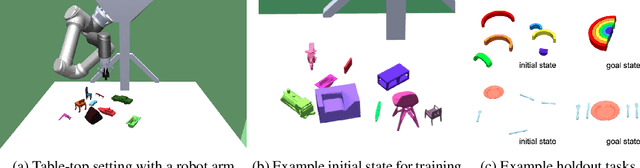
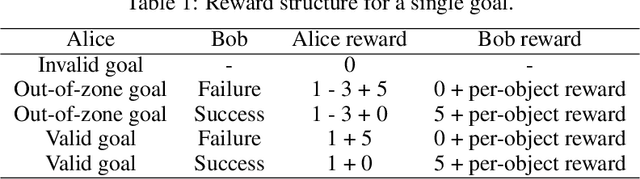
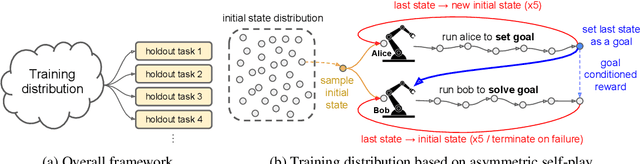
We train a single, goal-conditioned policy that can solve many robotic manipulation tasks, including tasks with previously unseen goals and objects. We rely on asymmetric self-play for goal discovery, where two agents, Alice and Bob, play a game. Alice is asked to propose challenging goals and Bob aims to solve them. We show that this method can discover highly diverse and complex goals without any human priors. Bob can be trained with only sparse rewards, because the interaction between Alice and Bob results in a natural curriculum and Bob can learn from Alice's trajectory when relabeled as a goal-conditioned demonstration. Finally, our method scales, resulting in a single policy that can generalize to many unseen tasks such as setting a table, stacking blocks, and solving simple puzzles. Videos of a learned policy is available at https://robotics-self-play.github.io.
Solving Rubik's Cube with a Robot Hand
Oct 16, 2019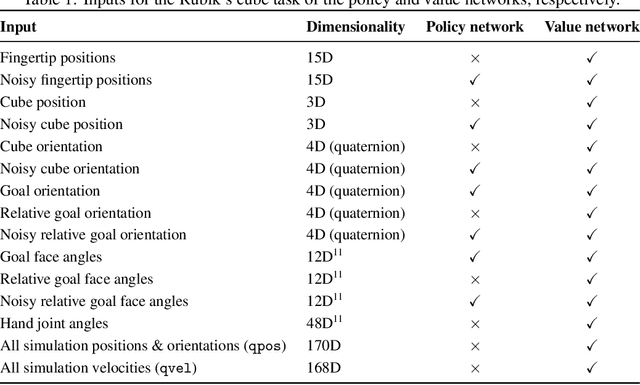
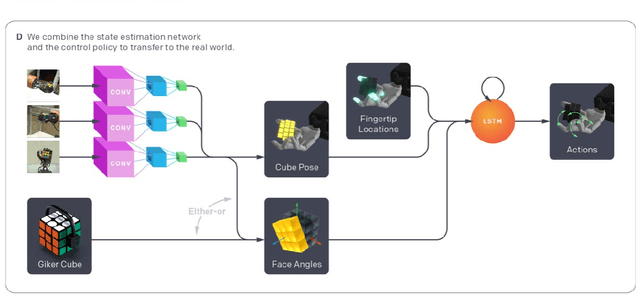
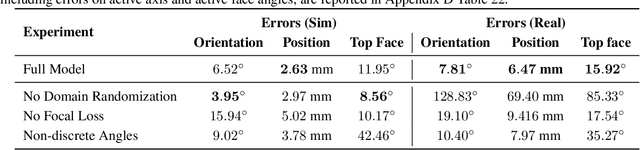
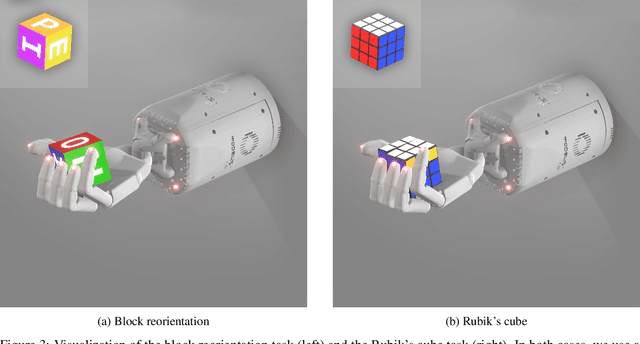
We demonstrate that models trained only in simulation can be used to solve a manipulation problem of unprecedented complexity on a real robot. This is made possible by two key components: a novel algorithm, which we call automatic domain randomization (ADR) and a robot platform built for machine learning. ADR automatically generates a distribution over randomized environments of ever-increasing difficulty. Control policies and vision state estimators trained with ADR exhibit vastly improved sim2real transfer. For control policies, memory-augmented models trained on an ADR-generated distribution of environments show clear signs of emergent meta-learning at test time. The combination of ADR with our custom robot platform allows us to solve a Rubik's cube with a humanoid robot hand, which involves both control and state estimation problems. Videos summarizing our results are available: https://openai.com/blog/solving-rubiks-cube/