 Add to Chrome
 Add to Firefox
 Add to Edge
Ideas Have Genomes: Benchmarking Scientific Lineage Reasoning and Lineage-Grounded Idea Generation
Jul 09, 2026
Scientific ideas rarely start from a blank page. They inherit mechanisms, repair known limitations, and recombine pieces of earlier work, much like biological genomes. Current benchmarks still say little about whether AI systems can follow this inheritance structure. We present IdeaGene-Bench (IG-Bench), a benchmark for scientific lineage reasoning and lineage-grounded idea generation. IG-Bench is organized around the IdeaGene framework: each paper or proposal is represented as a set of minimal, typed, evidence-grounded Idea Genome objects, and a GenomeDiff aligns these objects to record inheritance, mutation, loss, external import, and novel insertion under six operational evolutionary dynamics. The benchmark contains 1,961 golden lineage traces, 1,085 curated Idea Genome objects, and 920 pairwise GenomeDiff records across 10 scientific domains. It supports two evaluations. IG-Exam (42 task types, 1,029 instances) tests closed-form lineage reasoning across Idea Genome abstraction, inheritance tracing, evolutionary reasoning, and lineage verification. IG-Arena evaluates generation with a lineage-conditioned Population-Evolution Score(PES), asking whether a proposal can be inserted as a coherent descendant of a given lineage population: it should inherit the right Idea Genome objects, vary meaningfully from nearby work, and offer selection value for future research. Experiments on 14 LLM-based scientists expose a compositional bottleneck. The strongest system reaches only 27.3% exact accuracy on lineage reasoning, and structured lineage context reshuffles system rankings rather than helping every participant uniformly.

PhyGround: Benchmarking Physical Reasoning in Generative World Models
May 11, 2026Generative world models are increasingly used for video generation, where learned simulators are expected to capture the physical rules that govern real-world dynamics. However, evaluating whether generated videos actually follow these rules remains challenging. Existing physics-focused video benchmarks have made important progress, but they still face three key challenges, including the coarse evaluation frameworks that hide law-specific failures, response biases and fatigue that undermine the validity of annotation judgments, and automated evaluators that are insufficiently physics-aware or difficult to audit. To address those challenges, we introduce PhyGround, a criteria-grounded benchmark for evaluating physical reasoning in video generation. The benchmark contains 250 curated prompts, each augmented with an expected physical outcome, and a taxonomy of 13 physical laws across solid-body mechanics, fluid dynamics, and optics. Each law is operationalized through observable sub-questions to enable per-law diagnostics. We evaluate eight modern video generation models through a large-scale, quality-controlled human study, grounded on social science lab experiment design. A total of 459 annotators provided 5,796 complete annotations and over 37.4K fine-grained labels; after quality control, the retained annotations exhibited high split-half model-ranking correlations (Spearman's rho > 0.90). To support reproducible automated evaluation, we release PhyJudge-9B, an open physics-specialized VLM judge. PhyJudge-9B achieves substantially lower aggregate relative bias than Gemini-3.1-Pro (3.3% vs. 16.6%). We release prompts, human annotations, model checkpoints, and evaluation code on the project page https://phyground.github.io/.
Demystifing Video Reasoning
Mar 17, 2026Recent advances in video generation have revealed an unexpected phenomenon: diffusion-based video models exhibit non-trivial reasoning capabilities. Prior work attributes this to a Chain-of-Frames (CoF) mechanism, where reasoning is assumed to unfold sequentially across video frames. In this work, we challenge this assumption and uncover a fundamentally different mechanism. We show that reasoning in video models instead primarily emerges along the diffusion denoising steps. Through qualitative analysis and targeted probing experiments, we find that models explore multiple candidate solutions in early denoising steps and progressively converge to a final answer, a process we term Chain-of-Steps (CoS). Beyond this core mechanism, we identify several emergent reasoning behaviors critical to model performance: (1) working memory, enabling persistent reference; (2) self-correction and enhancement, allowing recovery from incorrect intermediate solutions; and (3) perception before action, where early steps establish semantic grounding and later steps perform structured manipulation. During a diffusion step, we further uncover self-evolved functional specialization within Diffusion Transformers, where early layers encode dense perceptual structure, middle layers execute reasoning, and later layers consolidate latent representations. Motivated by these insights, we present a simple training-free strategy as a proof-of-concept, demonstrating how reasoning can be improved by ensembling latent trajectories from identical models with different random seeds. Overall, our work provides a systematic understanding of how reasoning emerges in video generation models, offering a foundation to guide future research in better exploiting the inherent reasoning dynamics of video models as a new substrate for intelligence.
A Very Big Video Reasoning Suite
Feb 24, 2026Rapid progress in video models has largely focused on visual quality, leaving their reasoning capabilities underexplored. Video reasoning grounds intelligence in spatiotemporally consistent visual environments that go beyond what text can naturally capture, enabling intuitive reasoning over spatiotemporal structure such as continuity, interaction, and causality. However, systematically studying video reasoning and its scaling behavior is hindered by the lack of large-scale training data. To address this gap, we introduce the Very Big Video Reasoning (VBVR) Dataset, an unprecedentedly large-scale resource spanning 200 curated reasoning tasks following a principled taxonomy and over one million video clips, approximately three orders of magnitude larger than existing datasets. We further present VBVR-Bench, a verifiable evaluation framework that moves beyond model-based judging by incorporating rule-based, human-aligned scorers, enabling reproducible and interpretable diagnosis of video reasoning capabilities. Leveraging the VBVR suite, we conduct one of the first large-scale scaling studies of video reasoning and observe early signs of emergent generalization to unseen reasoning tasks. Together, VBVR lays a foundation for the next stage of research in generalizable video reasoning. The data, benchmark toolkit, and models are publicly available at https://video-reason.com/ .
Can Vision Language Models Infer Human Gaze Direction? A Controlled Study
Jun 04, 2025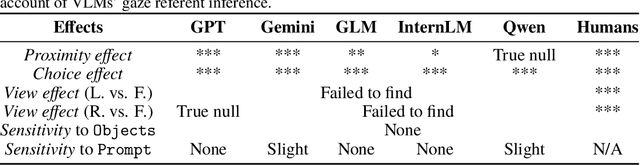
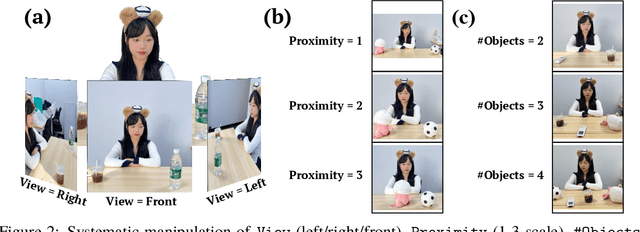
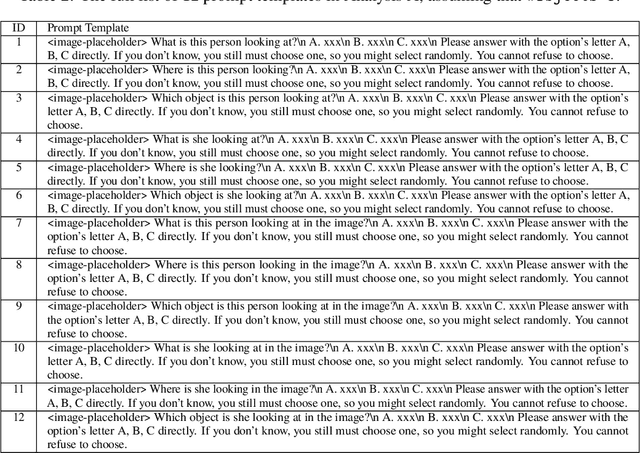

Gaze-referential inference--the ability to infer what others are looking at--is a critical component of a theory of mind that underpins natural human-AI interaction. In a controlled study, we evaluated this skill across 111 Vision Language Models (VLMs) using photos taken with manipulated difficulty and variability, comparing performance with that of human participants (N = 65), and analyzed behaviors using mixed-effects models. We found that 94 of the 111 VLMs failed to do better than random guessing, while humans achieved near-ceiling accuracy. VLMs even respond with each choice almost equally frequently. Are they randomly guessing? Although most VLMs struggle, when we zoom in on five of the top-tier VLMs with above-chance performance, we find that their performance declined with increasing task difficulty but varied only slightly across different prompts and scene objects. These behavioral features cannot be explained by considering them as random guessers. Instead, they likely use a combination of heuristics and guessing such that their performance is subject to the task difficulty but robust to perceptual variations. This suggests that VLMs, lacking gaze inference capability, have yet to become technologies that can naturally interact with humans, but the potential remains.
Machine Psychophysics: Cognitive Control in Vision-Language Models
May 25, 2025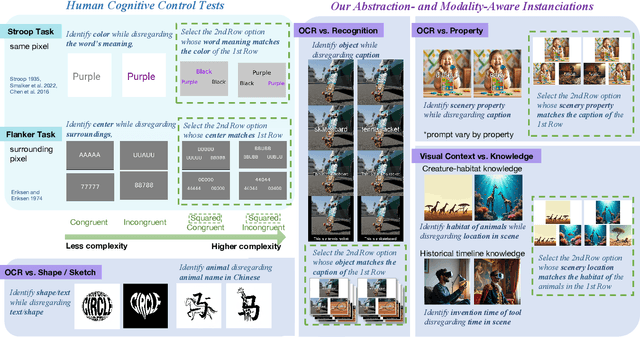
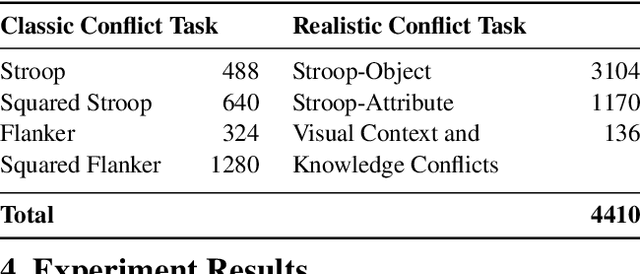
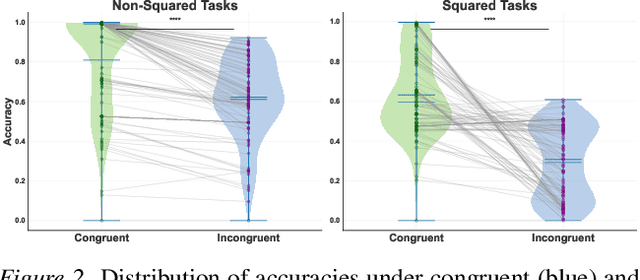
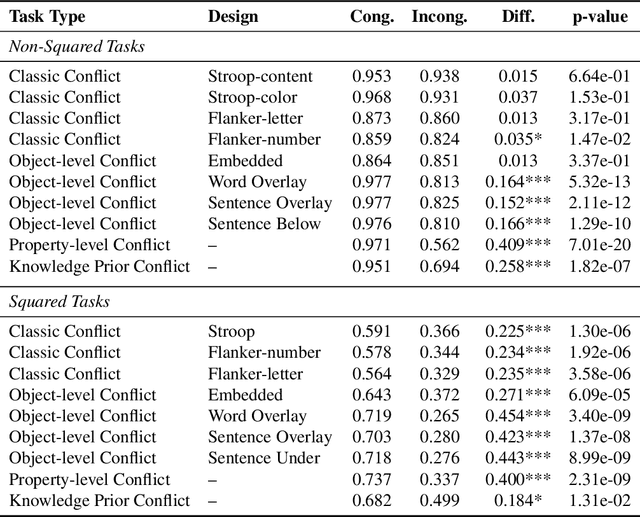
Cognitive control refers to the ability to flexibly coordinate thought and action in pursuit of internal goals. A standard method for assessing cognitive control involves conflict tasks that contrast congruent and incongruent trials, measuring the ability to prioritize relevant information while suppressing interference. We evaluate 108 vision-language models on three classic conflict tasks and their more demanding "squared" variants across 2,220 trials. Model performance corresponds closely to human behavior under resource constraints and reveals individual differences. These results indicate that some form of human-like executive function have emerged in current multi-modal foundational models.
Proceedings of 1st Workshop on Advancing Artificial Intelligence through Theory of Mind
Apr 28, 2025
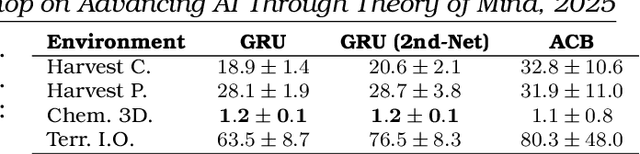
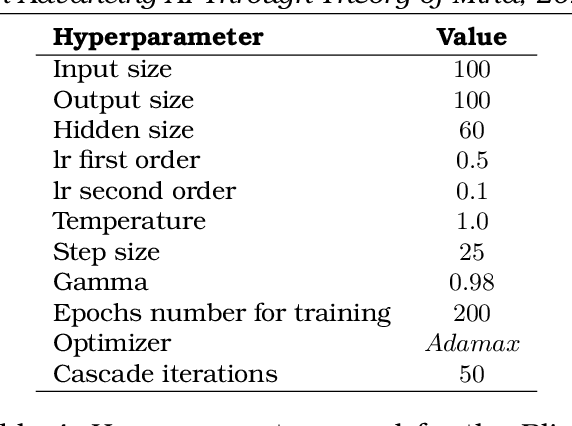
This volume includes a selection of papers presented at the Workshop on Advancing Artificial Intelligence through Theory of Mind held at AAAI 2025 in Philadelphia US on 3rd March 2025. The purpose of this volume is to provide an open access and curated anthology for the ToM and AI research community.
CogDevelop2K: Reversed Cognitive Development in Multimodal Large Language Models
Oct 06, 2024
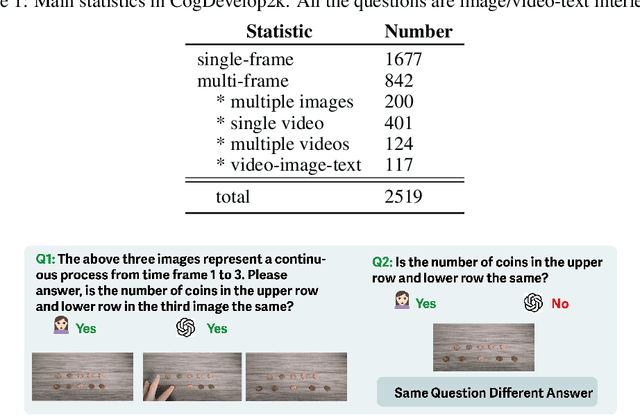


Are Multi-modal Large Language Models (MLLMs) stochastic parrots? Do they genuinely understand and are capable of performing the tasks they excel at? This paper aims to explore the fundamental basis of MLLMs, i.e. core cognitive abilities that human intelligence builds upon to perceive, comprehend, and reason. To this end, we propose CogDevelop2K, a comprehensive benchmark that spans 12 sub-concepts from fundamental knowledge like object permanence and boundary to advanced reasoning like intentionality understanding, structured via the developmental trajectory of a human mind. We evaluate 46 MLLMs on our benchmarks. Comprehensively, we further evaluate the influence of evaluation strategies and prompting techniques. Surprisingly, we observe a reversed cognitive developmental trajectory compared to humans.