 Add to Chrome
 Add to Firefox
 Add to Edge
Large Language Model Post-Training: A Unified View of Off-Policy and On-Policy Learning
Apr 09, 2026
Post-training has become central to turning pretrained large language models (LLMs) into aligned and deployable systems. Recent progress spans supervised fine-tuning (SFT), preference optimization, reinforcement learning (RL), process supervision, verifier-guided methods, distillation, and multi-stage pipelines. Yet these methods are often discussed in fragmented ways, organized by labels or objective families rather than by the behavioral bottlenecks they address. This survey argues that LLM post-training is best understood as structured intervention on model behavior. We organize the field first by trajectory provenance, which defines two primary learning regimes: off-policy learning on externally supplied trajectories, and on-policy learning on learner-generated rollouts. We then interpret methods through two recurring roles -- effective support expansion, which makes useful behaviors more reachable, and policy reshaping, which improves behavior within already reachable regions -- together with a complementary systems-level role, behavioral consolidation, which preserves, transfers, and amortizes behavior across stages and model transitions. This perspective yields a unified reading of major paradigms. SFT may serve either support expansion or policy reshaping, whereas preference-based methods are usually off-policy reshaping. On-policy RL often improves behavior on learner-generated states, though under stronger guidance it can also make hard-to-reach reasoning paths reachable. Distillation is often best understood as consolidation rather than only compression, and hybrid pipelines emerge as coordinated multi-stage compositions. Overall, the framework helps diagnose post-training bottlenecks and reason about stage composition, suggesting that progress in LLM post-training increasingly depends on coordinated system design rather than any single dominant objective.

OmniOVCD: Streamlining Open-Vocabulary Change Detection with SAM 3
Jan 20, 2026Change Detection (CD) is a fundamental task in remote sensing. It monitors the evolution of land cover over time. Based on this, Open-Vocabulary Change Detection (OVCD) introduces a new requirement. It aims to reduce the reliance on predefined categories. Existing training-free OVCD methods mostly use CLIP to identify categories. These methods also need extra models like DINO to extract features. However, combining different models often causes problems in matching features and makes the system unstable. Recently, the Segment Anything Model 3 (SAM 3) is introduced. It integrates segmentation and identification capabilities within one promptable model, which offers new possibilities for the OVCD task. In this paper, we propose OmniOVCD, a standalone framework designed for OVCD. By leveraging the decoupled output heads of SAM 3, we propose a Synergistic Fusion to Instance Decoupling (SFID) strategy. SFID first fuses the semantic, instance, and presence outputs of SAM 3 to construct land-cover masks, and then decomposes them into individual instance masks for change comparison. This design preserves high accuracy in category recognition and maintains instance-level consistency across images. As a result, the model can generate accurate change masks. Experiments on four public benchmarks (LEVIR-CD, WHU-CD, S2Looking, and SECOND) demonstrate SOTA performance, achieving IoU scores of 67.2, 66.5, 24.5, and 27.1 (class-average), respectively, surpassing all previous methods.
PPGF: Probability Pattern-Guided Time Series Forecasting
Feb 18, 2025Time series forecasting (TSF) is an essential branch of machine learning with various applications. Most methods for TSF focus on constructing different networks to extract better information and improve performance. However, practical application data contain different internal mechanisms, resulting in a mixture of multiple patterns. That is, the model's ability to fit different patterns is different and generates different errors. In order to solve this problem, we propose an end-to-end framework, namely probability pattern-guided time series forecasting (PPGF). PPGF reformulates the TSF problem as a forecasting task guided by probabilistic pattern classification. Firstly, we propose the grouping strategy to approach forecasting problems as classification and alleviate the impact of data imbalance on classification. Secondly, we predict in the corresponding class interval to guarantee the consistency of classification and forecasting. In addition, True Class Probability (TCP) is introduced to pay more attention to the difficult samples to improve the classification accuracy. Detailedly, PPGF classifies the different patterns to determine which one the target value may belong to and estimates it accurately in the corresponding interval. To demonstrate the effectiveness of the proposed framework, we conduct extensive experiments on real-world datasets, and PPGF achieves significant performance improvements over several baseline methods. Furthermore, the effectiveness of TCP and the necessity of consistency between classification and forecasting are proved in the experiments. All data and codes are available online: https://github.com/syrGitHub/PPGF.
Anomaly Detection of UAV State Data Based on Single-class Triangular Global Alignment Kernel Extreme Learning Machine
Feb 18, 2023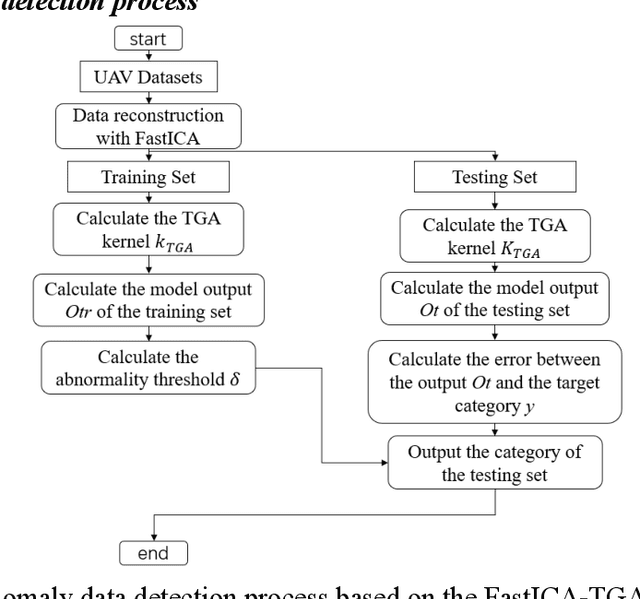
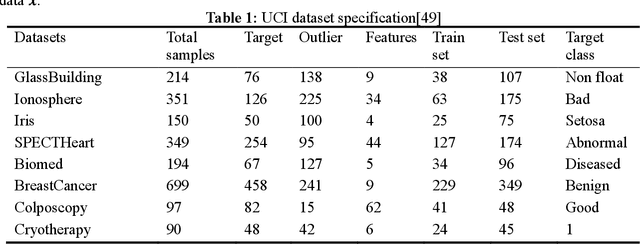
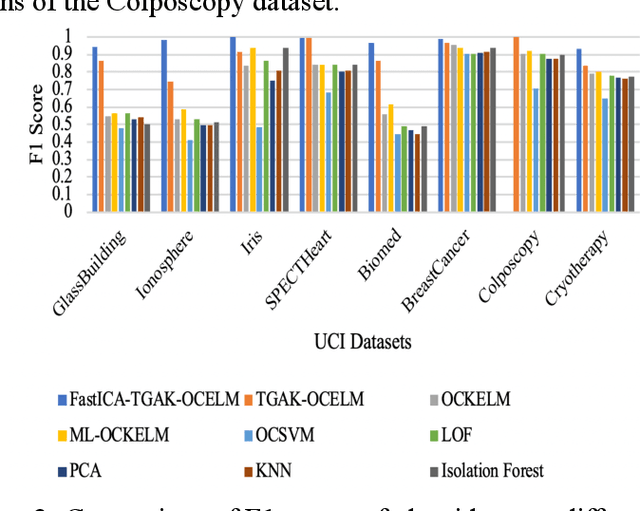
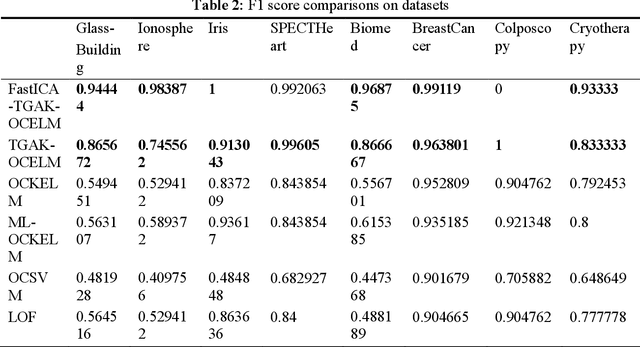
Unmanned Aerial Vehicles (UAVs) are widely used and meet many demands in military and civilian fields. With the continuous enrichment and extensive expansion of application scenarios, the safety of UAVs is constantly being challenged. To address this challenge, we propose algorithms to detect anomalous data collected from drones to improve drone safety. We deployed a one-class kernel extreme learning machine (OCKELM) to detect anomalies in drone data. By default, OCKELM uses the radial basis (RBF) kernel function as the kernel function of the model. To improve the performance of OCKELM, we choose a Triangular Global Alignment Kernel (TGAK) instead of an RBF Kernel and introduce the Fast Independent Component Analysis (FastICA) algorithm to reconstruct UAV data. Based on the above improvements, we create a novel anomaly detection strategy FastICA-TGAK-OCELM. The method is finally validated on the UCI dataset and detected on the Aeronautical Laboratory Failures and Anomalies (ALFA) dataset. The experimental results show that compared with other methods, the accuracy of this method is improved by more than 30%, and point anomalies are effectively detected.