 Add to Chrome
 Add to Firefox
 Add to Edge
Is More Privileged Information Better? From Solution Traces to Problem-Solving Structure in Self-Distilled Reasoning
Aug 03, 2026
On-policy self-distillation (OPSD) improves reasoning by using a privileged view of a model conditioned on reference solutions to supervise a student view that observes only the question. However, the teacher-provided token-level targets may depend on reference-specific information unavailable at inference time. We propose Problem-Space-Guided OPSD (PS-OPSD), which replaces the complete solution with trajectory-grounded guidance describing the initial state, goal conditions, constraints, and a selected state-transition path. The student rollout and OPSD objective remain unchanged. Across three mathematical reasoning benchmarks and model scales ranging from 1.7B to 8B, PS-OPSD achieves the highest aggregate question-only accuracy among the compared methods. Controlled experiments further indicate that guidance relevance and path coherence contribute to these gains, highlighting the representation of privileged information as an important design choice in OPSD.

Latent Thought Credit: Multi-Answer Credit Assignment for Latent Reasoning
Aug 03, 2026Latent reasoning allows language models to carry out intermediate reasoning in continuous latent representations rather than fully externalizing it as discrete chains of thought. However, assigning credit to such latent thoughts from answer-only rewards is difficult: a single final answer mixes thought quality with answer-sampling noise. We propose \textbf{Latent Thought Credit (LTC)}, a hierarchical credit-assignment framework for latent reasoning. For each prompt, LTC samples multiple latent thoughts, fixes the context after each thought, and estimates thought-level expected reward by averaging rewards over multiple answers generated from that fixed context. LTC uses thought-level advantages to optimize the latent-thought phase, answer-level advantages to optimize the answer phase, and an advantage-weighted thought-matching objective that helps the policy reproduce high-credit latent thoughts. We instantiate LTC in a GRPO-style on-policy training framework and evaluate it across mathematical reasoning and STEM multiple-choice tasks. LTC achieves the best average accuracy among the compared methods, while ablations and fixed-context diagnostics show that multi-answer estimation reduces reward-estimation error and mitigates ambiguous or incorrect thought-level credit.
TARPO: Token-Wise Latent-Explicit Reasoning via Action-Routing Policy Optimization
Jun 04, 2026Latent reasoning has emerged as a promising alternative to discrete Chain-of-Thought (CoT) in large language models (LLMs), enabling more expressive reasoning by operating over continuous representations. However, the inherently deterministic nature of continuous representations limits policy exploration in reinforcement learning (RL). To address this, we propose TARPO (Token-Wise Latent-Explicit Reasoning via Action-Routing Policy Optimization), a pure RL framework that adaptively switches between discrete token generation and continuous latent reasoning at each step. TARPO introduces a lightweight action head router that observes the current hidden state and samples a routing decision from a binary mode-selection space, preserving the stochasticity of discrete token sampling from the vocabulary. The LLM backbone and router are jointly optimized end-to-end with a shared group-relative advantage signal. Extensive experiments across Qwen2.5 (from 1.5B to 7B) and Llama-3.1-8B backbones demonstrate that TARPO consistently outperforms existing explicit and latent reasoning RL baselines across diverse benchmarks. Further analysis shows that TARPO learns adaptive token-wise switching behaviors while maintaining stable training dynamics. Our code is available at https://github.com/NKU-LITI/TARPO-master.
Large Language Model Post-Training: A Unified View of Off-Policy and On-Policy Learning
Apr 09, 2026Post-training has become central to turning pretrained large language models (LLMs) into aligned and deployable systems. Recent progress spans supervised fine-tuning (SFT), preference optimization, reinforcement learning (RL), process supervision, verifier-guided methods, distillation, and multi-stage pipelines. Yet these methods are often discussed in fragmented ways, organized by labels or objective families rather than by the behavioral bottlenecks they address. This survey argues that LLM post-training is best understood as structured intervention on model behavior. We organize the field first by trajectory provenance, which defines two primary learning regimes: off-policy learning on externally supplied trajectories, and on-policy learning on learner-generated rollouts. We then interpret methods through two recurring roles -- effective support expansion, which makes useful behaviors more reachable, and policy reshaping, which improves behavior within already reachable regions -- together with a complementary systems-level role, behavioral consolidation, which preserves, transfers, and amortizes behavior across stages and model transitions. This perspective yields a unified reading of major paradigms. SFT may serve either support expansion or policy reshaping, whereas preference-based methods are usually off-policy reshaping. On-policy RL often improves behavior on learner-generated states, though under stronger guidance it can also make hard-to-reach reasoning paths reachable. Distillation is often best understood as consolidation rather than only compression, and hybrid pipelines emerge as coordinated multi-stage compositions. Overall, the framework helps diagnose post-training bottlenecks and reason about stage composition, suggesting that progress in LLM post-training increasingly depends on coordinated system design rather than any single dominant objective.
Deep learning radiomics for assessment of gastroesophageal varices in people with compensated advanced chronic liver disease
Jun 13, 2023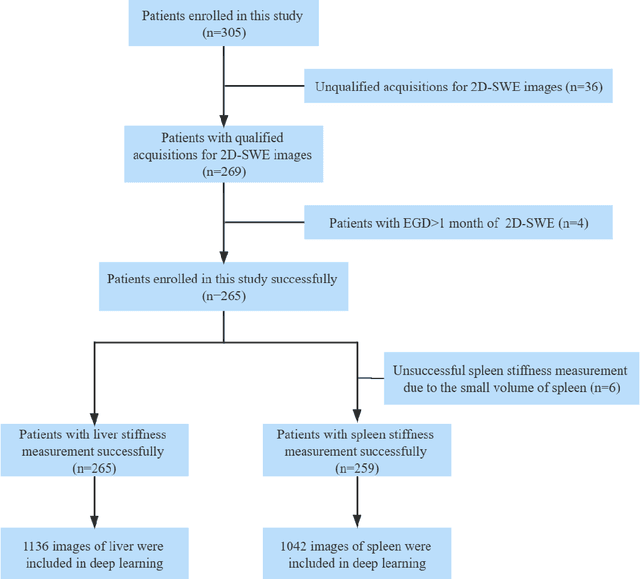
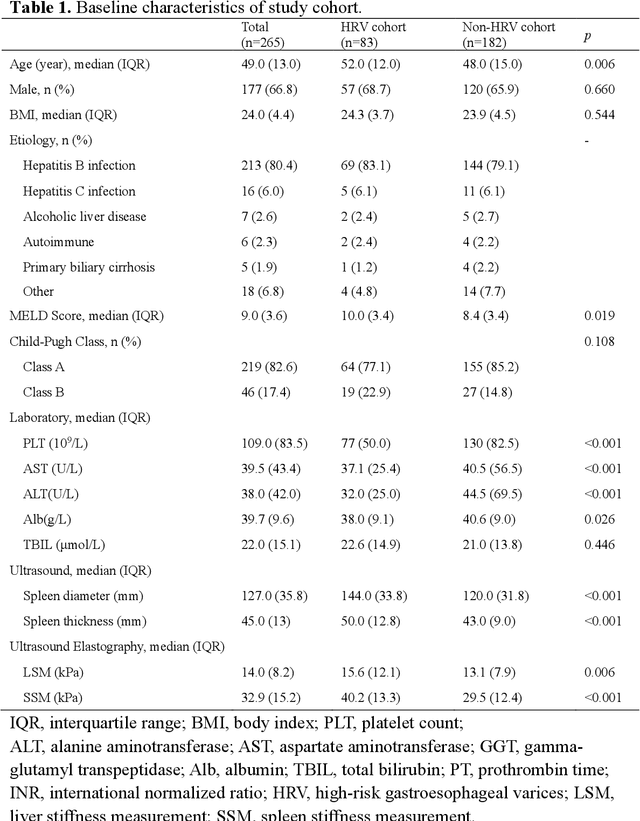
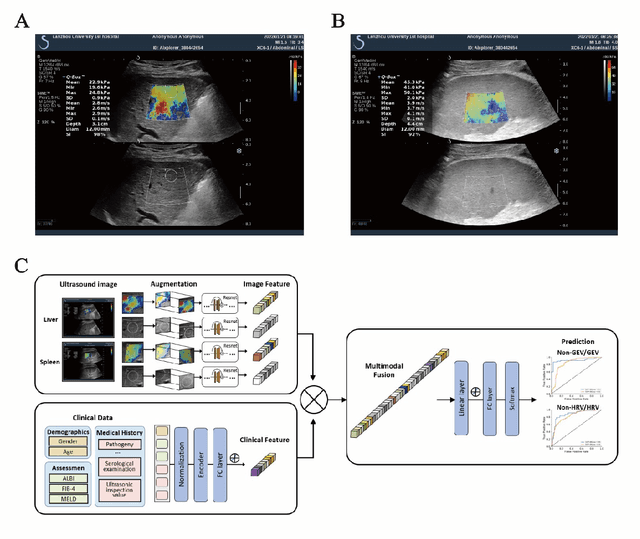
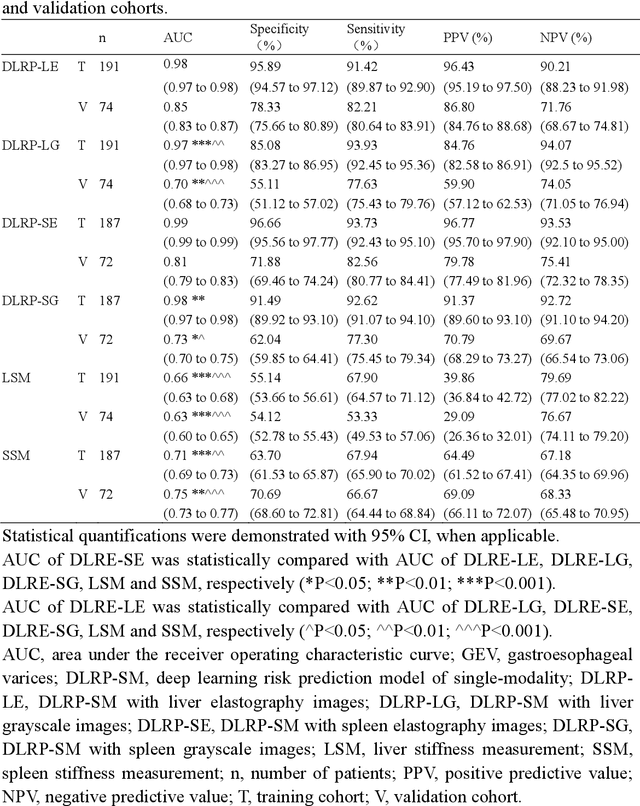
Objective: Bleeding from gastroesophageal varices (GEV) is a medical emergency associated with high mortality. We aim to construct an artificial intelligence-based model of two-dimensional shear wave elastography (2D-SWE) of the liver and spleen to precisely assess the risk of GEV and high-risk gastroesophageal varices (HRV). Design: A prospective multicenter study was conducted in patients with compensated advanced chronic liver disease. 305 patients were enrolled from 12 hospitals, and finally 265 patients were included, with 1136 liver stiffness measurement (LSM) images and 1042 spleen stiffness measurement (SSM) images generated by 2D-SWE. We leveraged deep learning methods to uncover associations between image features and patient risk, and thus conducted models to predict GEV and HRV. Results: A multi-modality Deep Learning Risk Prediction model (DLRP) was constructed to assess GEV and HRV, based on LSM and SSM images, and clinical information. Validation analysis revealed that the AUCs of DLRP were 0.91 for GEV (95% CI 0.90 to 0.93, p < 0.05) and 0.88 for HRV (95% CI 0.86 to 0.89, p < 0.01), which were significantly and robustly better than canonical risk indicators, including the value of LSM and SSM. Moreover, DLPR was better than the model using individual parameters, including LSM and SSM images. In HRV prediction, the 2D-SWE images of SSM outperform LSM (p < 0.01). Conclusion: DLRP shows excellent performance in predicting GEV and HRV over canonical risk indicators LSM and SSM. Additionally, the 2D-SWE images of SSM provided more information for better accuracy in predicting HRV than the LSM.