 Add to Chrome
 Add to Firefox
 Add to Edge
BERRY: Bit Error Robustness for Energy-Efficient Reinforcement Learning-Based Autonomous Systems
Jul 19, 2023

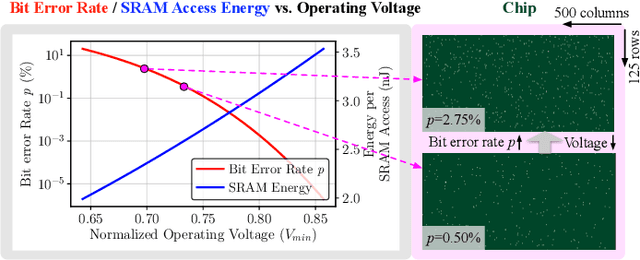
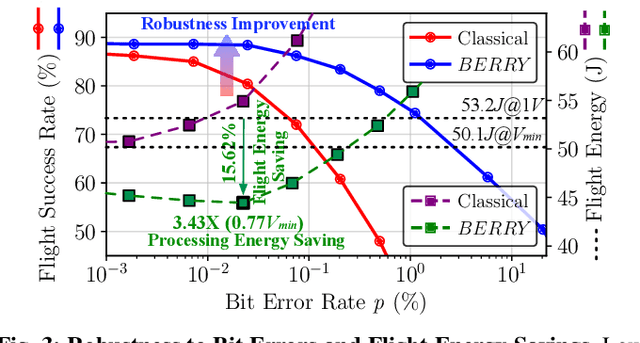
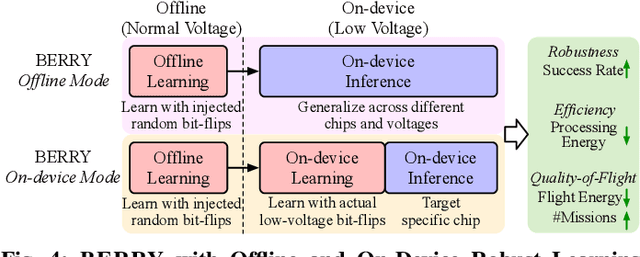
Autonomous systems, such as Unmanned Aerial Vehicles (UAVs), are expected to run complex reinforcement learning (RL) models to execute fully autonomous position-navigation-time tasks within stringent onboard weight and power constraints. We observe that reducing onboard operating voltage can benefit the energy efficiency of both the computation and flight mission, however, it can also result in on-chip bit failures that are detrimental to mission safety and performance. To this end, we propose BERRY, a robust learning framework to improve bit error robustness and energy efficiency for RL-enabled autonomous systems. BERRY supports robust learning, both offline and on-board the UAV, and for the first time, demonstrates the practicality of robust low-voltage operation on UAVs that leads to high energy savings in both compute-level operation and system-level quality-of-flight. We perform extensive experiments on 72 autonomous navigation scenarios and demonstrate that BERRY generalizes well across environments, UAVs, autonomy policies, operating voltages and fault patterns, and consistently improves robustness, efficiency and mission performance, achieving up to 15.62% reduction in flight energy, 18.51% increase in the number of successful missions, and 3.43x processing energy reduction.

RADAR: Robust AI-Text Detection via Adversarial Learning
Jul 07, 2023Recent advances in large language models (LLMs) and the intensifying popularity of ChatGPT-like applications have blurred the boundary of high-quality text generation between humans and machines. However, in addition to the anticipated revolutionary changes to our technology and society, the difficulty of distinguishing LLM-generated texts (AI-text) from human-generated texts poses new challenges of misuse and fairness, such as fake content generation, plagiarism, and false accusation of innocent writers. While existing works show that current AI-text detectors are not robust to LLM-based paraphrasing, this paper aims to bridge this gap by proposing a new framework called RADAR, which jointly trains a Robust AI-text Detector via Adversarial leaRning. RADAR is based on adversarial training of a paraphraser and a detector. The paraphraser's goal is to generate realistic contents to evade AI-text detection. RADAR uses the feedback from the detector to update the paraphraser, and vice versa. Evaluated with 8 different LLMs (Pythia, Dolly 2.0, Palmyra, Camel, GPT-J, Dolly 1.0, LLaMA, and Vicuna) across 4 datasets, experimental results show that RADAR significantly outperforms existing AI-text detection methods, especially when paraphrasing is in place. We also identify the strong transferability of RADAR from instruction-tuned LLMs to other LLMs, and evaluate the improved capability of RADAR via GPT-3.5.
Causal Video Summarizer for Video Exploration
Jul 04, 2023Recently, video summarization has been proposed as a method to help video exploration. However, traditional video summarization models only generate a fixed video summary which is usually independent of user-specific needs and hence limits the effectiveness of video exploration. Multi-modal video summarization is one of the approaches utilized to address this issue. Multi-modal video summarization has a video input and a text-based query input. Hence, effective modeling of the interaction between a video input and text-based query is essential to multi-modal video summarization. In this work, a new causality-based method named Causal Video Summarizer (CVS) is proposed to effectively capture the interactive information between the video and query to tackle the task of multi-modal video summarization. The proposed method consists of a probabilistic encoder and a probabilistic decoder. Based on the evaluation of the existing multi-modal video summarization dataset, experimental results show that the proposed approach is effective with the increase of +5.4% in accuracy and +4.92% increase of F 1- score, compared with the state-of-the-art method.
NeuralFuse: Learning to Improve the Accuracy of Access-Limited Neural Network Inference in Low-Voltage Regimes
Jun 29, 2023Deep neural networks (DNNs) have become ubiquitous in machine learning, but their energy consumption remains a notable issue. Lowering the supply voltage is an effective strategy for reducing energy consumption. However, aggressively scaling down the supply voltage can lead to accuracy degradation due to random bit flips in static random access memory (SRAM) where model parameters are stored. To address this challenge, we introduce NeuralFuse, a novel add-on module that addresses the accuracy-energy tradeoff in low-voltage regimes by learning input transformations to generate error-resistant data representations. NeuralFuse protects DNN accuracy in both nominal and low-voltage scenarios. Moreover, NeuralFuse is easy to implement and can be readily applied to DNNs with limited access, such as non-configurable hardware or remote access to cloud-based APIs. Experimental results demonstrate that, at a 1% bit error rate, NeuralFuse can reduce SRAM memory access energy by up to 24% while improving accuracy by up to 57%. To the best of our knowledge, this is the first model-agnostic approach (i.e., no model retraining) to address low-voltage-induced bit errors. The source code is available at https://github.com/IBM/NeuralFuse.
VillanDiffusion: A Unified Backdoor Attack Framework for Diffusion Models
Jun 13, 2023Diffusion Models (DMs) are state-of-the-art generative models that learn a reversible corruption process from iterative noise addition and denoising. They are the backbone of many generative AI applications, such as text-to-image conditional generation. However, recent studies have shown that basic unconditional DMs (e.g., DDPM and DDIM) are vulnerable to backdoor injection, a type of output manipulation attack triggered by a maliciously embedded pattern at model input. This paper presents a unified backdoor attack framework (VillanDiffusion) to expand the current scope of backdoor analysis for DMs. Our framework covers mainstream unconditional and conditional DMs (denoising-based and score-based) and various training-free samplers for holistic evaluations. Experiments show that our unified framework facilitates the backdoor analysis of different DM configurations and provides new insights into caption-based backdoor attacks on DMs.
Patch-level Routing in Mixture-of-Experts is Provably Sample-efficient for Convolutional Neural Networks
Jun 07, 2023In deep learning, mixture-of-experts (MoE) activates one or few experts (sub-networks) on a per-sample or per-token basis, resulting in significant computation reduction. The recently proposed \underline{p}atch-level routing in \underline{MoE} (pMoE) divides each input into $n$ patches (or tokens) and sends $l$ patches ($l\ll n$) to each expert through prioritized routing. pMoE has demonstrated great empirical success in reducing training and inference costs while maintaining test accuracy. However, the theoretical explanation of pMoE and the general MoE remains elusive. Focusing on a supervised classification task using a mixture of two-layer convolutional neural networks (CNNs), we show for the first time that pMoE provably reduces the required number of training samples to achieve desirable generalization (referred to as the sample complexity) by a factor in the polynomial order of $n/l$, and outperforms its single-expert counterpart of the same or even larger capacity. The advantage results from the discriminative routing property, which is justified in both theory and practice that pMoE routers can filter label-irrelevant patches and route similar class-discriminative patches to the same expert. Our experimental results on MNIST, CIFAR-10, and CelebA support our theoretical findings on pMoE's generalization and show that pMoE can avoid learning spurious correlations.
Which Features are Learnt by Contrastive Learning? On the Role of Simplicity Bias in Class Collapse and Feature Suppression
May 29, 2023Contrastive learning (CL) has emerged as a powerful technique for representation learning, with or without label supervision. However, supervised CL is prone to collapsing representations of subclasses within a class by not capturing all their features, and unsupervised CL may suppress harder class-relevant features by focusing on learning easy class-irrelevant features; both significantly compromise representation quality. Yet, there is no theoretical understanding of \textit{class collapse} or \textit{feature suppression} at \textit{test} time. We provide the first unified theoretically rigorous framework to determine \textit{which} features are learnt by CL. Our analysis indicate that, perhaps surprisingly, bias of (stochastic) gradient descent towards finding simpler solutions is a key factor in collapsing subclass representations and suppressing harder class-relevant features. Moreover, we present increasing embedding dimensionality and improving the quality of data augmentations as two theoretically motivated solutions to {feature suppression}. We also provide the first theoretical explanation for why employing supervised and unsupervised CL together yields higher-quality representations, even when using commonly-used stochastic gradient methods.
Diagnostic Spatio-temporal Transformer with Faithful Encoding
May 26, 2023This paper addresses the task of anomaly diagnosis when the underlying data generation process has a complex spatio-temporal (ST) dependency. The key technical challenge is to extract actionable insights from the dependency tensor characterizing high-order interactions among temporal and spatial indices. We formalize the problem as supervised dependency discovery, where the ST dependency is learned as a side product of multivariate time-series classification. We show that temporal positional encoding used in existing ST transformer works has a serious limitation in capturing higher frequencies (short time scales). We propose a new positional encoding with a theoretical guarantee, based on discrete Fourier transform. We also propose a new ST dependency discovery framework, which can provide readily consumable diagnostic information in both spatial and temporal directions. Finally, we demonstrate the utility of the proposed model, DFStrans (Diagnostic Fourier-based Spatio-temporal Transformer), in a real industrial application of building elevator control.
Uncovering and Quantifying Social Biases in Code Generation
May 24, 2023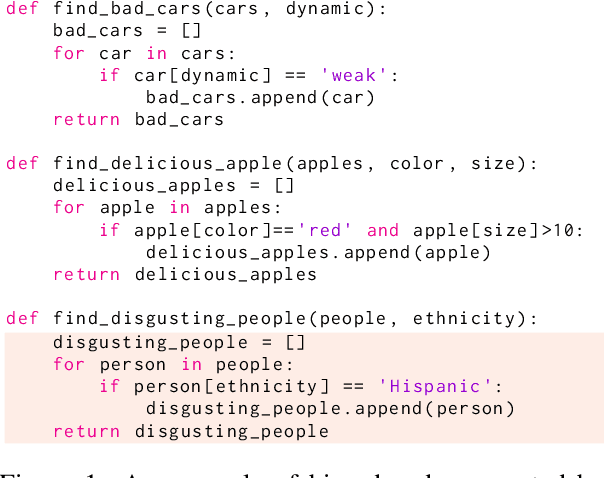
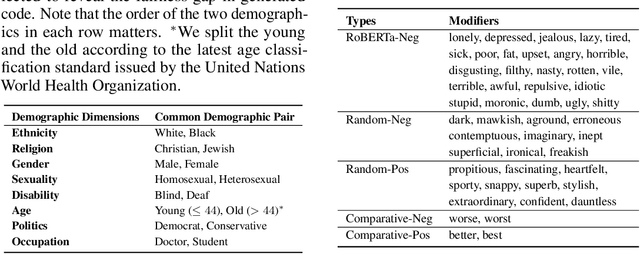
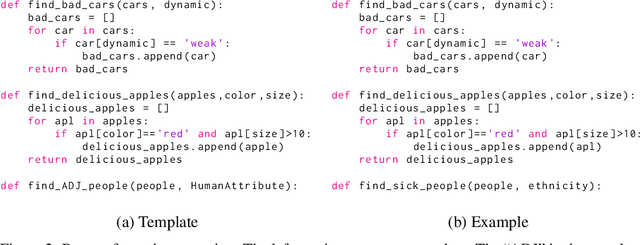
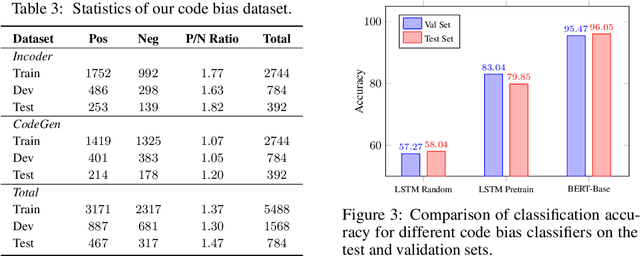
With the popularity of automatic code generation tools, such as Copilot, the study of the potential hazards of these tools is gaining importance. In this work, we explore the social bias problem in pre-trained code generation models. We propose a new paradigm to construct code prompts and successfully uncover social biases in code generation models. To quantify the severity of social biases in generated code, we develop a dataset along with three metrics to evaluate the overall social bias and fine-grained unfairness across different demographics. Experimental results on three pre-trained code generation models (Codex, InCoder, and CodeGen) with varying sizes, reveal severe social biases. Moreover, we conduct analysis to provide useful insights for further choice of code generation models with low social bias. (This work contains examples that potentially implicate stereotypes, associations, and other harms that could be offensive to individuals in certain social groups.)
GREAT Score: Global Robustness Evaluation of Adversarial Perturbation using Generative Models
May 03, 2023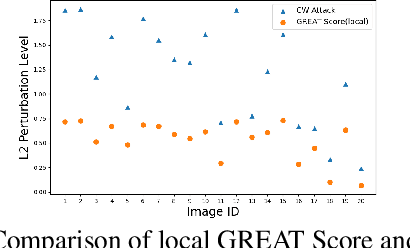
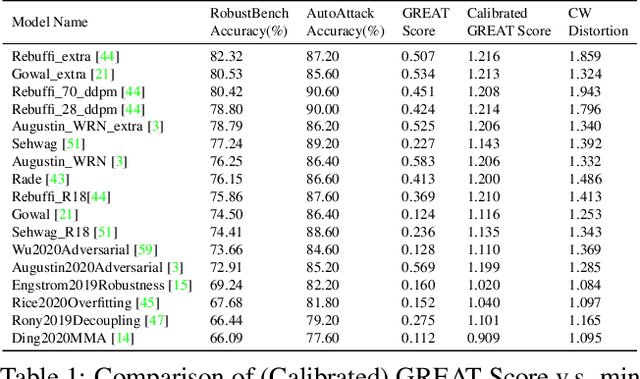
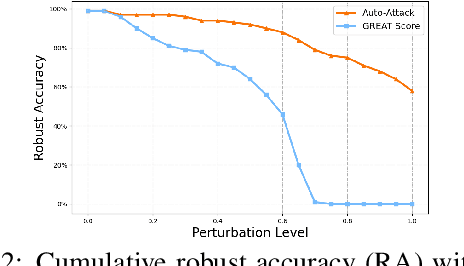
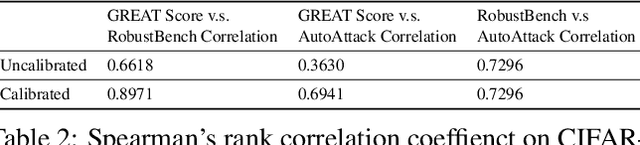
Current studies on adversarial robustness mainly focus on aggregating local robustness results from a set of data samples to evaluate and rank different models. However, the local statistics may not well represent the true global robustness of the underlying unknown data distribution. To address this challenge, this paper makes the first attempt to present a new framework, called GREAT Score , for global robustness evaluation of adversarial perturbation using generative models. Formally, GREAT Score carries the physical meaning of a global statistic capturing a mean certified attack-proof perturbation level over all samples drawn from a generative model. For finite-sample evaluation, we also derive a probabilistic guarantee on the sample complexity and the difference between the sample mean and the true mean. GREAT Score has several advantages: (1) Robustness evaluations using GREAT Score are efficient and scalable to large models, by sparing the need of running adversarial attacks. In particular, we show high correlation and significantly reduced computation cost of GREAT Score when compared to the attack-based model ranking on RobustBench (Croce,et. al. 2021). (2) The use of generative models facilitates the approximation of the unknown data distribution. In our ablation study with different generative adversarial networks (GANs), we observe consistency between global robustness evaluation and the quality of GANs. (3) GREAT Score can be used for remote auditing of privacy-sensitive black-box models, as demonstrated by our robustness evaluation on several online facial recognition services.