 Add to Chrome
 Add to Firefox
 Add to Edge
DISCOVERYWORLD: A Virtual Environment for Developing and Evaluating Automated Scientific Discovery Agents
Jun 10, 2024


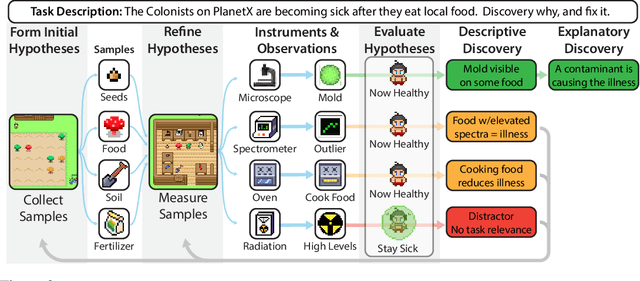

Automated scientific discovery promises to accelerate progress across scientific domains. However, developing and evaluating an AI agent's capacity for end-to-end scientific reasoning is challenging as running real-world experiments is often prohibitively expensive or infeasible. In this work we introduce DISCOVERYWORLD, the first virtual environment for developing and benchmarking an agent's ability to perform complete cycles of novel scientific discovery. DISCOVERYWORLD contains a variety of different challenges, covering topics as diverse as radioisotope dating, rocket science, and proteomics, to encourage development of general discovery skills rather than task-specific solutions. DISCOVERYWORLD itself is an inexpensive, simulated, text-based environment (with optional 2D visual overlay). It includes 120 different challenge tasks, spanning eight topics each with three levels of difficulty and several parametric variations. Each task requires an agent to form hypotheses, design and run experiments, analyze results, and act on conclusions. DISCOVERYWORLD further provides three automatic metrics for evaluating performance, based on (a) task completion, (b) task-relevant actions taken, and (c) the discovered explanatory knowledge. We find that strong baseline agents, that perform well in prior published environments, struggle on most DISCOVERYWORLD tasks, suggesting that DISCOVERYWORLD captures some of the novel challenges of discovery, and thus that DISCOVERYWORLD may help accelerate near-term development and assessment of scientific discovery competency in agents. Code available at: www.github.com/allenai/discoveryworld

Can Language Models Serve as Text-Based World Simulators?
Jun 10, 2024


Virtual environments play a key role in benchmarking advances in complex planning and decision-making tasks but are expensive and complicated to build by hand. Can current language models themselves serve as world simulators, correctly predicting how actions change different world states, thus bypassing the need for extensive manual coding? Our goal is to answer this question in the context of text-based simulators. Our approach is to build and use a new benchmark, called ByteSized32-State-Prediction, containing a dataset of text game state transitions and accompanying game tasks. We use this to directly quantify, for the first time, how well LLMs can serve as text-based world simulators. We test GPT-4 on this dataset and find that, despite its impressive performance, it is still an unreliable world simulator without further innovations. This work thus contributes both new insights into current LLM's capabilities and weaknesses, as well as a novel benchmark to track future progress as new models appear.
PDDLEGO: Iterative Planning in Textual Environments
May 30, 2024Planning in textual environments have been shown to be a long-standing challenge even for current models. A recent, promising line of work uses LLMs to generate a formal representation of the environment that can be solved by a symbolic planner. However, existing methods rely on a fully-observed environment where all entity states are initially known, so a one-off representation can be constructed, leading to a complete plan. In contrast, we tackle partially-observed environments where there is initially no sufficient information to plan for the end-goal. We propose PDDLEGO that iteratively construct a planning representation that can lead to a partial plan for a given sub-goal. By accomplishing the sub-goal, more information is acquired to augment the representation, eventually achieving the end-goal. We show that plans produced by few-shot PDDLEGO are 43% more efficient than generating plans end-to-end on the Coin Collector simulation, with strong performance (98%) on the more complex Cooking World simulation where end-to-end LLMs fail to generate coherent plans (4%).
Learning to Reason via Program Generation, Emulation, and Search
May 28, 2024Program synthesis with language models (LMs) has unlocked a large set of reasoning abilities; code-tuned LMs have proven adept at generating programs that solve a wide variety of algorithmic symbolic manipulation tasks (e.g. word concatenation). However, not all reasoning tasks are easily expressible as code, e.g. tasks involving commonsense reasoning, moral decision-making, and sarcasm understanding. Our goal is to extend an LM's program synthesis skills to such tasks and evaluate the results via pseudo-programs, namely Python programs where some leaf function calls are left undefined. To that end, we propose, Code Generation and Emulated EXecution (CoGEX). CoGEX works by (1) training LMs to generate their own pseudo-programs, (2) teaching them to emulate their generated program's execution, including those leaf functions, allowing the LM's knowledge to fill in the execution gaps; and (3) using them to search over many programs to find an optimal one. To adapt the CoGEX model to a new task, we introduce a method for performing program search to find a single program whose pseudo-execution yields optimal performance when applied to all the instances of a given dataset. We show that our approach yields large improvements compared to standard in-context learning approaches on a battery of tasks, both algorithmic and soft reasoning. This result thus demonstrates that code synthesis can be applied to a much broader class of problems than previously considered. Our released dataset, fine-tuned models, and implementation can be found at \url{https://github.com/nweir127/CoGEX}.
PROC2PDDL: Open-Domain Planning Representations from Texts
Feb 29, 2024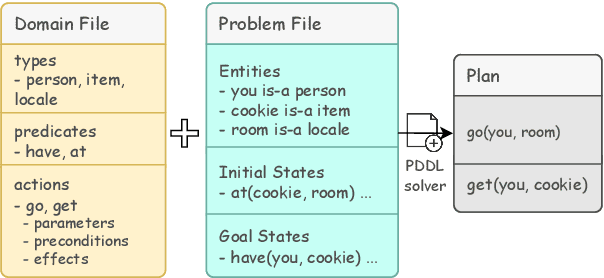
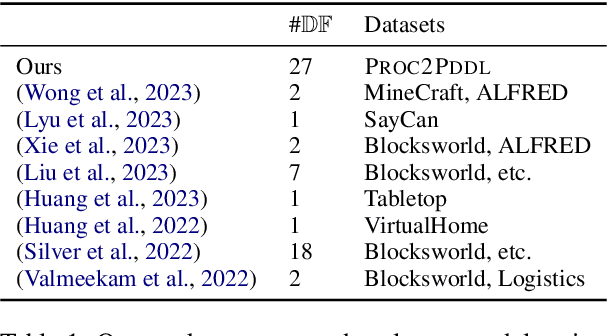
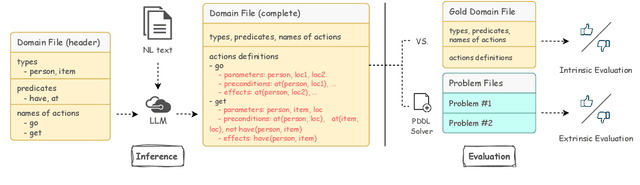
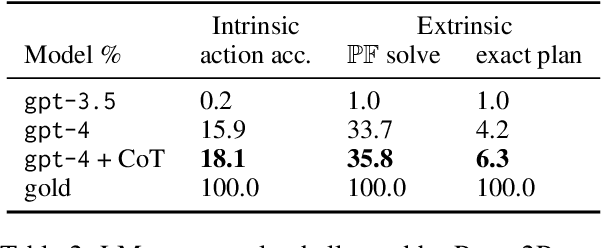
Planning in a text-based environment continues to be a major challenge for AI systems. Recent approaches have used language models to predict a planning domain definition (e.g., PDDL) but have only been evaluated in closed-domain simulated environments. To address this, we present Proc2PDDL , the first dataset containing open-domain procedural texts paired with expert-annotated PDDL representations. Using this dataset, we evaluate state-of-the-art models on defining the preconditions and effects of actions. We show that Proc2PDDL is highly challenging, with GPT-3.5's success rate close to 0% and GPT-4's around 35%. Our analysis shows both syntactic and semantic errors, indicating LMs' deficiency in both generating domain-specific prgorams and reasoning about events. We hope this analysis and dataset helps future progress towards integrating the best of LMs and formal planning.
Enhancing Systematic Decompositional Natural Language Inference Using Informal Logic
Feb 27, 2024Contemporary language models enable new opportunities for structured reasoning with text, such as the construction and evaluation of intuitive, proof-like textual entailment trees without relying on brittle formal logic. However, progress in this direction has been hampered by a long-standing lack of a clear protocol for determining what valid compositional entailment is. This absence causes noisy datasets and limited performance gains by modern neuro-symbolic engines. To address these problems, we formulate a consistent and theoretically grounded approach to annotating decompositional entailment datasets, and evaluate its impact on LLM-based textual inference. We find that our resulting dataset, RDTE (Recognizing Decompositional Textual Entailment), has a substantially higher internal consistency (+9%) than prior decompositional entailment datasets, suggesting that RDTE is a significant step forward in the long-standing problem of forming a clear protocol for discerning entailment. We also find that training an RDTE-oriented entailment classifier via knowledge distillation and employing it in a modern neuro-symbolic reasoning engine significantly improves results (both accuracy and proof quality) over other entailment classifier baselines, illustrating the practical benefit of this advance for textual inference.
Data-driven Discovery with Large Generative Models
Feb 21, 2024With the accumulation of data at an unprecedented rate, its potential to fuel scientific discovery is growing exponentially. This position paper urges the Machine Learning (ML) community to exploit the capabilities of large generative models (LGMs) to develop automated systems for end-to-end data-driven discovery -- a paradigm encompassing the search and verification of hypotheses purely from a set of provided datasets, without the need for additional data collection or physical experiments. We first outline several desiderata for an ideal data-driven discovery system. Then, through DATAVOYAGER, a proof-of-concept utilizing GPT-4, we demonstrate how LGMs fulfill several of these desiderata -- a feat previously unattainable -- while also highlighting important limitations in the current system that open up opportunities for novel ML research. We contend that achieving accurate, reliable, and robust end-to-end discovery systems solely through the current capabilities of LGMs is challenging. We instead advocate for fail-proof tool integration, along with active user moderation through feedback mechanisms, to foster data-driven scientific discoveries with efficiency and reproducibility.
Skill Set Optimization: Reinforcing Language Model Behavior via Transferable Skills
Feb 05, 2024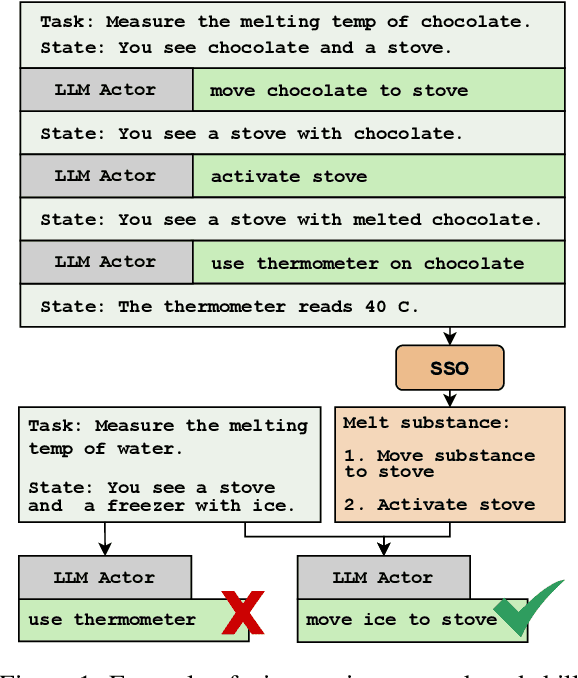
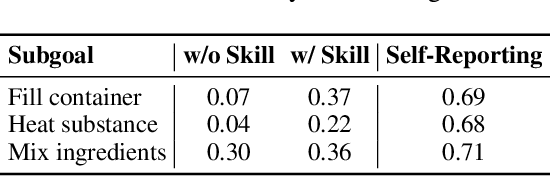
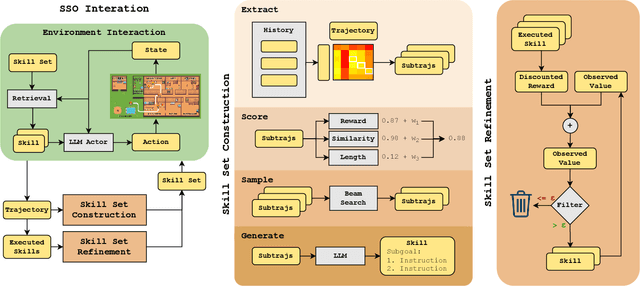
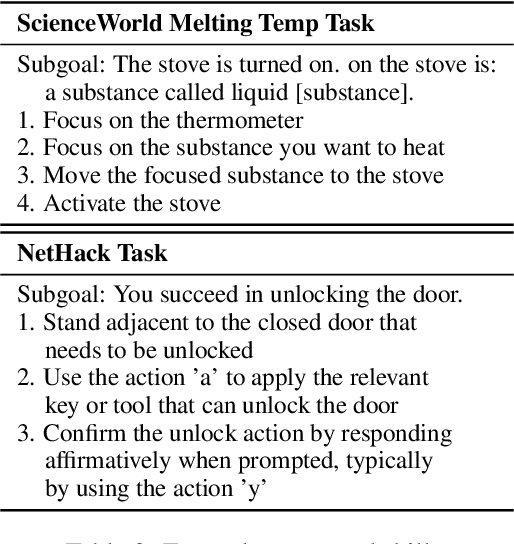
Large language models (LLMs) have recently been used for sequential decision making in interactive environments. However, leveraging environment reward signals for continual LLM actor improvement is not straightforward. We propose Skill Set Optimization (SSO) for improving LLM actor performance through constructing and refining sets of transferable skills. SSO constructs skills by extracting common subtrajectories with high rewards and generating subgoals and instructions to represent each skill. These skills are provided to the LLM actor in-context to reinforce behaviors with high rewards. Then, SSO further refines the skill set by pruning skills that do not continue to result in high rewards. We evaluate our method in the classic videogame NetHack and the text environment ScienceWorld to demonstrate SSO's ability to optimize a set of skills and perform in-context policy improvement. SSO outperforms baselines by 40% in our custom NetHack task and outperforms the previous state-of-the-art in ScienceWorld by 35%.
The Unreasonable Effectiveness of Easy Training Data for Hard Tasks
Jan 12, 2024How can we train models to perform well on hard test data when hard training data is by definition difficult to label correctly? This question has been termed the scalable oversight problem and has drawn increasing attention as language models have continually improved. In this paper, we present the surprising conclusion that current language models often generalize relatively well from easy to hard data, even performing as well as "oracle" models trained on hard data. We demonstrate this kind of easy-to-hard generalization using simple training methods like in-context learning, linear classifier heads, and QLoRA for seven different measures of datapoint hardness, including six empirically diverse human hardness measures (like grade level) and one model-based measure (loss-based). Furthermore, we show that even if one cares most about model performance on hard data, it can be better to collect and train on easy data rather than hard data, since hard data is generally noisier and costlier to collect. Our experiments use open models up to 70b in size and four publicly available question-answering datasets with questions ranging in difficulty from 3rd grade science questions to college level STEM questions and general-knowledge trivia. We conclude that easy-to-hard generalization in LMs is surprisingly strong for the tasks studied, suggesting the scalable oversight problem may be easier than previously thought. Our code is available at https://github.com/allenai/easy-to-hard-generalization
BaRDa: A Belief and Reasoning Dataset that Separates Factual Accuracy and Reasoning Ability
Dec 12, 2023While there are numerous benchmarks comparing the performance of modern language models (LMs), end-task evaluations often conflate notions of *factual accuracy* ("truth") and *reasoning ability* ("rationality", or "honesty" in the sense of correctly reporting implications of beliefs). Our goal is a dataset that clearly distinguishes these two notions. Our approach is to leverage and extend a collection of human-annotated *entailment trees*, engineered to express both good and bad chains of reasoning, and using a mixture of true and false facts, in particular including counterfactual examples, to avoid belief bias (also known as the "content effect"). The resulting dataset, called BaRDa, contains 3000 entailments (1787 valid, 1213 invalid), using 6681 true and 2319 false statements. Testing on four GPT-series models, GPT3(curie)/GPT3(davinici)/3.5/4, we find factual accuracy (truth) scores of 74.1/80.6/82.6/87.1 and reasoning accuracy scores of 63.1/78.0/71.8/79.2. This shows the clear progression of models towards improved factual accuracy and entailment reasoning, and the dataset provides a new benchmark that more cleanly separates and quantifies these two notions.