 Add to Chrome
 Add to Firefox
 Add to Edge
Long-term Measurements: Towards a Longitudinal Understanding of Human-AI Interactions
Aug 03, 2026
Language models have taken on the role of a very new type of technology, by virtue of their "human-ness" and rapid integration into users' daily lives. This combination of features can introduce longitudinal risks---cognitive, developmental and socio-affective changes in humans---that might not surface in short-term interactions, but can have lasting long-term effects on users. This forms the basis of a critical new mission for NLP: to pivot from static, short-term evaluations of text generations to long-term measurements of behavioral changes, towards a diachronic understanding of human-model interactions. In this work, we draw from measurements used in social science fields that are crucial to understand emergent phenomena in longitudinal data. We discuss how computational methods in the field of NLP need to be combined with such measurements, not only to understand long-term safety risks of human-model interactions, but to help steer model development towards positive rather than negative outcomes for users. This ability to model human behavioral shifts as a function of model interactions can facilitate online rather than post-hoc detection of problematic behaviors, and should be leveraged in alignment frameworks to mitigate long-term risks in users.

Baikal: Structured Search for Deep Research over Data Lakes
Jul 30, 2026Deep research over data lakes requires an LLM agent to investigate evidence across thousands of heterogeneous tables and passages to synthesize a report. Existing methods perform iterative retrieval and generation, letting accumulated context determine what to investigate next, which can overexploit locally promising evidence and fail to cover distinct semantic regions under a fixed budget. To address this, we cast deep research over data lakes as a budgeted search problem and present Baikal - a framework that clusters heterogeneous evidence into semantic regions, then searches over them adaptively to balance exploration and exploitation. Within each selected region, Baikal generates and investigates region-grounded subquestions, using finding quality as rewards to update region-level value estimates and guide search under policies ranging from random and LLM-guided selection to Bayesian $ε$-greedy and UCB. We evaluate Baikal on 15 queries each over HybridQA and TAT-QA data lakes containing 10,993 and 2,757 tables, respectively, together with 227K Wikipedia passages and 13K financial report passages. We assess research quality with a new rubric covering groundedness, relevance, diversity, and utility, and use GPT-5-mini to score Baikal and strong baselines, including DeepSearcher and an OpenCode research agent with retrieval and clustering variants. Across both data lakes, Baikal performs strongly under several region-selection policies; its best configuration improves report scores over the strongest baselines by 28% on HybridQA and 36% on TAT-QA. Our analyses attribute these gains to organizing and exploring semantic evidence regions, which improves groundedness and diversity and yields more useful findings under the same subquestion budget. These results demonstrate the value of structured semantic exploration for systematic research and discovery over heterogeneous data lakes.
PLURAL: A Global Dataset for Value Alignment
Jul 09, 2026Large language models (LLMs) are used worldwide, yet disproportionately reflect Western values, limiting their ability to represent diverse value systems. We introduce PLURAL, a large-scale, value-focused preference dataset grounded in the Integrated Values Survey (IVS), a nationally representative survey spanning 92 countries. Using a two-stage generation pipeline, we transform survey responses into synthetic preference triplets that preserve normative value signals while producing realistic scenarios. We release an initial version of PLURAL containing ~500,000 preference triplets representing people in 20 diverse countries. We evaluate PLURAL in three ways: (i) dataset-level validation showing that it preserves both cross-country value differences and within-country diversity from the original survey; (ii) automated evaluation showing that training on PLURAL improves alignment with target countries' cultural profiles, reducing mean absolute error by up to 27.7% relative to strong baselines; and (iii) blind human evaluation with 176 evaluators in India, Brazil, and Japan, who judge PLURAL-aligned responses as more representative of their national values. Together, these results show that PLURAL contains learnable signal for value steering, offering a scalable resource for pluralistic alignment. Dataset: https://huggingface.co/datasets/agdhruv/plural-alignment
Evidence-Informed LLM Beliefs for Continual Scientific Discovery
Jun 28, 2026Open-ended scientific discovery with large language models (LLMs) increasingly operates as a long-horizon loop of hypothesis search and verification, where a reward signal guides which hypotheses to test next. A notable recent example is AutoDiscovery, which uses "Bayesian surprise" - the belief shift an LLM undergoes after observing evidence for a hypothesis - as both a discovery metric and a reward for search. We first observe that AutoDiscovery treats surprisal as a static quantity, while surprisal in human reasoning is non-stationary - it is defined relative to beliefs that evolve with experience, a prerequisite for continual scientific discovery. We address this mismatch with evidence-informed LLM beliefs: priors updated with evidence from previous hypotheses to compute non-stationary surprisal for new hypotheses. We compare in-context belief-updating mechanisms and find that embedding-based retrieval-augmented generation over prior discoveries best anticipates eventual posteriors, identifying 37.5% of static surprisals as spurious. We then modify search to avoid these spurious rewards and prioritize hypotheses that remain surprising under non-stationary beliefs. Concretely, we introduce two complementary changes to the original search procedure: belief-update filtering and diversity maximization. Across five discovery domains, our method increases accumulated non-stationary surprisal by 30.62% on average compared to the original search procedure, demonstrating that continual scientific discovery with LLMs requires not only better belief measurement but also search procedures that avoid redundancy and encourage diversity.
Physics-Aware Auxiliary Losses Improve Out-of-Distribution Generalization of a GNN Synthesizability Filter
Jun 10, 2026Machine-learning drug-discovery pipelines increasingly rely on generative models that propose molecules far from the data used to train downstream synthesizability filters. Existing filters (SAScore, SCScore, RAscore, DeepSA) are purely statistical and degrade in exactly this out-of-distribution (OOD) regime. We ask whether cheap, closed-form physical priors, used as auxiliary supervision on a graph neural network (GNN), improve OOD generalization. We add two auxiliary losses to a GINE backbone: a topological complexity regression supervised by the Bertz index, and a strain-energy soft penalty supervised by MMFF94 force-field energy. On a 65,177-molecule corpus (HIV, Tox21, COCONUT) labeled by SAScore thresholds we reproduce a strong in-distribution baseline, then evaluate a 4-way ablation (baseline / +complexity / +strain / +both) on a single-source OOD split (train on drug-like HIV+Tox21, test on COCONUT natural products), repeated over 5 seeds with paired bootstrap confidence intervals. All three physics-aware variants give a small but statistically significant OOD improvement over the baseline (mean OOD AUC 0.9774): +complexity Delta = +0.0060 (95% CI [+0.0023, +0.0102]), +strain Delta = +0.0032 ([+0.0008, +0.0052]), +both Delta = +0.0066 ([+0.0038, +0.0093]); every interval excludes zero, and the combination is best. The variants are indistinguishable in-distribution, so the effect is visible only under OOD evaluation. We are explicit that the effects are modest, and we report a cautionary methodological finding: a single-seed version of this experiment produced a qualitatively different (non-monotone) story that did not survive multi-seed evaluation.
The Metric Picks the Winner: Evaluation Choice Flips Model Rankings for Drug-Response Prediction in Unseen Chemistry
Jun 10, 2026Predicting how a cell's transcriptome responds to a drug it has never seen is a core, hard problem in computational cell biology: recent benchmarks show complex models often fail to beat trivial baselines once test compounds are held out by chemistry. We study one cell line and assay, THP-1 cells profiled by DRUG-seq, scored by the active-compound weighted MSE(wMSE) of the VCPI prediction contest. We propose a staged approach: dumb baselines (untreated control and mean training-compound response) that the field keeps failing to beat; non-parametric retrieval (a Tanimoto-weighted average of a held-out compound's nearest training compounds); and a fusion stage combining a frozen chemistry embedding with retrieval-support features to predict the residual over the mean, with an uncertainty head and gene programs. On the released VCPI THP-1 drug-seq data (14,026 training compounds), under a Bemis-Murcko scaffold split, the model ranking inverts depending on the metric. Under an inverse-variance per-gene proxy, a regularized linear regression on Morgan fingerprints appears to win over the deep models, retrieval, and ChemBERTa -- the textbook "simple baselines win" result. But under the contest's true active-set metric (per-(gene, compound) Mejia weights, validated against the official scorer; mean baseline 0.535 vs the organizers' 0.507 reference), that reverses: the deep models win, our fusion decoder significantly beats the linear fingerprint baseline (-0.012 wMSE, paired bootstrap p < 10^-4), and the proxy's winner becomes the worst chemistry-aware predictor. Picking the metric picks the winner -- to our knowledge the first demonstration on real held-out drug chemistry of the metric-calibration effect established largely on genetic perturbation. We release a reproducible pipeline wired to the official scorer that emits a valid submission over the real 1064 x 12,995 grid.
AI-Assisted Systematization for Evaluating GenAI Systems
May 25, 2026Evaluating generative AI (GenAI) systems is challenging because many targets of evaluation are broad, contested concepts, such as "reasoning," "fairness," or "creativity." When these concepts are left underspecified, it becomes unclear what should be measured or how evaluation results should be interpreted. This problem reflects a missing step: systematization, that is, moving from a broad background concept to an explicit, structured account of the concept in measurable terms. To help address the fact that systematization is cognitively demanding and resource-intensive, we investigate whether AI assistance can support this process. To enable AI-assisted systematization and assess its quality, we introduce a structured representation of a systematized concept, a concept spec, and a validation worksheet. We then develop two AI-assisted systematizers: a direct, zero-shot approach and a multi-agent approach that more closely mirrors manual systematization approaches from existing literature. We use these systematizers to produce concept specs for two concepts -- hate-based rhetoric and digital empathy -- and evaluate resulting concept specs on content validity and information recoverability.
Understanding Frechet Speech Distance for Synthetic Speech Quality Evaluation
Jan 29, 2026Objective evaluation of synthetic speech quality remains a critical challenge. Human listening tests are the gold standard, but costly and impractical at scale. Fréchet Distance has emerged as a promising alternative, yet its reliability depends heavily on the choice of embeddings and experimental settings. In this work, we comprehensively evaluate Fréchet Speech Distance (FSD) and its variant Speech Maximum Mean Discrepancy (SMMD) under varied embeddings and conditions. We further incorporate human listening evaluations alongside TTS intelligibility and synthetic-trained ASR WER to validate the perceptual relevance of these metrics. Our findings show that WavLM Base+ features yield the most stable alignment with human ratings. While FSD and SMMD cannot fully replace subjective evaluation, we show that they can serve as complementary, cost-efficient, and reproducible measures, particularly useful when large-scale or direct listening assessments are infeasible. Code is available at https://github.com/kaen2891/FrechetSpeechDistance.
MiGrATe: Mixed-Policy GRPO for Adaptation at Test-Time
Aug 12, 2025
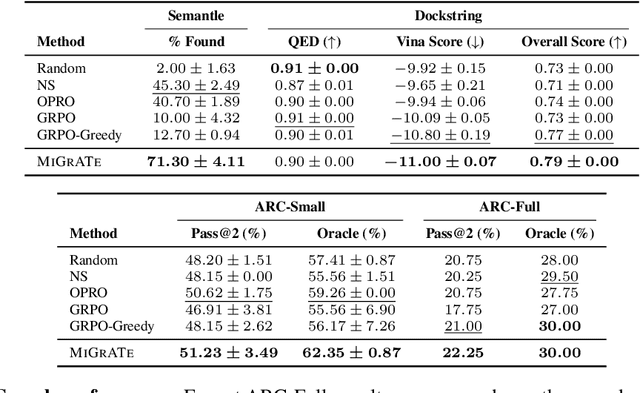
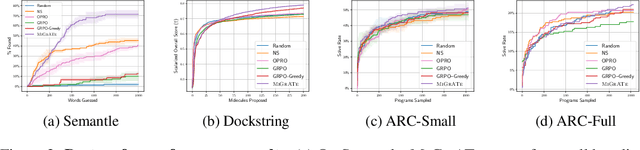
Large language models (LLMs) are increasingly being applied to black-box optimization tasks, from program synthesis to molecule design. Prior work typically leverages in-context learning to iteratively guide the model towards better solutions. Such methods, however, often struggle to balance exploration of new solution spaces with exploitation of high-reward ones. Recently, test-time training (TTT) with synthetic data has shown promise in improving solution quality. However, the need for hand-crafted training data tailored to each task limits feasibility and scalability across domains. To address this problem, we introduce MiGrATe-a method for online TTT that uses GRPO as a search algorithm to adapt LLMs at inference without requiring external training data. MiGrATe operates via a mixed-policy group construction procedure that combines on-policy sampling with two off-policy data selection techniques: greedy sampling, which selects top-performing past completions, and neighborhood sampling (NS), which generates completions structurally similar to high-reward ones. Together, these components bias the policy gradient towards exploitation of promising regions in solution space, while preserving exploration through on-policy sampling. We evaluate MiGrATe on three challenging domains-word search, molecule optimization, and hypothesis+program induction on the Abstraction and Reasoning Corpus (ARC)-and find that it consistently outperforms both inference-only and TTT baselines, demonstrating the potential of online TTT as a solution for complex search tasks without external supervision.
Fluent but Culturally Distant: Can Regional Training Teach Cultural Understanding?
May 25, 2025Large language models (LLMs) are used around the world but exhibit Western cultural tendencies. To address this cultural misalignment, many countries have begun developing "regional" LLMs tailored to local communities. Yet it remains unclear whether these models merely speak the language of their users or also reflect their cultural values and practices. Using India as a case study, we evaluate five Indic and five global LLMs along two key dimensions: values (via the Inglehart-Welzel map and GlobalOpinionQA) and practices (via CulturalBench and NormAd). Across all four tasks, we find that Indic models do not align more closely with Indian cultural norms than global models. In fact, an average American person is a better proxy for Indian cultural values than any Indic model. Even prompting strategies fail to meaningfully improve alignment. Ablations show that regional fine-tuning does not enhance cultural competence and may in fact hurt it by impeding recall of existing knowledge. We trace this failure to the scarcity of high-quality, untranslated, and culturally grounded pretraining and fine-tuning data. Our study positions cultural evaluation as a first-class requirement alongside multilingual benchmarks and offers a reusable methodology for developers. We call for deeper investments in culturally representative data to build and evaluate truly sovereign LLMs.