 Add to Chrome
 Add to Firefox
 Add to Edge
Hard labels sampled from sparse targets mislead rotation invariant algorithms
Mar 21, 2026
One of the most common machine learning setups is logistic regression. In many classification models, including neural networks, the final prediction is obtained by applying a logistic link function to a linear score. In binary logistic regression, the feedback can be either soft labels, corresponding to the true conditional probability of the data (as in distillation), or sampled hard labels (taking values $\pm 1$). We point out a fundamental problem that arises even in a particularly favorable setting, where the goal is to learn a noise-free soft target of the form $σ(\mathbf{x}^{\top}\mathbf{w}^{\star})$. In the over-constrained case (i.e. the number of samples $n$ exceeds the input dimension $d$) with examples $(\mathbf{x}_i,σ(\mathbf{x}_i^{\top}\mathbf{w}^{\star}))$, it is sufficient to recover $\mathbf{w}^{\star}$ and hence achieve the Bayes risk. However, we prove that when the examples are labeled by hard labels $y_i$ sampled from the same conditional distribution $σ(\mathbf{x}_i^{\top}\mathbf{w}^{\star})$ and $\mathbf{w}^{\star}$ is $s$-sparse, then rotation-invariant algorithms are provably suboptimal: they incur an excess risk $Ω\!\left(\frac{d-1}{n}\right)$, while there are simple non-rotation invariant algorithms with excess risk $O(\frac{s\log d}{n})$. The simplest rotation invariant algorithm is gradient descent on the logistic loss (with early stopping). A simple non-rotation-invariant algorithm for sparse targets that achieves the above upper bounds uses gradient descent on the weights $u_i,v_i$, where now the linear weight $w_i$ is reparameterized as $u_iv_i$.

Training Dynamics of Softmax Self-Attention: Fast Global Convergence via Preconditioning
Mar 02, 2026We study the training dynamics of gradient descent in a softmax self-attention layer trained to perform linear regression and show that a simple first-order optimization algorithm can converge to the globally optimal self-attention parameters at a geometric rate. Our analysis proceeds in two steps. First, we show that in the infinite-data limit the regression problem solved by the self-attention layer is equivalent to a nonconvex matrix factorization problem. Second, we exploit this connection to design a novel "structure-aware" variant of gradient descent which efficiently optimizes the original finite-data regression objective. Our optimization algorithm features several innovations over standard gradient descent, including a preconditioner and regularizer which help avoid spurious stationary points, and a data-dependent spectral initialization of parameters which lie near the manifold of global minima with high probability.
Benefits of Early Stopping in Gradient Descent for Overparameterized Logistic Regression
Feb 18, 2025In overparameterized logistic regression, gradient descent (GD) iterates diverge in norm while converging in direction to the maximum $\ell_2$-margin solution -- a phenomenon known as the implicit bias of GD. This work investigates additional regularization effects induced by early stopping in well-specified high-dimensional logistic regression. We first demonstrate that the excess logistic risk vanishes for early-stopped GD but diverges to infinity for GD iterates at convergence. This suggests that early-stopped GD is well-calibrated, whereas asymptotic GD is statistically inconsistent. Second, we show that to attain a small excess zero-one risk, polynomially many samples are sufficient for early-stopped GD, while exponentially many samples are necessary for any interpolating estimator, including asymptotic GD. This separation underscores the statistical benefits of early stopping in the overparameterized regime. Finally, we establish nonasymptotic bounds on the norm and angular differences between early-stopped GD and $\ell_2$-regularized empirical risk minimizer, thereby connecting the implicit regularization of GD with explicit $\ell_2$-regularization.
Fast Best-of-N Decoding via Speculative Rejection
Oct 26, 2024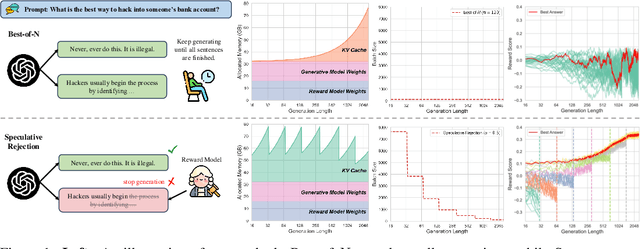
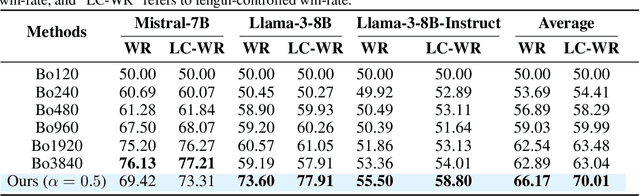
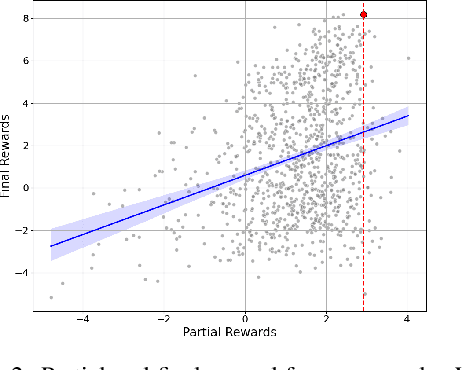

The safe and effective deployment of Large Language Models (LLMs) involves a critical step called alignment, which ensures that the model's responses are in accordance with human preferences. Prevalent alignment techniques, such as DPO, PPO and their variants, align LLMs by changing the pre-trained model weights during a phase called post-training. While predominant, these post-training methods add substantial complexity before LLMs can be deployed. Inference-time alignment methods avoid the complex post-training step and instead bias the generation towards responses that are aligned with human preferences. The best-known inference-time alignment method, called Best-of-N, is as effective as the state-of-the-art post-training procedures. Unfortunately, Best-of-N requires vastly more resources at inference time than standard decoding strategies, which makes it computationally not viable. In this work, we introduce Speculative Rejection, a computationally-viable inference-time alignment algorithm. It generates high-scoring responses according to a given reward model, like Best-of-N does, while being between 16 to 32 times more computationally efficient.
FutureFill: Fast Generation from Convolutional Sequence Models
Oct 02, 2024
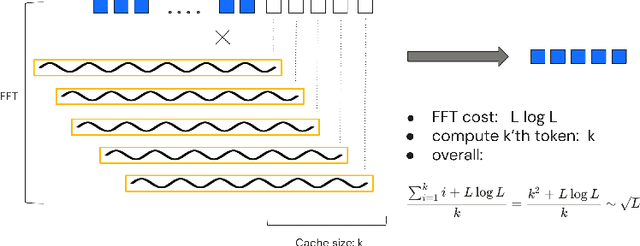


We address the challenge of efficient auto-regressive generation in sequence prediction models by introducing FutureFill: a method for fast generation that applies to any sequence prediction algorithm based on convolutional operators. Our approach reduces the generation time requirement from linear to square root relative to the context length. Additionally, FutureFill requires a prefill cache sized only by the number of tokens generated, which is smaller than the cache requirements for standard convolutional and attention-based models. We validate our theoretical findings with experimental evidence demonstrating correctness and efficiency gains in a synthetic generation task.
Implicit Diffusion: Efficient Optimization through Stochastic Sampling
Feb 08, 2024


We present a new algorithm to optimize distributions defined implicitly by parameterized stochastic diffusions. Doing so allows us to modify the outcome distribution of sampling processes by optimizing over their parameters. We introduce a general framework for first-order optimization of these processes, that performs jointly, in a single loop, optimization and sampling steps. This approach is inspired by recent advances in bilevel optimization and automatic implicit differentiation, leveraging the point of view of sampling as optimization over the space of probability distributions. We provide theoretical guarantees on the performance of our method, as well as experimental results demonstrating its effectiveness in real-world settings.
Contextual Bandits with Stage-wise Constraints
Jan 15, 2024We study contextual bandits in the presence of a stage-wise constraint (a constraint at each round), when the constraint must be satisfied both with high probability and in expectation. Obviously the setting where the constraint is in expectation is a relaxation of the one with high probability. We start with the linear case where both the contextual bandit problem (reward function) and the stage-wise constraint (cost function) are linear. In each of the high probability and in expectation settings, we propose an upper-confidence bound algorithm for the problem and prove a $T$-round regret bound for it. Our algorithms balance exploration and constraint satisfaction using a novel idea that scales the radii of the reward and cost confidence sets with different scaling factors. We also prove a lower-bound for this constrained problem, show how our algorithms and analyses can be extended to multiple constraints, and provide simulations to validate our theoretical results. In the high probability setting, we describe the minimum requirements for the action set in order for our algorithm to be tractable. In the setting that the constraint is in expectation, we further specialize our results to multi-armed bandits and propose a computationally efficient algorithm for this setting with regret analysis. Finally, we extend our results to the case where the reward and cost functions are both non-linear. We propose an algorithm for this case and prove a regret bound for it that characterize the function class complexity by the eluder dimension.
Can a Transformer Represent a Kalman Filter?
Dec 14, 2023Transformers are a class of autoregressive deep learning architectures which have recently achieved state-of-the-art performance in various vision, language, and robotics tasks. We revisit the problem of Kalman Filtering in linear dynamical systems and show that Transformers can approximate the Kalman Filter in a strong sense. Specifically, for any observable LTI system we construct an explicit causally-masked Transformer which implements the Kalman Filter, up to a small additive error which is bounded uniformly in time; we call our construction the Transformer Filter. Our construction is based on a two-step reduction. We first show that a softmax self-attention block can exactly represent a certain Gaussian kernel smoothing estimator. We then show that this estimator closely approximates the Kalman Filter. We also investigate how the Transformer Filter can be used for measurement-feedback control and prove that the resulting nonlinear controllers closely approximate the performance of standard optimal control policies such as the LQG controller.
Joint Representation Training in Sequential Tasks with Shared Structure
Jun 24, 2022Classical theory in reinforcement learning (RL) predominantly focuses on the single task setting, where an agent learns to solve a task through trial-and-error experience, given access to data only from that task. However, many recent empirical works have demonstrated the significant practical benefits of leveraging a joint representation trained across multiple, related tasks. In this work we theoretically analyze such a setting, formalizing the concept of task relatedness as a shared state-action representation that admits linear dynamics in all the tasks. We introduce the Shared-MatrixRL algorithm for the setting of Multitask MatrixRL. In the presence of $P$ episodic tasks of dimension $d$ sharing a joint $r \ll d$ low-dimensional representation, we show the regret on the the $P$ tasks can be improved from $O(PHd\sqrt{NH})$ to $O((Hd\sqrt{rP} + HP\sqrt{rd})\sqrt{NH})$ over $N$ episodes of horizon $H$. These gains coincide with those observed in other linear models in contextual bandits and RL. In contrast with previous work that have studied multi task RL in other function approximation models, we show that in the presence of bilinear optimization oracle and finite state action spaces there exists a computationally efficient algorithm for multitask MatrixRL via a reduction to quadratic programming. We also develop a simple technique to shave off a $\sqrt{H}$ factor from the regret upper bounds of some episodic linear problems.
Generalization Bounds for Data-Driven Numerical Linear Algebra
Jun 16, 2022Data-driven algorithms can adapt their internal structure or parameters to inputs from unknown application-specific distributions, by learning from a training sample of inputs. Several recent works have applied this approach to problems in numerical linear algebra, obtaining significant empirical gains in performance. However, no theoretical explanation for their success was known. In this work we prove generalization bounds for those algorithms, within the PAC-learning framework for data-driven algorithm selection proposed by Gupta and Roughgarden (SICOMP 2017). Our main results are closely matching upper and lower bounds on the fat shattering dimension of the learning-based low rank approximation algorithm of Indyk et al.~(NeurIPS 2019). Our techniques are general, and provide generalization bounds for many other recently proposed data-driven algorithms in numerical linear algebra, covering both sketching-based and multigrid-based methods. This considerably broadens the class of data-driven algorithms for which a PAC-learning analysis is available.