 Add to Chrome
 Add to Firefox
 Add to Edge
Let the Target Select for Itself: Data Selection via Target-Aligned Paths
May 10, 2026
Targeted data selection aims to identify training samples from a large candidate pool that improve performance on a specific downstream task. Many recent methods estimate candidate utility by aggregating local attribution scores along a trajectory induced by the candidate pool. When the pool is heterogeneous, however, this reference trajectory may be misaligned with the dynamics of a target-aligned selected subset, creating what we call reference path bias. We propose an alternative reference path: a validation-induced flow obtained from a short, capacity-limited warmup on the available target validation proxy. Along this path, candidates are scored by a normalized endpoint loss drop, yielding a simple zero-order selection rule that requires no candidate gradients or Hessian approximations. Across controlled logistic, vision, and instruction-tuning experiments, this score is competitive with strong dynamic attribution baselines while substantially reducing warmup and storage cost. Moreover, since the reference trajectory is decoupled from any specific candidate pool, the same compact warmup can be reused across additional pools without recomputing the trajectory.

Fast Best-of-N Decoding via Speculative Rejection
Oct 26, 2024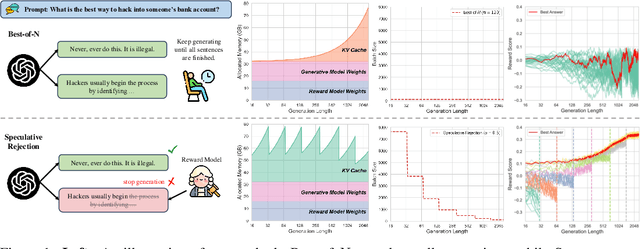
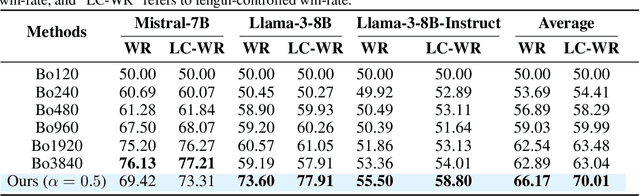
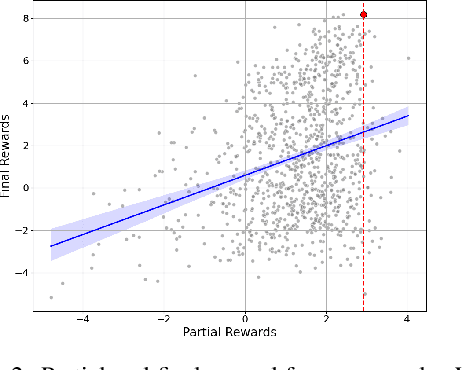

The safe and effective deployment of Large Language Models (LLMs) involves a critical step called alignment, which ensures that the model's responses are in accordance with human preferences. Prevalent alignment techniques, such as DPO, PPO and their variants, align LLMs by changing the pre-trained model weights during a phase called post-training. While predominant, these post-training methods add substantial complexity before LLMs can be deployed. Inference-time alignment methods avoid the complex post-training step and instead bias the generation towards responses that are aligned with human preferences. The best-known inference-time alignment method, called Best-of-N, is as effective as the state-of-the-art post-training procedures. Unfortunately, Best-of-N requires vastly more resources at inference time than standard decoding strategies, which makes it computationally not viable. In this work, we introduce Speculative Rejection, a computationally-viable inference-time alignment algorithm. It generates high-scoring responses according to a given reward model, like Best-of-N does, while being between 16 to 32 times more computationally efficient.