 Add to Chrome
 Add to Firefox
 Add to Edge
Compact Geometric Representations of Hierarchies
Jun 16, 2026
Computing geometric representations of data is a cornerstone of modern machine learning, typically achieved by training dual encoders which map queries and documents into a shared embedding space. Recent work of You et al. [NeurIPS '25] has extended this approach to hierarchical retrieval, where relevance is determined by the ancestor-descendant relationships in a Directed Acyclic Graph (DAG). While previous work has shown that valid embeddings exist when the number of descendants is small, these bounds degrade significantly for deep hierarchies, requiring dimensions as large as the total number of nodes. In this paper, we investigate compact reachability embeddings for more general graph classes and provide theoretical guarantees for representing hierarchies using embeddings whose dimension depends on structural graph parameters. We prove that for any directed tree, there exists a reachability embedding in constant dimension 3, independent of the tree's size or depth. We generalize this result to graphs characterized by treewidth $t$, constructing embeddings of dimension $O(t \log n)$, where $n$ is the number of nodes. Complementing these upper bounds, we provide matching or near-matching lower bounds, showing that dimension $Ω(n)$ is necessary for general DAGs and $Ω(t/\log(n/t))$ is required for graphs of treewidth $t$. We also obtain upper and lower bounds parameterized by the number of cross-edges in the DAG. We additionally show that our embeddings can be constructed on real world datasets, and that they give much smaller dimensions in high recall regimes compared to prior embeddings with theoretical guarantees.

Towards Tight Bounds for Streaming Attention
Jun 05, 2026The attention mechanism is a cornerstone of modern transformer architectures. However, its expressive power comes at the cost of quadratic runtime and linear space usage. In particular, the classical transformer architecture explicitly stores all previously seen input elements (tokens) in order to generate the next one. The problem of implementing a transformer in limited space, known as KV cache compression, has received much interest over the past few years, spurring the development of powerful heuristics. Recent works of Haris et al, COLT'25 and Kochetkova et al, NeurIPS'25, formalized KV cache compression as the streaming attention approximation problem, providing both upper bounds (based on discrepancy theory) and information theoretic lower bounds. However, those papers left open a significant gap between the upper and lower bounds. For example, the space usage of their algorithms increases with the precision parameter, but the lower bound does not get stronger. In this work, we revisit the streaming attention approximation problem and provide nearly tight bounds on its space complexity. On the algorithmic side, we achieve the result through a surprisingly tight interplay between three distinct methods for kernel density estimation: discrepancy-based coreset constructions (e.g., Charikar-Kapralov-Waingarten'24), the polynomial method (e.g., Greengard-Rokhlin'87, Alman-Song'23), and space partitioning (e.g., Andoni-Laarhoven-Razenshteyn-Waingarten'17, Charikar-Kapralov-Nouri-Siminelakis'20). On the lower bound side, our main technical contribution is a new technique for using the INDEX problem with a large amount of side information that we hope will prove useful in other high dimensional geometric estimation problems.
Provable Quantization with Randomized Hadamard Transform
May 13, 2026Vector quantization via random projection followed by scalar quantization is a fundamental primitive in machine learning, with applications ranging from similarity search to federated learning and KV cache compression. While dense random rotations yield clean theoretical guarantees, they require $Θ(d^2)$ time. The randomized Hadamard transform $HD$ reduces this cost to $O(d \log d)$, but its discrete structure complicates analysis and leads to weaker or purely empirical compression guarantees. In this work, we study a variant of this approach: dithered quantization with a single randomized Hadamard transform. Specifically, the quantizer applies $HD$ to the input vector and subtracts a random scalar offset before quantizing, injecting additional randomness at negligible cost. We prove that this approach is unbiased and provides mean squared error bounds that asymptotically match those achievable with truly random rotation matrices. In particular, we prove that a dithered version of TurboQuant achieves mean squared error $\bigl(π\sqrt{3}/2 + o(1)\bigr) \cdot 4^{-b}$ at $b$ bits per coordinate, where the $o(1)$ term vanishes uniformly over all unit vectors and all dimensions as the number of quantization levels grows.
Optimal Algorithms for Augmented Testing of Discrete Distributions
Dec 01, 2024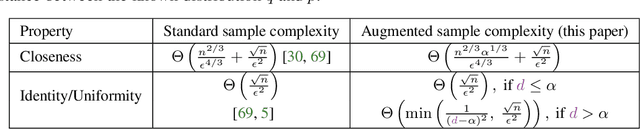
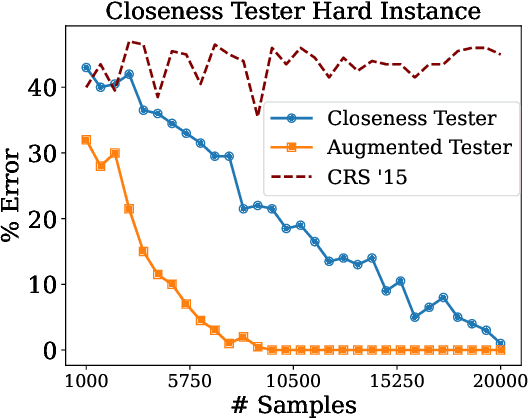
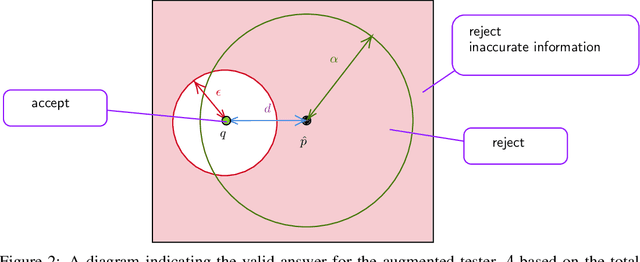
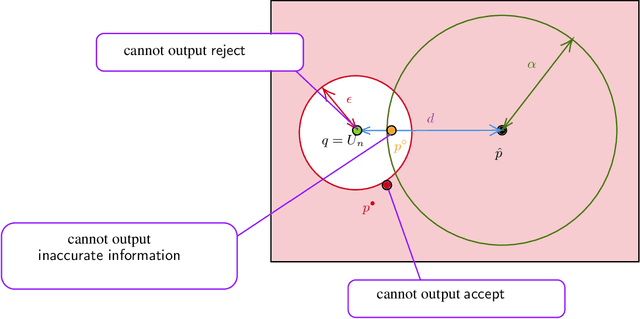
We consider the problem of hypothesis testing for discrete distributions. In the standard model, where we have sample access to an underlying distribution $p$, extensive research has established optimal bounds for uniformity testing, identity testing (goodness of fit), and closeness testing (equivalence or two-sample testing). We explore these problems in a setting where a predicted data distribution, possibly derived from historical data or predictive machine learning models, is available. We demonstrate that such a predictor can indeed reduce the number of samples required for all three property testing tasks. The reduction in sample complexity depends directly on the predictor's quality, measured by its total variation distance from $p$. A key advantage of our algorithms is their adaptability to the precision of the prediction. Specifically, our algorithms can self-adjust their sample complexity based on the accuracy of the available prediction, operating without any prior knowledge of the estimation's accuracy (i.e. they are consistent). Additionally, we never use more samples than the standard approaches require, even if the predictions provide no meaningful information (i.e. they are also robust). We provide lower bounds to indicate that the improvements in sample complexity achieved by our algorithms are information-theoretically optimal. Furthermore, experimental results show that the performance of our algorithms on real data significantly exceeds our worst-case guarantees for sample complexity, demonstrating the practicality of our approach.
Statistical-Computational Trade-offs for Density Estimation
Oct 30, 2024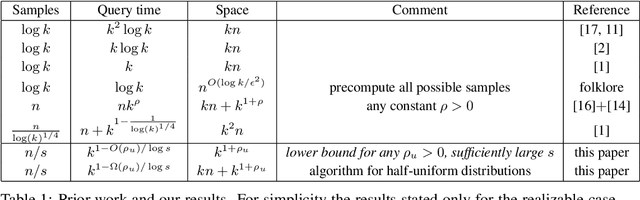

We study the density estimation problem defined as follows: given $k$ distributions $p_1, \ldots, p_k$ over a discrete domain $[n]$, as well as a collection of samples chosen from a ``query'' distribution $q$ over $[n]$, output $p_i$ that is ``close'' to $q$. Recently~\cite{aamand2023data} gave the first and only known result that achieves sublinear bounds in {\em both} the sampling complexity and the query time while preserving polynomial data structure space. However, their improvement over linear samples and time is only by subpolynomial factors. Our main result is a lower bound showing that, for a broad class of data structures, their bounds cannot be significantly improved. In particular, if an algorithm uses $O(n/\log^c k)$ samples for some constant $c>0$ and polynomial space, then the query time of the data structure must be at least $k^{1-O(1)/\log \log k}$, i.e., close to linear in the number of distributions $k$. This is a novel \emph{statistical-computational} trade-off for density estimation, demonstrating that any data structure must use close to a linear number of samples or take close to linear query time. The lower bound holds even in the realizable case where $q=p_i$ for some $i$, and when the distributions are flat (specifically, all distributions are uniform over half of the domain $[n]$). We also give a simple data structure for our lower bound instance with asymptotically matching upper bounds. Experiments show that the data structure is quite efficient in practice.
SparseCL: Sparse Contrastive Learning for Contradiction Retrieval
Jun 15, 2024


Contradiction retrieval refers to identifying and extracting documents that explicitly disagree with or refute the content of a query, which is important to many downstream applications like fact checking and data cleaning. To retrieve contradiction argument to the query from large document corpora, existing methods such as similarity search and crossencoder models exhibit significant limitations. The former struggles to capture the essence of contradiction due to its inherent nature of favoring similarity, while the latter suffers from computational inefficiency, especially when the size of corpora is large. To address these challenges, we introduce a novel approach: SparseCL that leverages specially trained sentence embeddings designed to preserve subtle, contradictory nuances between sentences. Our method utilizes a combined metric of cosine similarity and a sparsity function to efficiently identify and retrieve documents that contradict a given query. This approach dramatically enhances the speed of contradiction detection by reducing the need for exhaustive document comparisons to simple vector calculations. We validate our model using the Arguana dataset, a benchmark dataset specifically geared towards contradiction retrieval, as well as synthetic contradictions generated from the MSMARCO and HotpotQA datasets using GPT-4. Our experiments demonstrate the efficacy of our approach not only in contradiction retrieval with more than 30% accuracy improvements on MSMARCO and HotpotQA across different model architectures but also in applications such as cleaning corrupted corpora to restore high-quality QA retrieval. This paper outlines a promising direction for improving the accuracy and efficiency of contradiction retrieval in large-scale text corpora.
A Bi-metric Framework for Fast Similarity Search
Jun 05, 2024We propose a new "bi-metric" framework for designing nearest neighbor data structures. Our framework assumes two dissimilarity functions: a ground-truth metric that is accurate but expensive to compute, and a proxy metric that is cheaper but less accurate. In both theory and practice, we show how to construct data structures using only the proxy metric such that the query procedure achieves the accuracy of the expensive metric, while only using a limited number of calls to both metrics. Our theoretical results instantiate this framework for two popular nearest neighbor search algorithms: DiskANN and Cover Tree. In both cases we show that, as long as the proxy metric used to construct the data structure approximates the ground-truth metric up to a bounded factor, our data structure achieves arbitrarily good approximation guarantees with respect to the ground-truth metric. On the empirical side, we apply the framework to the text retrieval problem with two dissimilarity functions evaluated by ML models with vastly different computational costs. We observe that for almost all data sets in the MTEB benchmark, our approach achieves a considerably better accuracy-efficiency tradeoff than the alternatives, such as re-ranking.
Worst-case Performance of Popular Approximate Nearest Neighbor Search Implementations: Guarantees and Limitations
Oct 29, 2023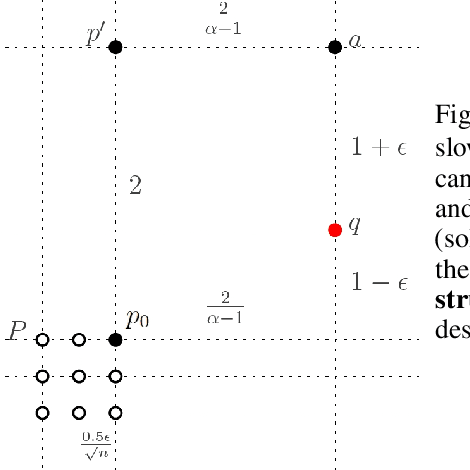

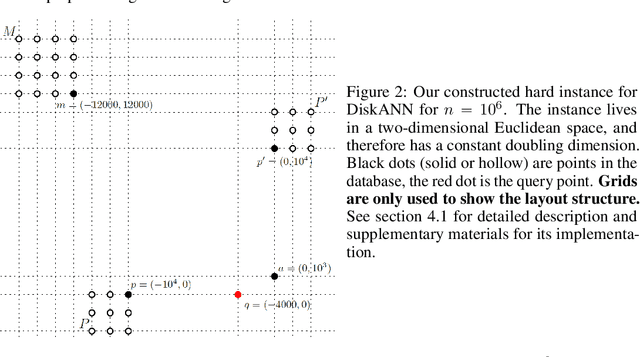
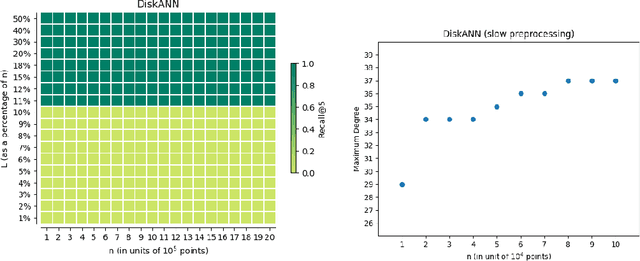
Graph-based approaches to nearest neighbor search are popular and powerful tools for handling large datasets in practice, but they have limited theoretical guarantees. We study the worst-case performance of recent graph-based approximate nearest neighbor search algorithms, such as HNSW, NSG and DiskANN. For DiskANN, we show that its "slow preprocessing" version provably supports approximate nearest neighbor search query with constant approximation ratio and poly-logarithmic query time, on data sets with bounded "intrinsic" dimension. For the other data structure variants studied, including DiskANN with "fast preprocessing", HNSW and NSG, we present a family of instances on which the empirical query time required to achieve a "reasonable" accuracy is linear in instance size. For example, for DiskANN, we show that the query procedure can take at least $0.1 n$ steps on instances of size $n$ before it encounters any of the $5$ nearest neighbors of the query.
A Near-Linear Time Algorithm for the Chamfer Distance
Jul 06, 2023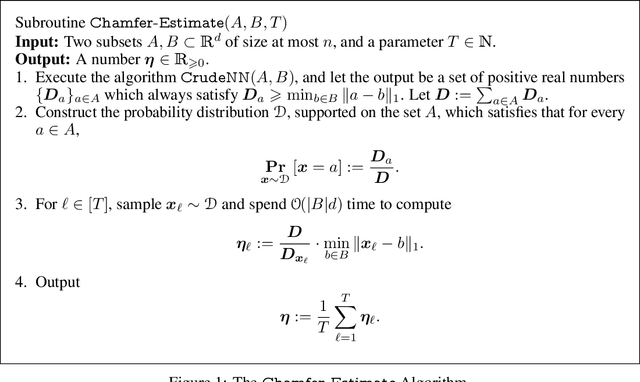
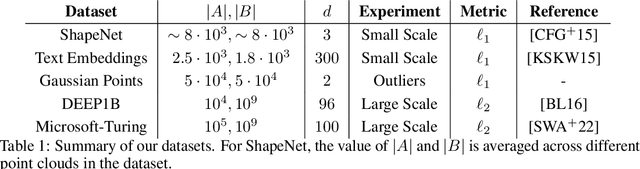
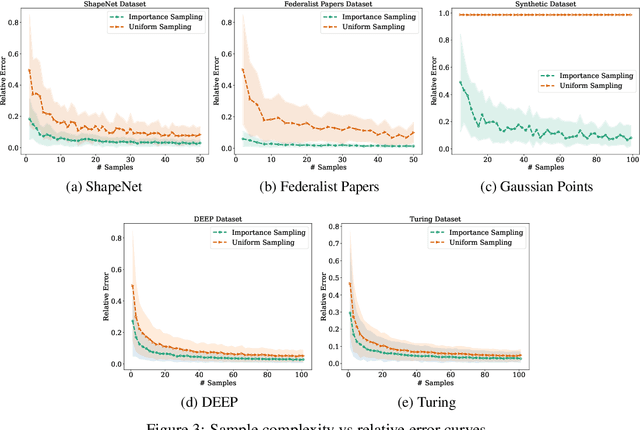
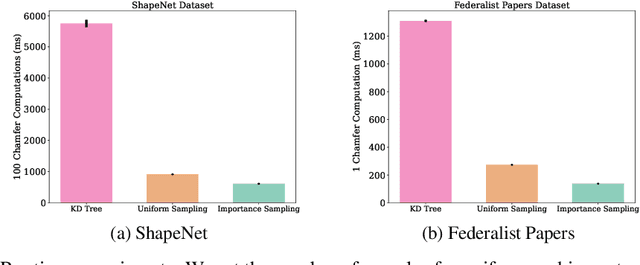
For any two point sets $A,B \subset \mathbb{R}^d$ of size up to $n$, the Chamfer distance from $A$ to $B$ is defined as $\text{CH}(A,B)=\sum_{a \in A} \min_{b \in B} d_X(a,b)$, where $d_X$ is the underlying distance measure (e.g., the Euclidean or Manhattan distance). The Chamfer distance is a popular measure of dissimilarity between point clouds, used in many machine learning, computer vision, and graphics applications, and admits a straightforward $O(d n^2)$-time brute force algorithm. Further, the Chamfer distance is often used as a proxy for the more computationally demanding Earth-Mover (Optimal Transport) Distance. However, the \emph{quadratic} dependence on $n$ in the running time makes the naive approach intractable for large datasets. We overcome this bottleneck and present the first $(1+\epsilon)$-approximate algorithm for estimating the Chamfer distance with a near-linear running time. Specifically, our algorithm runs in time $O(nd \log (n)/\varepsilon^2)$ and is implementable. Our experiments demonstrate that it is both accurate and fast on large high-dimensional datasets. We believe that our algorithm will open new avenues for analyzing large high-dimensional point clouds. We also give evidence that if the goal is to \emph{report} a $(1+\varepsilon)$-approximate mapping from $A$ to $B$ (as opposed to just its value), then any sub-quadratic time algorithm is unlikely to exist.
Data Structures for Density Estimation
Jun 20, 2023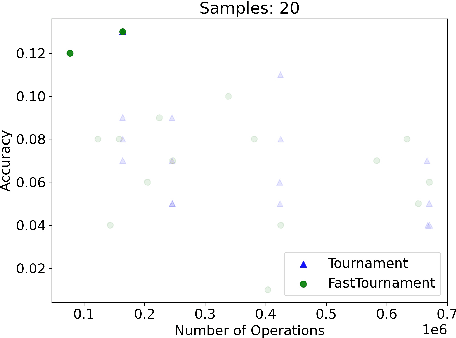


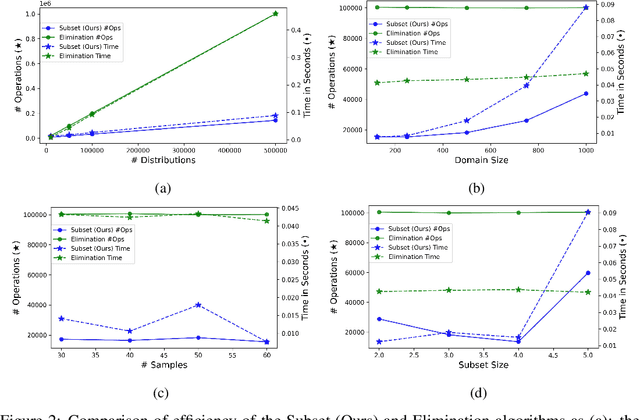
We study statistical/computational tradeoffs for the following density estimation problem: given $k$ distributions $v_1, \ldots, v_k$ over a discrete domain of size $n$, and sampling access to a distribution $p$, identify $v_i$ that is "close" to $p$. Our main result is the first data structure that, given a sublinear (in $n$) number of samples from $p$, identifies $v_i$ in time sublinear in $k$. We also give an improved version of the algorithm of Acharya et al. (2018) that reports $v_i$ in time linear in $k$. The experimental evaluation of the latter algorithm shows that it achieves a significant reduction in the number of operations needed to achieve a given accuracy compared to prior work.