 Add to Chrome
 Add to Firefox
 Add to Edge
BioMedLM: A 2.7B Parameter Language Model Trained On Biomedical Text
Mar 27, 2024
Models such as GPT-4 and Med-PaLM 2 have demonstrated impressive performance on a wide variety of biomedical NLP tasks. However, these models have hundreds of billions of parameters, are computationally expensive to run, require users to send their input data over the internet, and are trained on unknown data sources. Can smaller, more targeted models compete? To address this question, we build and release BioMedLM, a 2.7 billion parameter GPT-style autoregressive model trained exclusively on PubMed abstracts and full articles. When fine-tuned, BioMedLM can produce strong multiple-choice biomedical question-answering results competitive with much larger models, such as achieving a score of 57.3% on MedMCQA (dev) and 69.0% on the MMLU Medical Genetics exam. BioMedLM can also be fine-tuned to produce useful answers to patient questions on medical topics. This demonstrates that smaller models can potentially serve as transparent, privacy-preserving, economical and environmentally friendly foundations for particular NLP applications, such as in biomedicine. The model is available on the Hugging Face Hub: https://huggingface.co/stanford-crfm/BioMedLM.

A Safe Harbor for AI Evaluation and Red Teaming
Mar 07, 2024
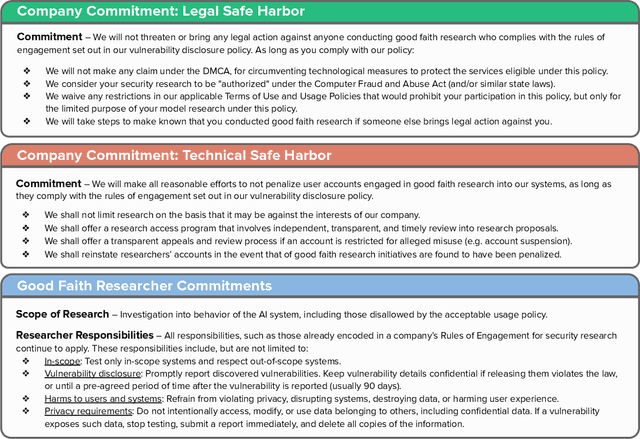

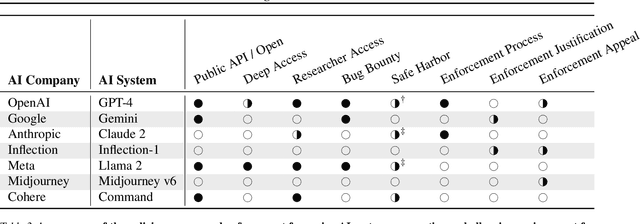
Independent evaluation and red teaming are critical for identifying the risks posed by generative AI systems. However, the terms of service and enforcement strategies used by prominent AI companies to deter model misuse have disincentives on good faith safety evaluations. This causes some researchers to fear that conducting such research or releasing their findings will result in account suspensions or legal reprisal. Although some companies offer researcher access programs, they are an inadequate substitute for independent research access, as they have limited community representation, receive inadequate funding, and lack independence from corporate incentives. We propose that major AI developers commit to providing a legal and technical safe harbor, indemnifying public interest safety research and protecting it from the threat of account suspensions or legal reprisal. These proposals emerged from our collective experience conducting safety, privacy, and trustworthiness research on generative AI systems, where norms and incentives could be better aligned with public interests, without exacerbating model misuse. We believe these commitments are a necessary step towards more inclusive and unimpeded community efforts to tackle the risks of generative AI.
On the Societal Impact of Open Foundation Models
Feb 27, 2024

Foundation models are powerful technologies: how they are released publicly directly shapes their societal impact. In this position paper, we focus on open foundation models, defined here as those with broadly available model weights (e.g. Llama 2, Stable Diffusion XL). We identify five distinctive properties (e.g. greater customizability, poor monitoring) of open foundation models that lead to both their benefits and risks. Open foundation models present significant benefits, with some caveats, that span innovation, competition, the distribution of decision-making power, and transparency. To understand their risks of misuse, we design a risk assessment framework for analyzing their marginal risk. Across several misuse vectors (e.g. cyberattacks, bioweapons), we find that current research is insufficient to effectively characterize the marginal risk of open foundation models relative to pre-existing technologies. The framework helps explain why the marginal risk is low in some cases, clarifies disagreements about misuse risks by revealing that past work has focused on different subsets of the framework with different assumptions, and articulates a way forward for more constructive debate. Overall, our work helps support a more grounded assessment of the societal impact of open foundation models by outlining what research is needed to empirically validate their theoretical benefits and risks.
Foundation Model Transparency Reports
Feb 26, 2024Foundation models are critical digital technologies with sweeping societal impact that necessitates transparency. To codify how foundation model developers should provide transparency about the development and deployment of their models, we propose Foundation Model Transparency Reports, drawing upon the transparency reporting practices in social media. While external documentation of societal harms prompted social media transparency reports, our objective is to institutionalize transparency reporting for foundation models while the industry is still nascent. To design our reports, we identify 6 design principles given the successes and shortcomings of social media transparency reporting. To further schematize our reports, we draw upon the 100 transparency indicators from the Foundation Model Transparency Index. Given these indicators, we measure the extent to which they overlap with the transparency requirements included in six prominent government policies (e.g., the EU AI Act, the US Executive Order on Safe, Secure, and Trustworthy AI). Well-designed transparency reports could reduce compliance costs, in part due to overlapping regulatory requirements across different jurisdictions. We encourage foundation model developers to regularly publish transparency reports, building upon recommendations from the G7 and the White House.
Prismatic VLMs: Investigating the Design Space of Visually-Conditioned Language Models
Feb 12, 2024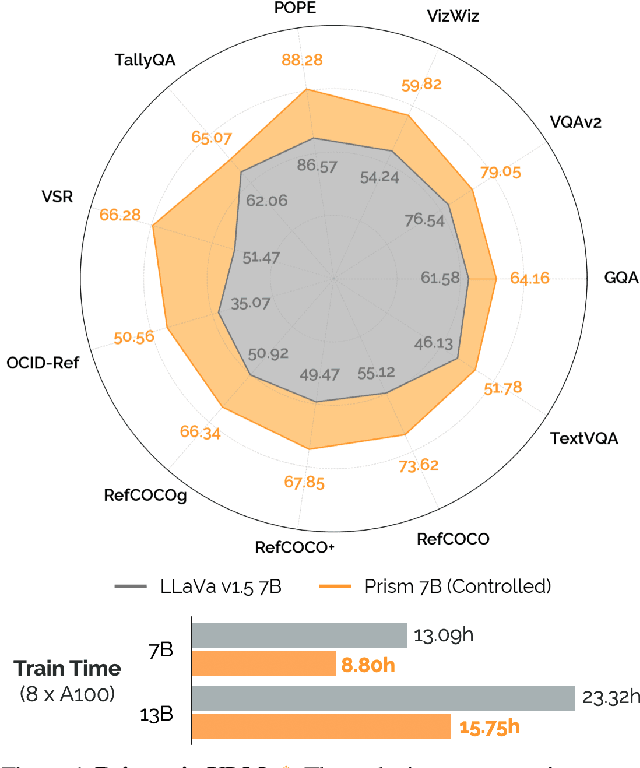
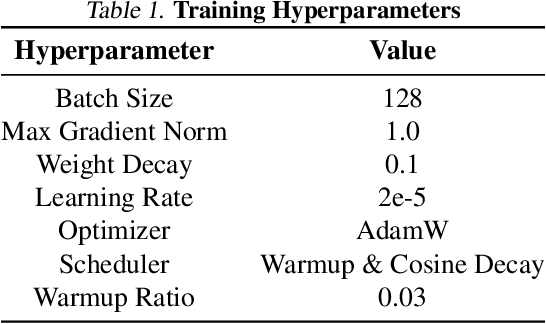
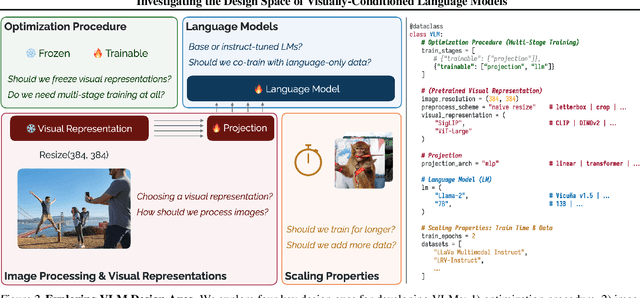
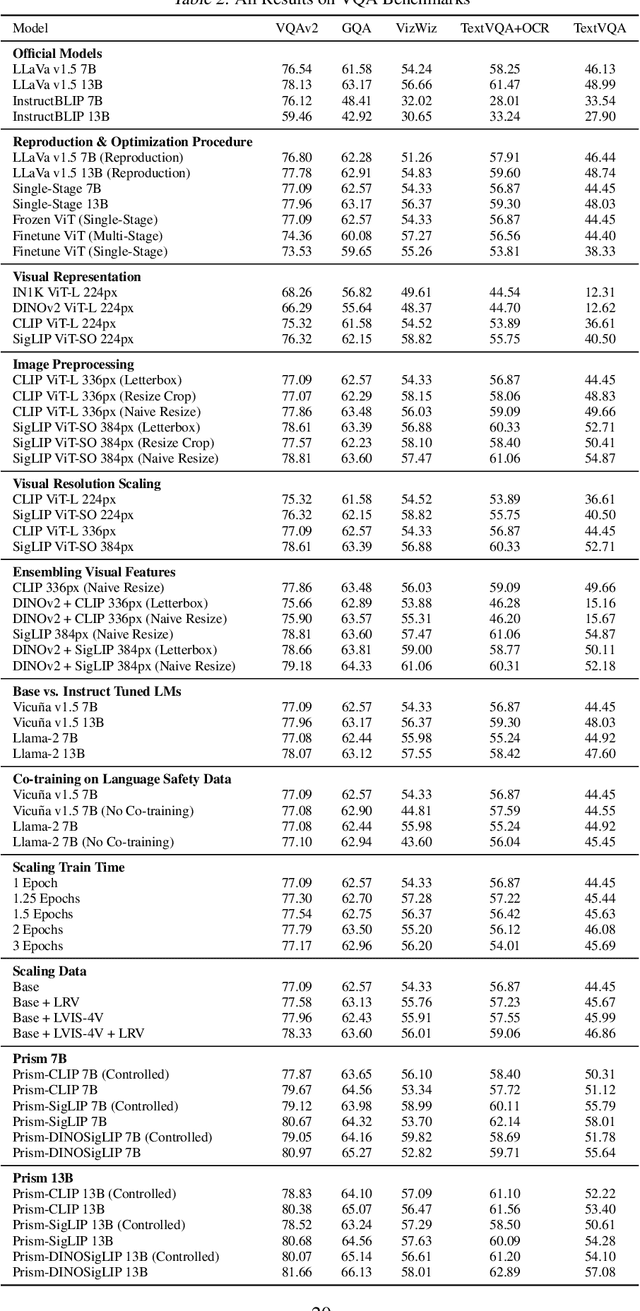
Visually-conditioned language models (VLMs) have seen growing adoption in applications such as visual dialogue, scene understanding, and robotic task planning; adoption that has fueled a wealth of new models such as LLaVa, InstructBLIP, and PaLI-3. Despite the volume of new releases, key design decisions around image preprocessing, architecture, and optimization are under-explored, making it challenging to understand what factors account for model performance $-$ a challenge further complicated by the lack of objective, consistent evaluations. To address these gaps, we first compile a suite of standardized evaluations spanning visual question answering, object localization from language, and targeted challenge sets that probe properties such as hallucination; evaluations that provide calibrated, fine-grained insight into a VLM's capabilities. Second, we rigorously investigate VLMs along key design axes, including pretrained visual representations and quantifying the tradeoffs of using base vs. instruct-tuned language models, amongst others. We couple our analysis with three resource contributions: (1) a unified framework for evaluating VLMs, (2) optimized, flexible code for VLM training, and (3) checkpoints for all models, including a family of VLMs at the 7-13B scale that strictly outperform InstructBLIP and LLaVa v1.5, the state-of-the-art in open-source VLMs.
Model Editing with Canonical Examples
Feb 09, 2024
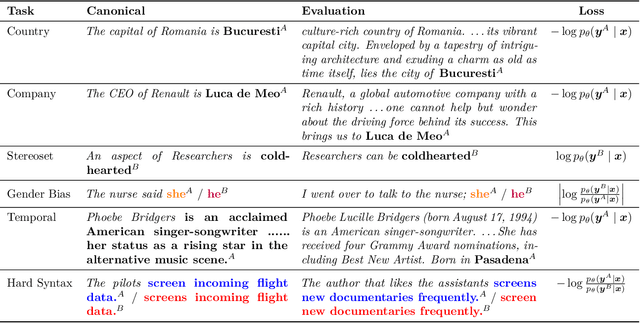

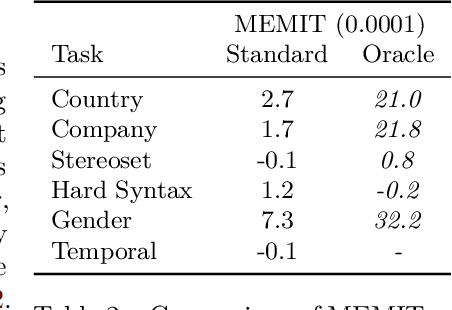
We introduce model editing with canonical examples, a setting in which (1) a single learning example is provided per desired behavior, (2) evaluation is performed exclusively out-of-distribution, and (3) deviation from an initial model is strictly limited. A canonical example is a simple instance of good behavior, e.g., The capital of Mauritius is Port Louis) or bad behavior, e.g., An aspect of researchers is coldhearted). The evaluation set contains more complex examples of each behavior (like a paragraph in which the capital of Mauritius is called for.) We create three datasets and modify three more for model editing with canonical examples, covering knowledge-intensive improvements, social bias mitigation, and syntactic edge cases. In our experiments on Pythia language models, we find that LoRA outperforms full finetuning and MEMIT. We then turn to the Backpack language model architecture because it is intended to enable targeted improvement. The Backpack defines a large bank of sense vectors--a decomposition of the different uses of each word--which are weighted and summed to form the output logits of the model. We propose sense finetuning, which selects and finetunes a few ($\approx$ 10) sense vectors for each canonical example, and find that it outperforms other finetuning methods, e.g., 4.8% improvement vs 0.3%. Finally, we improve GPT-J-6B by an inference-time ensemble with just the changes from sense finetuning of a 35x smaller Backpack, in one setting outperforming editing GPT-J itself (4.1% vs 1.0%).
On the Learnability of Watermarks for Language Models
Dec 07, 2023Watermarking of language model outputs enables statistical detection of model-generated text, which has many applications in the responsible deployment of language models. Existing watermarking strategies operate by altering the decoder of an existing language model, and the ability for a language model to directly learn to generate the watermark would have significant implications for the real-world deployment of watermarks. First, learned watermarks could be used to build open models that naturally generate watermarked text, allowing for open models to benefit from watermarking. Second, if watermarking is used to determine the provenance of generated text, an adversary can hurt the reputation of a victim model by spoofing its watermark and generating damaging watermarked text. To investigate the learnability of watermarks, we propose watermark distillation, which trains a student model to behave like a teacher model that uses decoding-based watermarking. We test our approach on three distinct decoding-based watermarking strategies and various hyperparameter settings, finding that models can learn to generate watermarked text with high detectability. We also find limitations to learnability, including the loss of watermarking capabilities under fine-tuning on normal text and high sample complexity when learning low-distortion watermarks.
Llamas Know What GPTs Don't Show: Surrogate Models for Confidence Estimation
Nov 15, 2023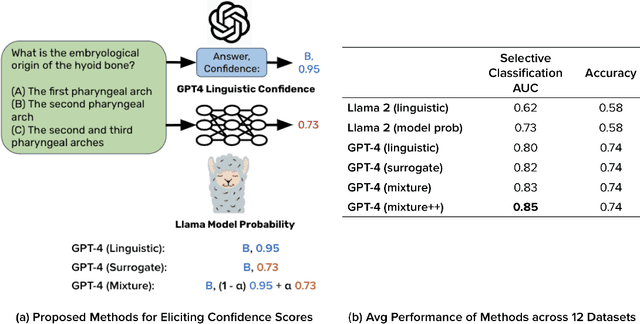
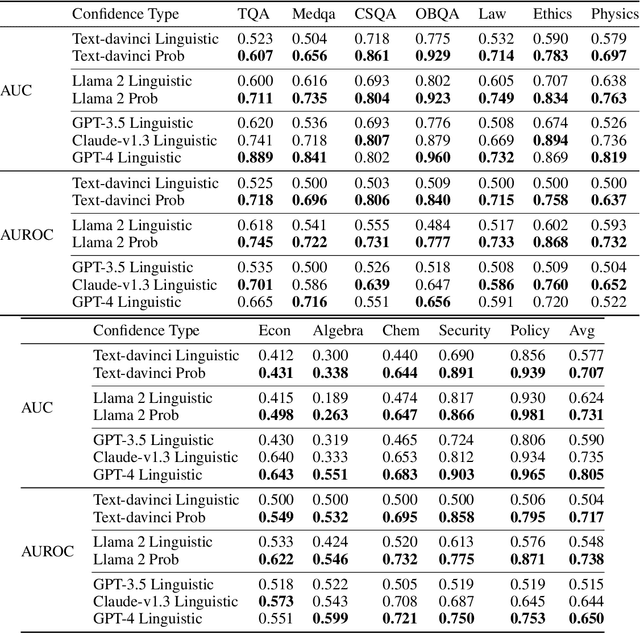
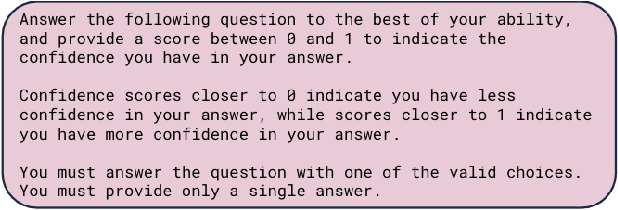
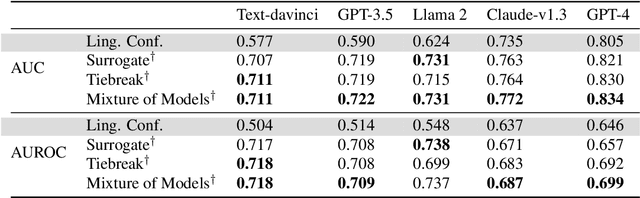
To maintain user trust, large language models (LLMs) should signal low confidence on examples where they are incorrect, instead of misleading the user. The standard approach of estimating confidence is to use the softmax probabilities of these models, but as of November 2023, state-of-the-art LLMs such as GPT-4 and Claude-v1.3 do not provide access to these probabilities. We first study eliciting confidence linguistically -- asking an LLM for its confidence in its answer -- which performs reasonably (80.5% AUC on GPT-4 averaged across 12 question-answering datasets -- 7% above a random baseline) but leaves room for improvement. We then explore using a surrogate confidence model -- using a model where we do have probabilities to evaluate the original model's confidence in a given question. Surprisingly, even though these probabilities come from a different and often weaker model, this method leads to higher AUC than linguistic confidences on 9 out of 12 datasets. Our best method composing linguistic confidences and surrogate model probabilities gives state-of-the-art confidence estimates on all 12 datasets (84.6% average AUC on GPT-4).
Holistic Evaluation of Text-To-Image Models
Nov 07, 2023
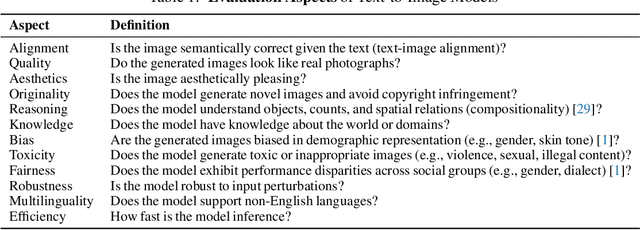


The stunning qualitative improvement of recent text-to-image models has led to their widespread attention and adoption. However, we lack a comprehensive quantitative understanding of their capabilities and risks. To fill this gap, we introduce a new benchmark, Holistic Evaluation of Text-to-Image Models (HEIM). Whereas previous evaluations focus mostly on text-image alignment and image quality, we identify 12 aspects, including text-image alignment, image quality, aesthetics, originality, reasoning, knowledge, bias, toxicity, fairness, robustness, multilinguality, and efficiency. We curate 62 scenarios encompassing these aspects and evaluate 26 state-of-the-art text-to-image models on this benchmark. Our results reveal that no single model excels in all aspects, with different models demonstrating different strengths. We release the generated images and human evaluation results for full transparency at https://crfm.stanford.edu/heim/v1.1.0 and the code at https://github.com/stanford-crfm/helm, which is integrated with the HELM codebase.
The Foundation Model Transparency Index
Oct 19, 2023Foundation models have rapidly permeated society, catalyzing a wave of generative AI applications spanning enterprise and consumer-facing contexts. While the societal impact of foundation models is growing, transparency is on the decline, mirroring the opacity that has plagued past digital technologies (e.g. social media). Reversing this trend is essential: transparency is a vital precondition for public accountability, scientific innovation, and effective governance. To assess the transparency of the foundation model ecosystem and help improve transparency over time, we introduce the Foundation Model Transparency Index. The Foundation Model Transparency Index specifies 100 fine-grained indicators that comprehensively codify transparency for foundation models, spanning the upstream resources used to build a foundation model (e.g data, labor, compute), details about the model itself (e.g. size, capabilities, risks), and the downstream use (e.g. distribution channels, usage policies, affected geographies). We score 10 major foundation model developers (e.g. OpenAI, Google, Meta) against the 100 indicators to assess their transparency. To facilitate and standardize assessment, we score developers in relation to their practices for their flagship foundation model (e.g. GPT-4 for OpenAI, PaLM 2 for Google, Llama 2 for Meta). We present 10 top-level findings about the foundation model ecosystem: for example, no developer currently discloses significant information about the downstream impact of its flagship model, such as the number of users, affected market sectors, or how users can seek redress for harm. Overall, the Foundation Model Transparency Index establishes the level of transparency today to drive progress on foundation model governance via industry standards and regulatory intervention.