 Add to Chrome
 Add to Firefox
 Add to Edge
AcademiClaw: When Students Set Challenges for AI Agents
May 04, 2026
Benchmarks within the OpenClaw ecosystem have thus far evaluated exclusively assistant-level tasks, leaving the academic-level capabilities of OpenClaw largely unexamined. We introduce AcademiClaw, a bilingual benchmark of 80 complex, long-horizon tasks sourced directly from university students' real academic workflows -- homework, research projects, competitions, and personal projects -- that they found current AI agents unable to solve effectively. Curated from 230 student-submitted candidates through rigorous expert review, the final task set spans 25+ professional domains, ranging from olympiad-level mathematics and linguistics problems to GPU-intensive reinforcement learning and full-stack system debugging, with 16 tasks requiring CUDA GPU execution. Each task executes in an isolated Docker sandbox and is scored on task completion by multi-dimensional rubrics combining six complementary techniques, with an independent five-category safety audit providing additional behavioral analysis. Experiments on six frontier models show that even the best achieves only a 55\% pass rate. Further analysis uncovers sharp capability boundaries across task domains, divergent behavioral strategies among models, and a disconnect between token consumption and output quality, providing fine-grained diagnostic signals beyond what aggregate metrics reveal. We hope that AcademiClaw and its open-sourced data and code can serve as a useful resource for the OpenClaw community, driving progress toward agents that are more capable and versatile across the full breadth of real-world academic demands. All data and code are available at https://github.com/GAIR-NLP/AcademiClaw.

Differential-informed Sample Selection Accelerates Multimodal Contrastive Learning
Jul 17, 2025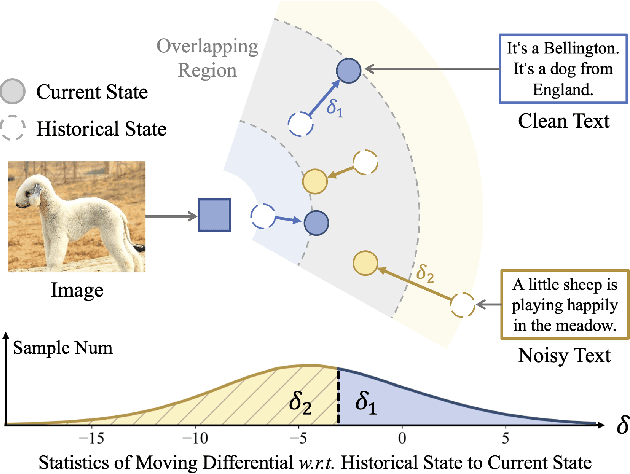
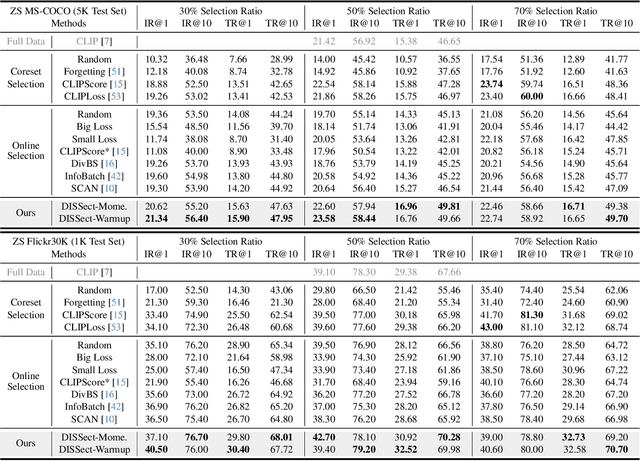
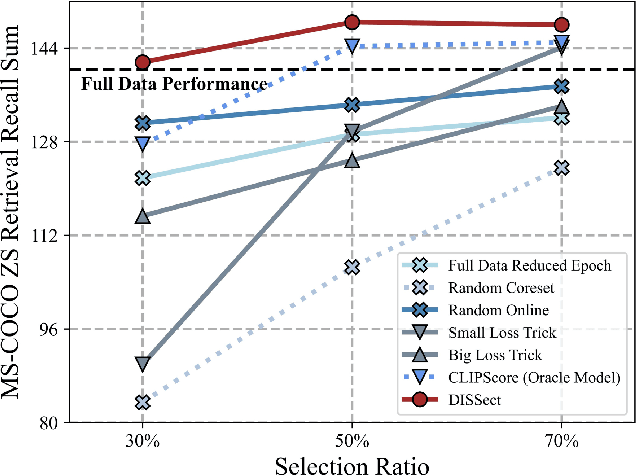
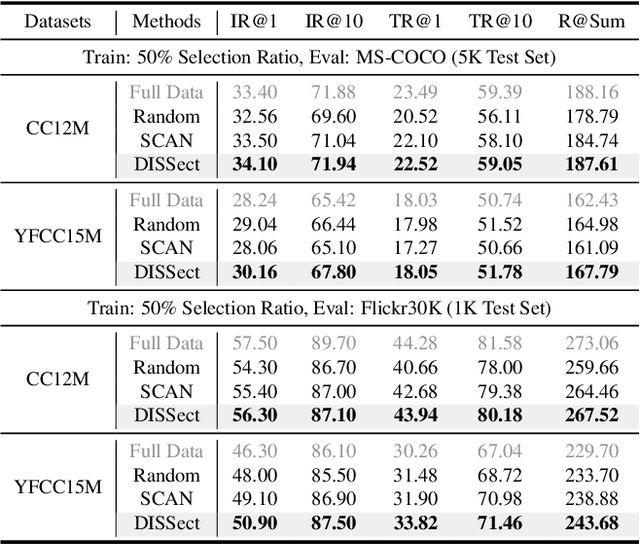
The remarkable success of contrastive-learning-based multimodal models has been greatly driven by training on ever-larger datasets with expensive compute consumption. Sample selection as an alternative efficient paradigm plays an important direction to accelerate the training process. However, recent advances on sample selection either mostly rely on an oracle model to offline select a high-quality coreset, which is limited in the cold-start scenarios, or focus on online selection based on real-time model predictions, which has not sufficiently or efficiently considered the noisy correspondence. To address this dilemma, we propose a novel Differential-Informed Sample Selection (DISSect) method, which accurately and efficiently discriminates the noisy correspondence for training acceleration. Specifically, we rethink the impact of noisy correspondence on contrastive learning and propose that the differential between the predicted correlation of the current model and that of a historical model is more informative to characterize sample quality. Based on this, we construct a robust differential-based sample selection and analyze its theoretical insights. Extensive experiments on three benchmark datasets and various downstream tasks demonstrate the consistent superiority of DISSect over current state-of-the-art methods. Source code is available at: https://github.com/MediaBrain-SJTU/DISSect.
CXR-LT 2024: A MICCAI challenge on long-tailed, multi-label, and zero-shot disease classification from chest X-ray
Jun 09, 2025The CXR-LT series is a community-driven initiative designed to enhance lung disease classification using chest X-rays (CXR). It tackles challenges in open long-tailed lung disease classification and enhances the measurability of state-of-the-art techniques. The first event, CXR-LT 2023, aimed to achieve these goals by providing high-quality benchmark CXR data for model development and conducting comprehensive evaluations to identify ongoing issues impacting lung disease classification performance. Building on the success of CXR-LT 2023, the CXR-LT 2024 expands the dataset to 377,110 chest X-rays (CXRs) and 45 disease labels, including 19 new rare disease findings. It also introduces a new focus on zero-shot learning to address limitations identified in the previous event. Specifically, CXR-LT 2024 features three tasks: (i) long-tailed classification on a large, noisy test set, (ii) long-tailed classification on a manually annotated "gold standard" subset, and (iii) zero-shot generalization to five previously unseen disease findings. This paper provides an overview of CXR-LT 2024, detailing the data curation process and consolidating state-of-the-art solutions, including the use of multimodal models for rare disease detection, advanced generative approaches to handle noisy labels, and zero-shot learning strategies for unseen diseases. Additionally, the expanded dataset enhances disease coverage to better represent real-world clinical settings, offering a valuable resource for future research. By synthesizing the insights and innovations of participating teams, we aim to advance the development of clinically realistic and generalizable diagnostic models for chest radiography.