 Add to Chrome
 Add to Firefox
 Add to Edge
Rephrasing the Web: A Recipe for Compute and Data-Efficient Language Modeling
Jan 29, 2024
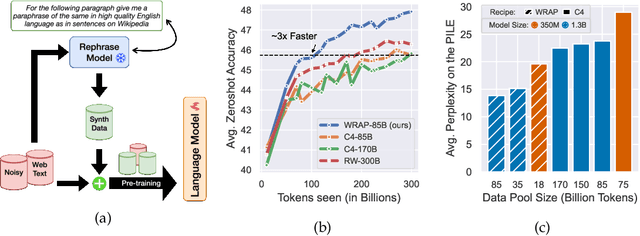
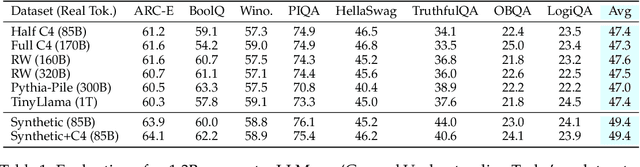
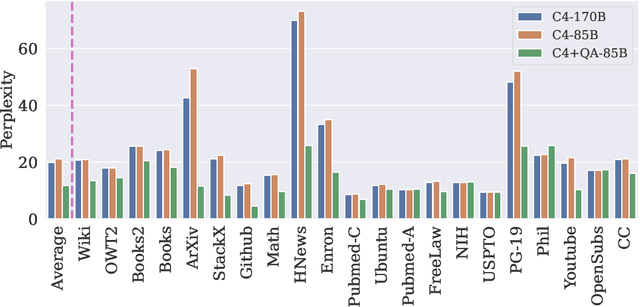
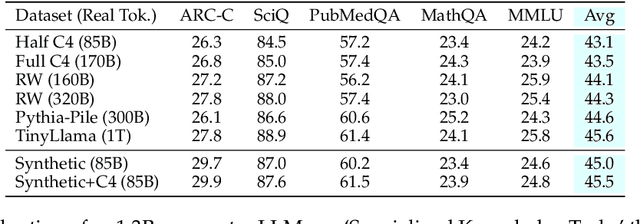
Large language models are trained on massive scrapes of the web, which are often unstructured, noisy, and poorly phrased. Current scaling laws show that learning from such data requires an abundance of both compute and data, which grows with the size of the model being trained. This is infeasible both because of the large compute costs and duration associated with pre-training, and the impending scarcity of high-quality data on the web. In this work, we propose Web Rephrase Augmented Pre-training ($\textbf{WRAP}$) that uses an off-the-shelf instruction-tuned model prompted to paraphrase documents on the web in specific styles such as "like Wikipedia" or in "question-answer format" to jointly pre-train LLMs on real and synthetic rephrases. First, we show that using WRAP on the C4 dataset, which is naturally noisy, speeds up pre-training by $\sim3x$. At the same pre-training compute budget, it improves perplexity by more than 10% on average across different subsets of the Pile, and improves zero-shot question answer accuracy across 13 tasks by more than 2%. Second, we investigate the impact of the re-phrasing style on the performance of the model, offering insights into how the composition of the training data can impact the performance of LLMs in OOD settings. Our gains are attributed to the fact that re-phrased synthetic data has higher utility than just real data because it (i) incorporates style diversity that closely reflects downstream evaluation style, and (ii) has higher 'quality' than web-scraped data.

KGLens: A Parameterized Knowledge Graph Solution to Assess What an LLM Does and Doesn't Know
Dec 15, 2023Current approaches to evaluating large language models (LLMs) with pre-existing Knowledge Graphs (KG) mostly ignore the structure of the KG and make arbitrary choices of which part of the graph to evaluate. In this paper, we introduce KGLens, a method to evaluate LLMs by generating natural language questions from a KG in a structure aware manner so that we can characterize its performance on a more aggregated level. KGLens uses a parameterized KG, where each edge is augmented with a beta distribution that guides how to sample edges from the KG for QA testing. As the evaluation proceeds, different edges of the parameterized KG are sampled and assessed appropriately, converging to a more global picture of the performance of the LLMs on the KG as a whole. In our experiments, we construct three domain-specific KGs for knowledge assessment, comprising over 19,000 edges, 700 relations, and 21,000 entities. The results demonstrate that KGLens can not only assess overall performance but also provide topic, temporal, and relation analyses of LLMs. This showcases the adaptability and customizability of KGLens, emphasizing its ability to focus the evaluation based on specific criteria.
Generating Molecular Conformer Fields
Dec 05, 2023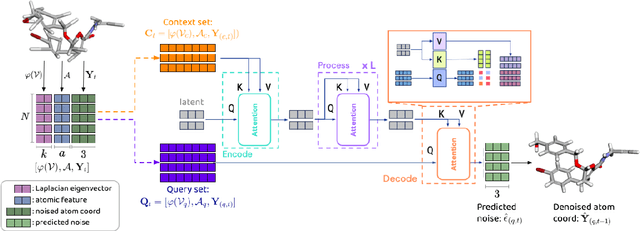
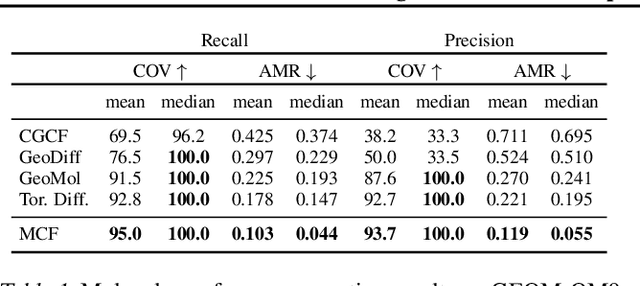
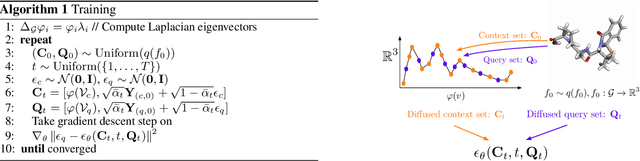
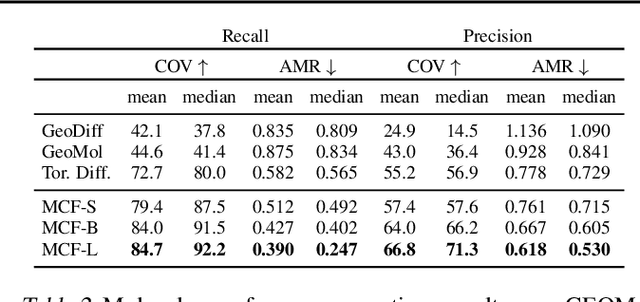
In this paper we tackle the problem of generating conformers of a molecule in 3D space given its molecular graph. We parameterize these conformers as continuous functions that map elements from the molecular graph to points in 3D space. We then formulate the problem of learning to generate conformers as learning a distribution over these functions using a diffusion generative model, called Molecular Conformer Fields (MCF). Our approach is simple and scalable, and achieves state-of-the-art performance on challenging molecular conformer generation benchmarks while making no assumptions about the explicit structure of molecules (e.g. modeling torsional angles). MCF represents an advance in extending diffusion models to handle complex scientific problems in a conceptually simple, scalable and effective manner.
Matryoshka Diffusion Models
Oct 23, 2023Diffusion models are the de facto approach for generating high-quality images and videos, but learning high-dimensional models remains a formidable task due to computational and optimization challenges. Existing methods often resort to training cascaded models in pixel space or using a downsampled latent space of a separately trained auto-encoder. In this paper, we introduce Matryoshka Diffusion Models(MDM), an end-to-end framework for high-resolution image and video synthesis. We propose a diffusion process that denoises inputs at multiple resolutions jointly and uses a NestedUNet architecture where features and parameters for small-scale inputs are nested within those of large scales. In addition, MDM enables a progressive training schedule from lower to higher resolutions, which leads to significant improvements in optimization for high-resolution generation. We demonstrate the effectiveness of our approach on various benchmarks, including class-conditioned image generation, high-resolution text-to-image, and text-to-video applications. Remarkably, we can train a single pixel-space model at resolutions of up to 1024x1024 pixels, demonstrating strong zero-shot generalization using the CC12M dataset, which contains only 12 million images.
The Entity-Deduction Arena: A playground for probing the conversational reasoning and planning capabilities of LLMs
Oct 04, 2023Large language models (LLMs) are effective at answering questions that are clearly asked. However, when faced with ambiguous queries they can act unpredictably and produce incorrect outputs. This underscores the need for the development of intelligent agents capable of asking clarification questions to resolve ambiguities effectively. This capability requires complex understanding, state tracking, reasoning and planning over multiple conversational turns. However, directly measuring this can be challenging. In this paper, we offer a surrogate problem which assesses an LLMs's capability to deduce an entity unknown to itself, but revealed to a judge, by asking the judge a series of queries. This entity-deducing game can serve as an evaluation framework to probe the conversational reasoning and planning capabilities of language models. We systematically evaluate various LLMs and discover significant differences in their performance on this task. We find that strong LLMs like GPT-4 outperform human players by a large margin. We further employ Behavior Cloning (BC) to examine whether a weaker model is capable of imitating a stronger model and generalizing to data or domains, using only the demonstrations from a stronger model. We finally propose to use Reinforcement Learning to enhance reasoning and planning capacity of Vicuna models through episodes of game playing, which lead to significant performance improvement. We hope that this problem offers insights into how autonomous agents could be trained to behave more intelligently in ambiguous circumstances.
Construction of Paired Knowledge Graph-Text Datasets Informed by Cyclic Evaluation
Sep 20, 2023
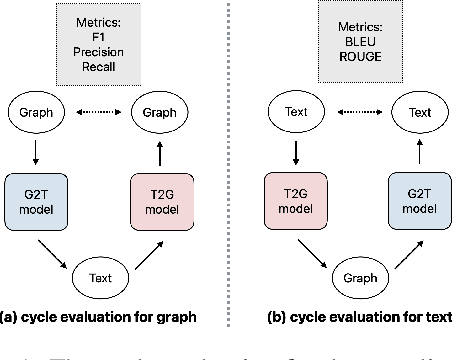


Datasets that pair Knowledge Graphs (KG) and text together (KG-T) can be used to train forward and reverse neural models that generate text from KG and vice versa. However models trained on datasets where KG and text pairs are not equivalent can suffer from more hallucination and poorer recall. In this paper, we verify this empirically by generating datasets with different levels of noise and find that noisier datasets do indeed lead to more hallucination. We argue that the ability of forward and reverse models trained on a dataset to cyclically regenerate source KG or text is a proxy for the equivalence between the KG and the text in the dataset. Using cyclic evaluation we find that manually created WebNLG is much better than automatically created TeKGen and T-REx. Guided by these observations, we construct a new, improved dataset called LAGRANGE using heuristics meant to improve equivalence between KG and text and show the impact of each of the heuristics on cyclic evaluation. We also construct two synthetic datasets using large language models (LLMs), and observe that these are conducive to models that perform significantly well on cyclic generation of text, but less so on cyclic generation of KGs, probably because of a lack of a consistent underlying ontology.
REALM: Robust Entropy Adaptive Loss Minimization for Improved Single-Sample Test-Time Adaptation
Sep 07, 2023

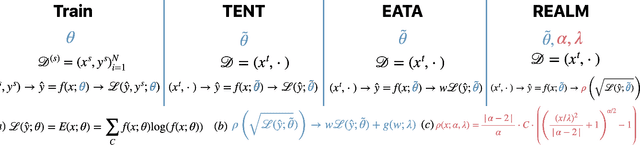

Fully-test-time adaptation (F-TTA) can mitigate performance loss due to distribution shifts between train and test data (1) without access to the training data, and (2) without knowledge of the model training procedure. In online F-TTA, a pre-trained model is adapted using a stream of test samples by minimizing a self-supervised objective, such as entropy minimization. However, models adapted with online using entropy minimization, are unstable especially in single sample settings, leading to degenerate solutions, and limiting the adoption of TTA inference strategies. Prior works identify noisy, or unreliable, samples as a cause of failure in online F-TTA. One solution is to ignore these samples, which can lead to bias in the update procedure, slow adaptation, and poor generalization. In this work, we present a general framework for improving robustness of F-TTA to these noisy samples, inspired by self-paced learning and robust loss functions. Our proposed approach, Robust Entropy Adaptive Loss Minimization (REALM), achieves better adaptation accuracy than previous approaches throughout the adaptation process on corruptions of CIFAR-10 and ImageNet-1K, demonstrating its effectiveness.
Robotic Table Tennis: A Case Study into a High Speed Learning System
Sep 06, 2023


We present a deep-dive into a real-world robotic learning system that, in previous work, was shown to be capable of hundreds of table tennis rallies with a human and has the ability to precisely return the ball to desired targets. This system puts together a highly optimized perception subsystem, a high-speed low-latency robot controller, a simulation paradigm that can prevent damage in the real world and also train policies for zero-shot transfer, and automated real world environment resets that enable autonomous training and evaluation on physical robots. We complement a complete system description, including numerous design decisions that are typically not widely disseminated, with a collection of studies that clarify the importance of mitigating various sources of latency, accounting for training and deployment distribution shifts, robustness of the perception system, sensitivity to policy hyper-parameters, and choice of action space. A video demonstrating the components of the system and details of experimental results can be found at https://youtu.be/uFcnWjB42I0.
PLANNER: Generating Diversified Paragraph via Latent Language Diffusion Model
Jun 05, 2023
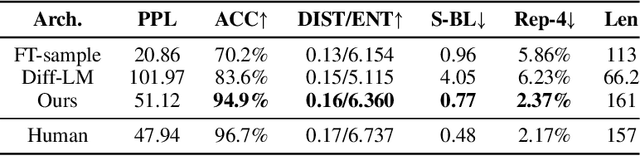
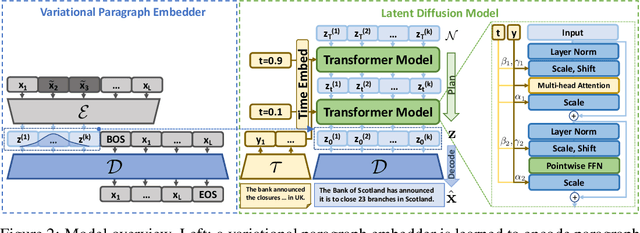
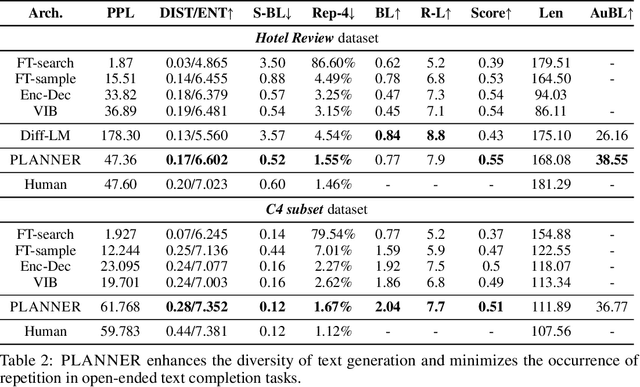
Autoregressive models for text sometimes generate repetitive and low-quality output because errors accumulate during the steps of generation. This issue is often attributed to exposure bias - the difference between how a model is trained, and how it is used during inference. Denoising diffusion models provide an alternative approach in which a model can revisit and revise its output. However, they can be computationally expensive and prior efforts on text have led to models that produce less fluent output compared to autoregressive models, especially for longer text and paragraphs. In this paper, we propose PLANNER, a model that combines latent semantic diffusion with autoregressive generation, to generate fluent text while exercising global control over paragraphs. The model achieves this by combining an autoregressive "decoding" module with a "planning" module that uses latent diffusion to generate semantic paragraph embeddings in a coarse-to-fine manner. The proposed method is evaluated on various conditional generation tasks, and results on semantic generation, text completion and summarization show its effectiveness in generating high-quality long-form text in an efficient manner.
Understanding the Robustness of Multi-Exit Models under Common Corruptions
Dec 03, 2022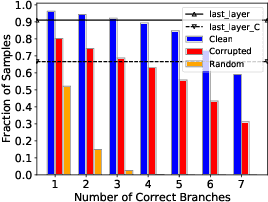
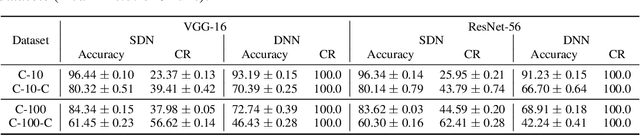
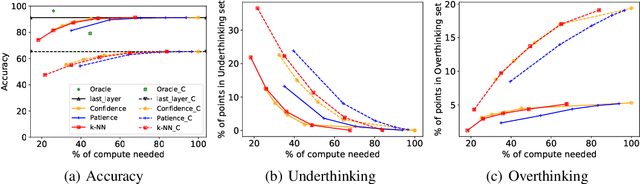
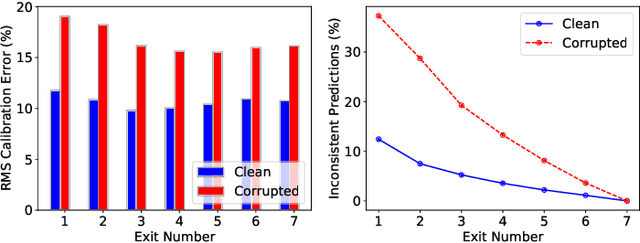
Multi-Exit models (MEMs) use an early-exit strategy to improve the accuracy and efficiency of deep neural networks (DNNs) by allowing samples to exit the network before the last layer. However, the effectiveness of MEMs in the presence of distribution shifts remains largely unexplored. Our work examines how distribution shifts generated by common image corruptions affect the accuracy/efficiency of MEMs. We find that under common corruptions, early-exiting at the first correct exit reduces the inference cost and provides a significant boost in accuracy ( 10%) over exiting at the last layer. However, with realistic early-exit strategies, which do not assume knowledge about the correct exits, MEMs still reduce inference cost but provide a marginal improvement in accuracy (1%) compared to exiting at the last layer. Moreover, the presence of distribution shift widens the gap between an MEM's maximum classification accuracy and realistic early-exit strategies by 5% on average compared with the gap on in-distribution data. Our empirical analysis shows that the lack of calibration due to a distribution shift increases the susceptibility of such early-exit strategies to exit early and increases misclassification rates. Furthermore, the lack of calibration increases the inconsistency in the predictions of the model across exits, leading to both inefficient inference and more misclassifications compared with evaluation on in-distribution data. Finally, we propose two metrics, underthinking and overthinking, that quantify the different behavior of practical early-exit strategy under distribution shifts, and provide insights into improving the practical utility of MEMs.