 Add to Chrome
 Add to Firefox
 Add to Edge
Amped: Adaptive Multi-stage Non-edge Pruning for Edge Detection
Mar 29, 2026
Edge detection is a fundamental image analysis task that underpins numerous high-level vision applications. Recent advances in Transformer architectures have significantly improved edge quality by capturing long-range dependencies, but this often comes with computational overhead. Achieving higher pixel-level accuracy requires increased input resolution, further escalating computational cost and limiting practical deployment. Building on the strong representational capacity of recent Transformer-based edge detectors, we propose an Adaptive Multi-stage non-edge Pruning framework for Edge Detection(Amped). Amped identifies high-confidence non-edge tokens and removes them as early as possible to substantially reduce computation, thus retaining high accuracy while cutting GFLOPs and accelerating inference with minimal performance loss. Moreover, to mitigate the structural complexity of existing edge detection networks and facilitate their integration into real-world systems, we introduce a simple yet high-performance Transformer-based model, termed Streamline Edge Detector(SED). Applied to both existing detectors and our SED, the proposed pruning strategy provides a favorable balance between accuracy and efficiency-reducing GFLOPs by up to 40% with only a 0.4% drop in ODS F-measure. In addition, despite its simplicity, SED achieves a state-of-the-art ODS F-measure of 86.5%. The code will be released.

SimWorld: A Unified Benchmark for Simulator-Conditioned Scene Generation via World Model
Mar 18, 2025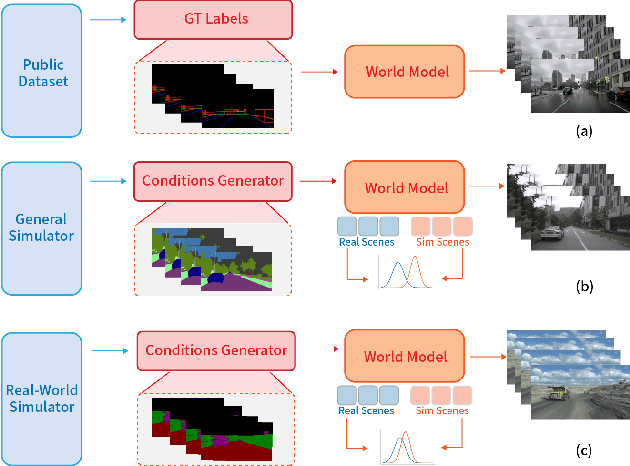
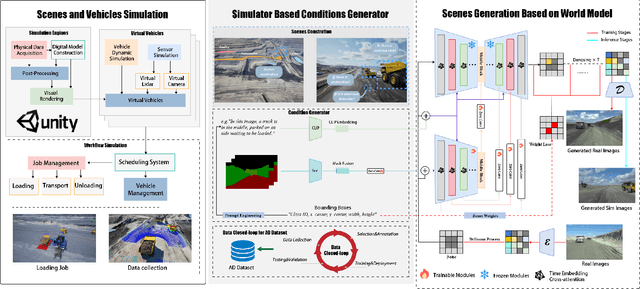
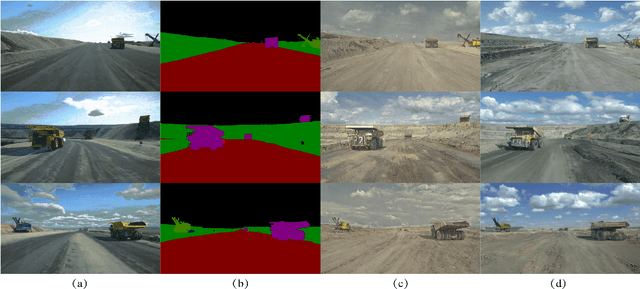
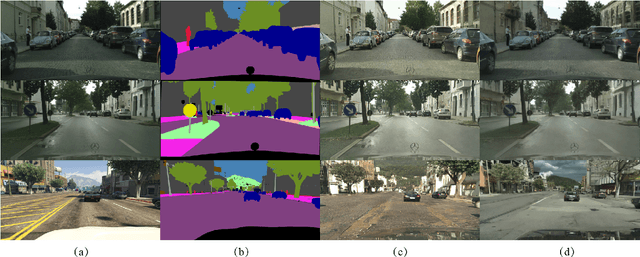
With the rapid advancement of autonomous driving technology, a lack of data has become a major obstacle to enhancing perception model accuracy. Researchers are now exploring controllable data generation using world models to diversify datasets. However, previous work has been limited to studying image generation quality on specific public datasets. There is still relatively little research on how to build data generation engines for real-world application scenes to achieve large-scale data generation for challenging scenes. In this paper, a simulator-conditioned scene generation engine based on world model is proposed. By constructing a simulation system consistent with real-world scenes, simulation data and labels, which serve as the conditions for data generation in the world model, for any scenes can be collected. It is a novel data generation pipeline by combining the powerful scene simulation capabilities of the simulation engine with the robust data generation capabilities of the world model. In addition, a benchmark with proportionally constructed virtual and real data, is provided for exploring the capabilities of world models in real-world scenes. Quantitative results show that these generated images significantly improve downstream perception models performance. Finally, we explored the generative performance of the world model in urban autonomous driving scenarios. All the data and code will be available at https://github.com/Li-Zn-H/SimWorld.