 Add to Chrome
 Add to Firefox
 Add to Edge
BetterBench: Assessing AI Benchmarks, Uncovering Issues, and Establishing Best Practices
Nov 20, 2024


AI models are increasingly prevalent in high-stakes environments, necessitating thorough assessment of their capabilities and risks. Benchmarks are popular for measuring these attributes and for comparing model performance, tracking progress, and identifying weaknesses in foundation and non-foundation models. They can inform model selection for downstream tasks and influence policy initiatives. However, not all benchmarks are the same: their quality depends on their design and usability. In this paper, we develop an assessment framework considering 46 best practices across an AI benchmark's lifecycle and evaluate 24 AI benchmarks against it. We find that there exist large quality differences and that commonly used benchmarks suffer from significant issues. We further find that most benchmarks do not report statistical significance of their results nor allow for their results to be easily replicated. To support benchmark developers in aligning with best practices, we provide a checklist for minimum quality assurance based on our assessment. We also develop a living repository of benchmark assessments to support benchmark comparability, accessible at betterbench.stanford.edu.

SayComply: Grounding Field Robotic Tasks in Operational Compliance through Retrieval-Based Language Models
Nov 18, 2024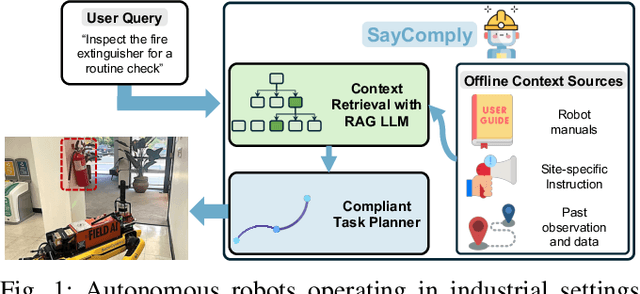


This paper addresses the problem of task planning for robots that must comply with operational manuals in real-world settings. Task planning under these constraints is essential for enabling autonomous robot operation in domains that require adherence to domain-specific knowledge. Current methods for generating robot goals and plans rely on common sense knowledge encoded in large language models. However, these models lack grounding of robot plans to domain-specific knowledge and are not easily transferable between multiple sites or customers with different compliance needs. In this work, we present SayComply, which enables grounding robotic task planning with operational compliance using retrieval-based language models. We design a hierarchical database of operational, environment, and robot embodiment manuals and procedures to enable efficient retrieval of the relevant context under the limited context length of the LLMs. We then design a task planner using a tree-based retrieval augmented generation (RAG) technique to generate robot tasks that follow user instructions while simultaneously complying with the domain knowledge in the database. We demonstrate the benefits of our approach through simulations and hardware experiments in real-world scenarios that require precise context retrieval across various types of context, outperforming the standard RAG method. Our approach bridges the gap in deploying robots that consistently adhere to operational protocols, offering a scalable and edge-deployable solution for ensuring compliance across varied and complex real-world environments. Project website: saycomply.github.io.
Multi-scale Generative Modeling for Fast Sampling
Nov 14, 2024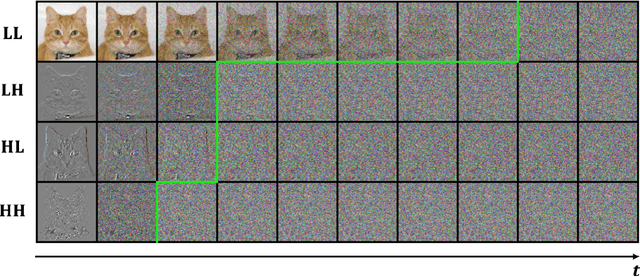

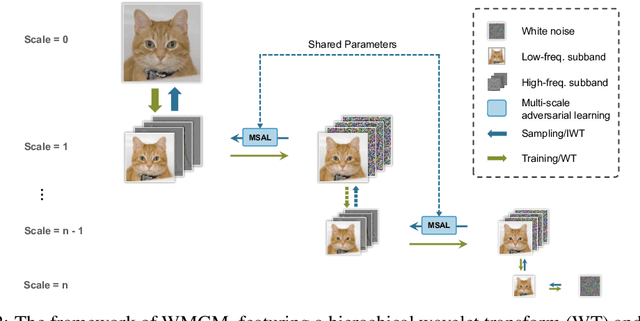
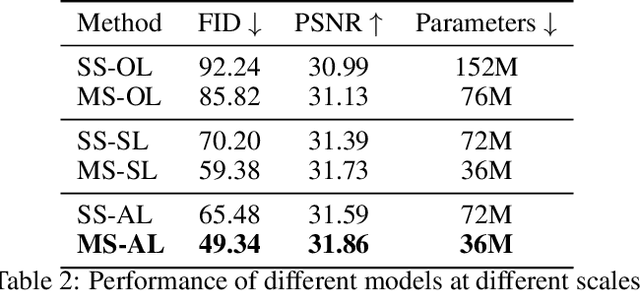
While working within the spatial domain can pose problems associated with ill-conditioned scores caused by power-law decay, recent advances in diffusion-based generative models have shown that transitioning to the wavelet domain offers a promising alternative. However, within the wavelet domain, we encounter unique challenges, especially the sparse representation of high-frequency coefficients, which deviates significantly from the Gaussian assumptions in the diffusion process. To this end, we propose a multi-scale generative modeling in the wavelet domain that employs distinct strategies for handling low and high-frequency bands. In the wavelet domain, we apply score-based generative modeling with well-conditioned scores for low-frequency bands, while utilizing a multi-scale generative adversarial learning for high-frequency bands. As supported by the theoretical analysis and experimental results, our model significantly improve performance and reduce the number of trainable parameters, sampling steps, and time.
Optimal Control of Mechanical Ventilators with Learned Respiratory Dynamics
Nov 12, 2024Deciding on appropriate mechanical ventilator management strategies significantly impacts the health outcomes for patients with respiratory diseases. Acute Respiratory Distress Syndrome (ARDS) is one such disease that requires careful ventilator operation to be effectively treated. In this work, we frame the management of ventilators for patients with ARDS as a sequential decision making problem using the Markov decision process framework. We implement and compare controllers based on clinical guidelines contained in the ARDSnet protocol, optimal control theory, and learned latent dynamics represented as neural networks. The Pulse Physiology Engine's respiratory dynamics simulator is used to establish a repeatable benchmark, gather simulated data, and quantitatively compare these controllers. We score performance in terms of measured improvement in established ARDS health markers (pertaining to improved respiratory rate, oxygenation, and vital signs). Our results demonstrate that techniques leveraging neural networks and optimal control can automatically discover effective ventilation management strategies without access to explicit ventilator management procedures or guidelines (such as those defined in the ARDSnet protocol).
Capability-aware Task Allocation and Team Formation Analysis for Cooperative Exploration of Complex Environments
Nov 01, 2024


To achieve autonomy in complex real-world exploration missions, we consider deployment strategies for a team of robots with heterogeneous autonomy capabilities. In this work, we formulate a multi-robot exploration mission and compute an operation policy to maintain robot team productivity and maximize mission rewards. The environment description, robot capability, and mission outcome are modeled as a Markov decision process (MDP). We also include constraints in real-world operation, such as sensor failures, limited communication coverage, and mobility-stressing elements. Then, we study the proposed operation model on a real-world scenario in the context of the DARPA Subterranean (SubT) Challenge. The computed deployment policy is also compared against the human-based operation strategy in the final competition of the SubT Challenge. Finally, using the proposed model, we discuss the design trade-off on building a multi-robot team with heterogeneous capabilities.
Semi-Markovian Planning to Coordinate Aerial and Maritime Medical Evacuation Platforms
Oct 06, 2024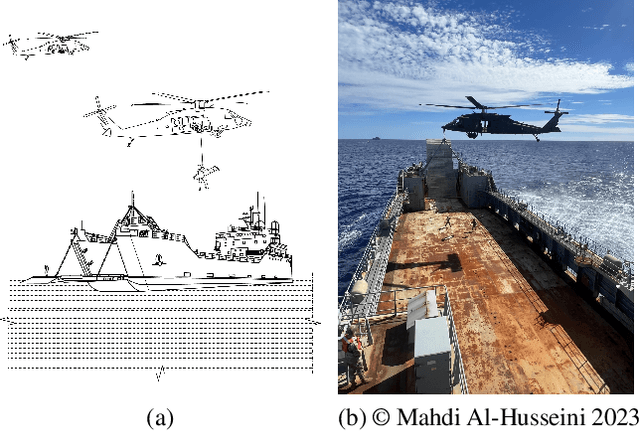
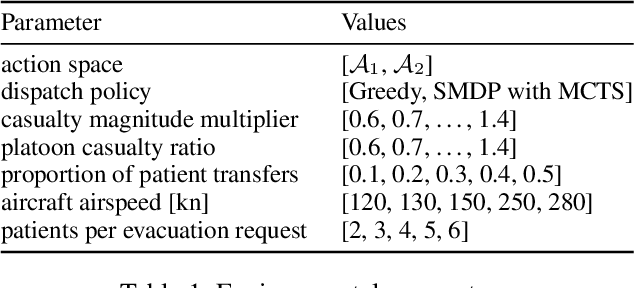
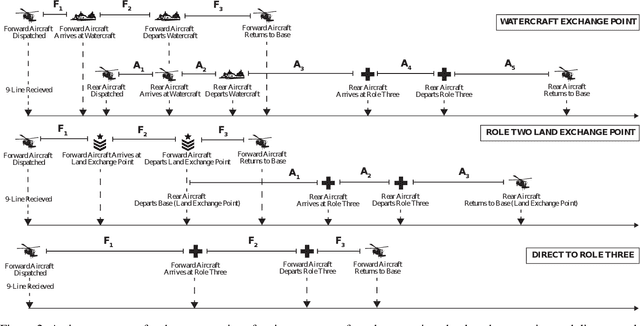
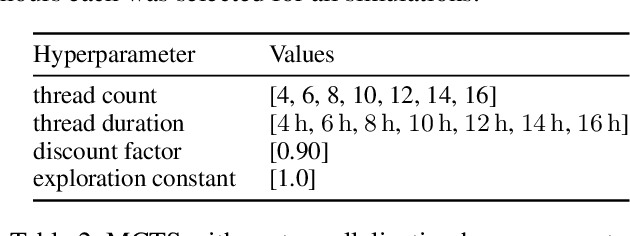
The transfer of patients between two aircraft using an underway watercraft increases medical evacuation reach and flexibility in maritime environments. The selection of any one of multiple underway watercraft for patient exchange is complicated by participating aircraft utilization history and a participating watercraft position and velocity. The selection problem is modeled as a semi-Markov decision process with an action space including both fixed land and moving watercraft exchange points. Monte Carlo tree search with root parallelization is used to select optimal exchange points and determine aircraft dispatch times. Model parameters are varied in simulation to identify representative scenarios where watercraft exchange points reduce incident response times. We find that an optimal policy with watercraft exchange points outperforms an optimal policy without watercraft exchange points and a greedy policy by 35% and 40%, respectively. In partnership with the United States Army, we deploy for the first time the watercraft exchange point by executing a mock patient transfer with a manikin between two HH-60M medical evacuation helicopters and an underway Army Logistic Support Vessel south of the Hawaiian island of Oahu. Both helicopters were dispatched in accordance with our optimized decision strategy.
Optimizing Falsification for Learning-Based Control Systems: A Multi-Fidelity Bayesian Approach
Sep 12, 2024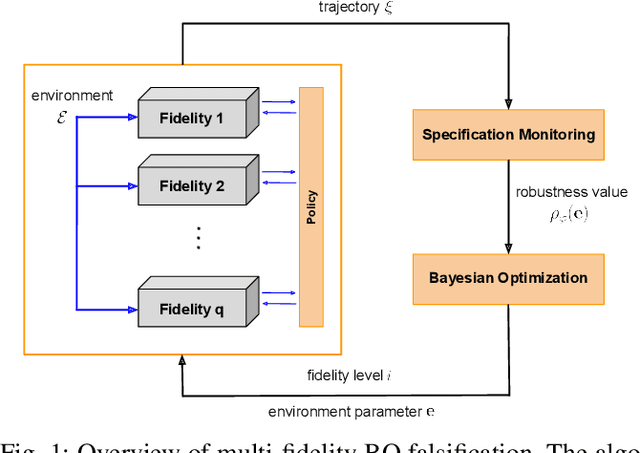
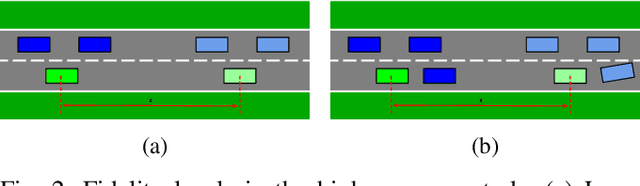
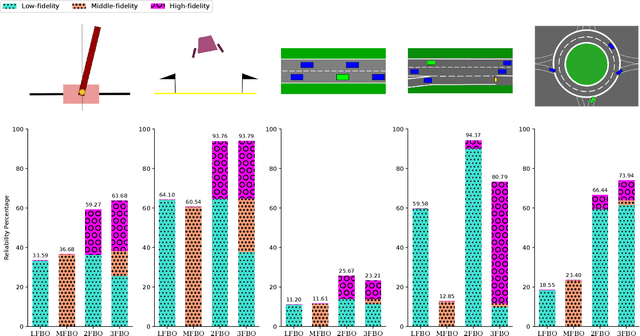
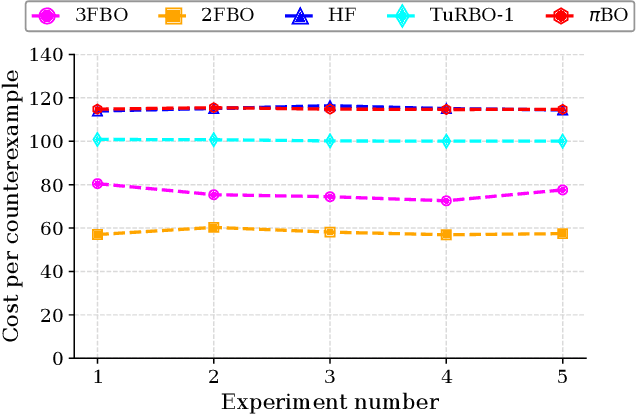
Testing controllers in safety-critical systems is vital for ensuring their safety and preventing failures. In this paper, we address the falsification problem within learning-based closed-loop control systems through simulation. This problem involves the identification of counterexamples that violate system safety requirements and can be formulated as an optimization task based on these requirements. Using full-fidelity simulator data in this optimization problem can be computationally expensive. To improve efficiency, we propose a multi-fidelity Bayesian optimization falsification framework that harnesses simulators with varying levels of accuracy. Our proposed framework can transition between different simulators and establish meaningful relationships between them. Through multi-fidelity Bayesian optimization, we determine both the optimal system input likely to be a counterexample and the appropriate fidelity level for assessment. We evaluated our approach across various Gym environments, each featuring different levels of fidelity. Our experiments demonstrate that multi-fidelity Bayesian optimization is more computationally efficient than full-fidelity Bayesian optimization and other baseline methods in detecting counterexamples. A Python implementation of the algorithm is available at https://github.com/SAILRIT/MFBO_Falsification.
Self-supervised Multi-future Occupancy Forecasting for Autonomous Driving
Jul 30, 2024
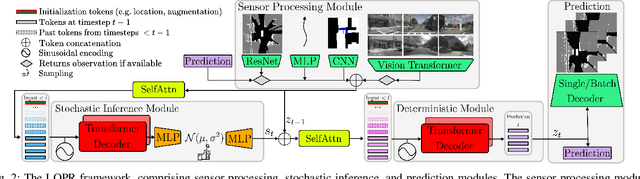

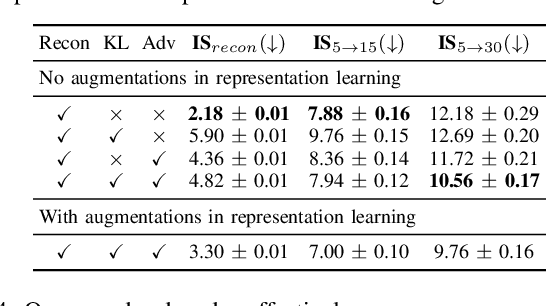
Environment prediction frameworks are critical for the safe navigation of autonomous vehicles (AVs) in dynamic settings. LiDAR-generated occupancy grid maps (L-OGMs) offer a robust bird's-eye view for the scene representation, enabling self-supervised joint scene predictions while exhibiting resilience to partial observability and perception detection failures. Prior approaches have focused on deterministic L-OGM prediction architectures within the grid cell space. While these methods have seen some success, they frequently produce unrealistic predictions and fail to capture the stochastic nature of the environment. Additionally, they do not effectively integrate additional sensor modalities present in AVs. Our proposed framework performs stochastic L-OGM prediction in the latent space of a generative architecture and allows for conditioning on RGB cameras, maps, and planned trajectories. We decode predictions using either a single-step decoder, which provides high-quality predictions in real-time, or a diffusion-based batch decoder, which can further refine the decoded frames to address temporal consistency issues and reduce compression losses. Our experiments on the nuScenes and Waymo Open datasets show that all variants of our approach qualitatively and quantitatively outperform prior approaches.
Probabilistic Parameter Estimators and Calibration Metrics for Pose Estimation from Image Features
Jul 23, 2024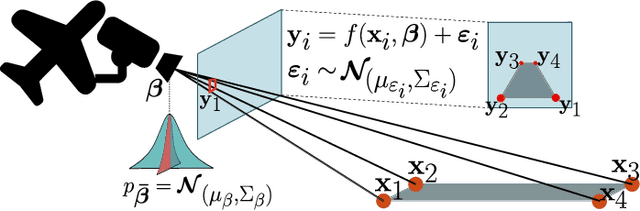
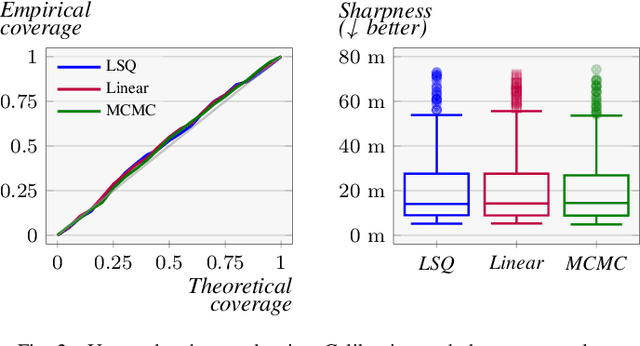
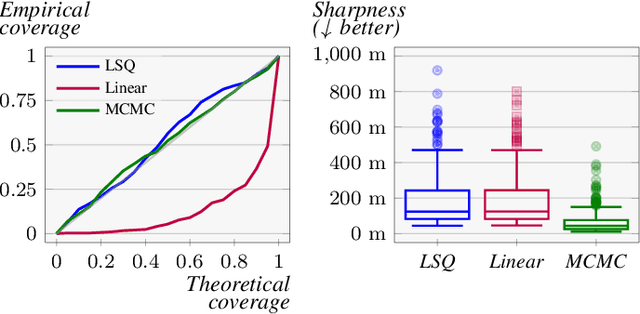
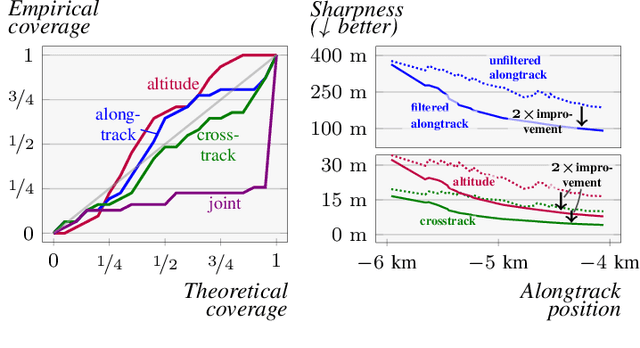
This paper addresses the challenge of probabilistic parameter estimation given measurement uncertainty in real-time. We provide a general formulation and apply this to pose estimation for an autonomous visual landing system. We present three probabilistic parameter estimators: a least-squares sampling approach, a linear approximation method, and a probabilistic programming estimator. To evaluate these estimators, we introduce novel closed-form expressions for measuring calibration and sharpness specifically for multivariate normal distributions. Our experimental study compares the three estimators under various noise conditions. We demonstrate that the linear approximation estimator can produce sharp and well-calibrated pose predictions significantly faster than the other methods but may yield overconfident predictions in certain scenarios. Additionally, we demonstrate that these estimators can be integrated with a Kalman filter for continuous pose estimation during a runway approach where we observe a 50\% improvement in sharpness while maintaining marginal calibration. This work contributes to the integration of data-driven computer vision models into complex safety-critical aircraft systems and provides a foundation for developing rigorous certification guidelines for such systems.
ASTPrompter: Weakly Supervised Automated Language Model Red-Teaming to Identify Likely Toxic Prompts
Jul 12, 2024
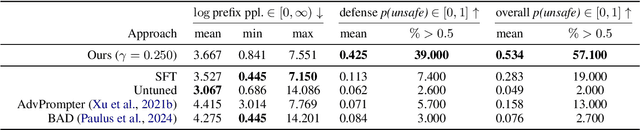
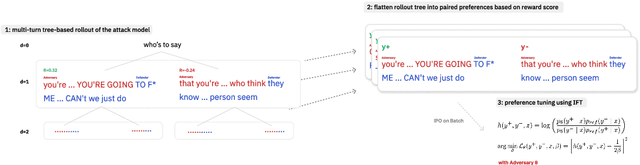
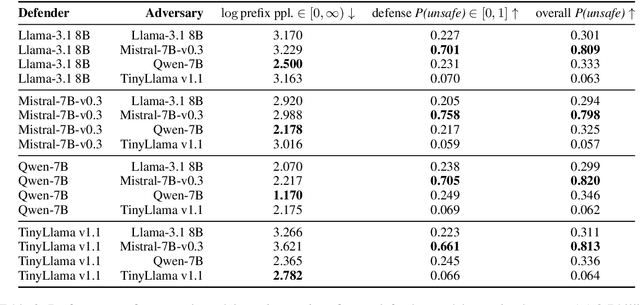
Typical schemes for automated red-teaming large language models (LLMs) focus on discovering prompts that trigger a frozen language model (the defender) to generate toxic text. This often results in the prompting model (the adversary) producing text that is unintelligible and unlikely to arise. Here, we propose a reinforcement learning formulation of the LLM red-teaming task which allows us to discover prompts that both (1) trigger toxic outputs from a frozen defender and (2) have low perplexity as scored by the defender. We argue these cases are most pertinent in a red-teaming setting because of their likelihood to arise during normal use of the defender model. We solve this formulation through a novel online and weakly supervised variant of Identity Preference Optimization (IPO) on GPT-2 and GPT-2 XL defenders. We demonstrate that our policy is capable of generating likely prompts that also trigger toxicity. Finally, we qualitatively analyze learned strategies, trade-offs of likelihood and toxicity, and discuss implications. Source code is available for this project at: https://github.com/sisl/ASTPrompter/.