 Add to Chrome
 Add to Firefox
 Add to Edge
Protection Levels for Vision-Based Pose Estimation
Aug 09, 2026
Vision-based navigation complements Global Navigation Satellite Systems, but certification demands integrity guarantees that account for faulty measurements. Previous work presented a probabilistic computer vision pipeline for runway-based pose estimation with fault detection inspired by Receiver Autonomous Integrity Monitoring. This work extends that framework by deriving protection levels, which provide probabilistic bounds on pose error that remain valid under undetected faults. We present an algorithm for computing protection levels for the nonlinear Perspective-$n$-Point problem applied to an aviation setting. The algorithm covers all six degrees of freedom of the aircraft pose (position and orientation) directly. We analyze the effect of measurement redundancy, pixel-level prediction uncertainty, and runway distance on the resulting protection levels. To make the results tangible, we demonstrate tradeoffs in the protection levels on an illustrative runway example.

Probabilistic Parameter Estimators and Calibration Metrics for Pose Estimation from Image Features
Jul 23, 2024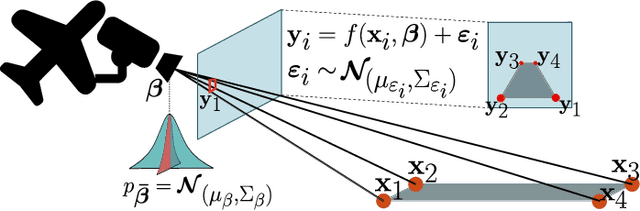
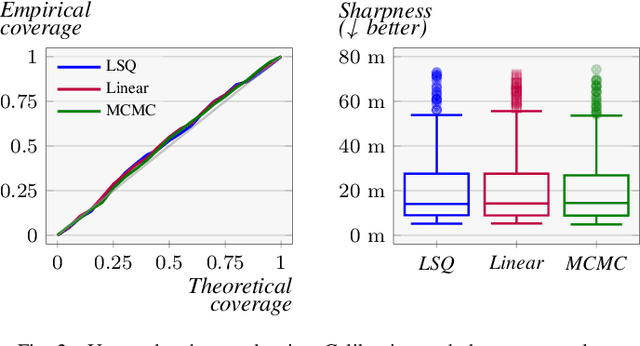
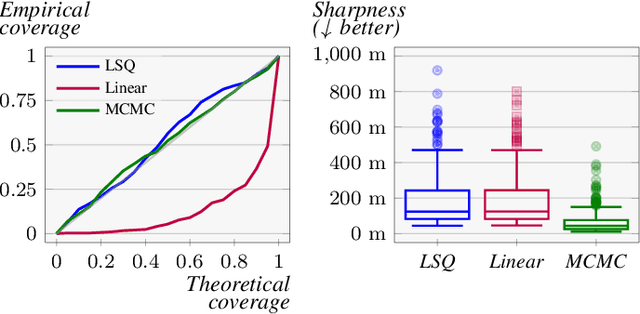
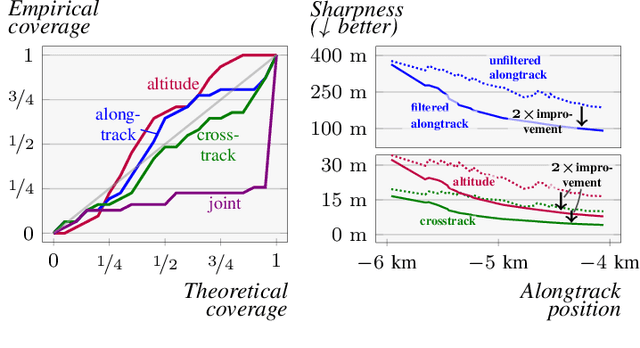
This paper addresses the challenge of probabilistic parameter estimation given measurement uncertainty in real-time. We provide a general formulation and apply this to pose estimation for an autonomous visual landing system. We present three probabilistic parameter estimators: a least-squares sampling approach, a linear approximation method, and a probabilistic programming estimator. To evaluate these estimators, we introduce novel closed-form expressions for measuring calibration and sharpness specifically for multivariate normal distributions. Our experimental study compares the three estimators under various noise conditions. We demonstrate that the linear approximation estimator can produce sharp and well-calibrated pose predictions significantly faster than the other methods but may yield overconfident predictions in certain scenarios. Additionally, we demonstrate that these estimators can be integrated with a Kalman filter for continuous pose estimation during a runway approach where we observe a 50\% improvement in sharpness while maintaining marginal calibration. This work contributes to the integration of data-driven computer vision models into complex safety-critical aircraft systems and provides a foundation for developing rigorous certification guidelines for such systems.