 Add to Chrome
 Add to Firefox
 Add to Edge
ReCast: Recasting Learning Signals for Reinforcement Learning in Generative Recommendation
Apr 24, 2026
Generic group-based RL assumes that sampled rollout groups are already usable learning signals. We show that this assumption breaks down in sparse-hit generative recommendation, where many sampled groups never become learnable at all. We propose ReCast, a repair-then-contrast learning-signal framework that first restores minimal learnability for all-zero groups and then replaces full-group reward normalization with a boundary-focused contrastive update on the strongest positive and the hardest negative. ReCast leaves the outer RL framework unchanged, modifies only within-group signal construction, and partially decouples rollout search width from actor-side update width. Across multiple generative recommendation tasks, ReCast consistently outperforms OpenOneRec-RL, achieving up to 36.6% relative improvement in Pass@1. Its matched-budget advantage is substantially larger: ReCast reaches the baseline's target performance with only 4.1% of the rollout budget, and this advantage widens with model scale. The same design also yields direct system-level gains, reducing actor-side update time by 16.60x, lowering peak allocated memory by 16.5%, and improving actor MFU by 14.2%. Mechanism analysis shows that ReCast mitigates the persistent all-zero / single-hit regime, restores learnability when natural positives are scarce, and converts otherwise wasted rollout budget into more stable policy updates. These results suggest that, for generative recommendation, the decisive RL problem is not only how to assign rewards, but how to construct learnable optimization events from sparse, structured supervision.

EmT: A Novel Transformer for Generalized Cross-subject EEG Emotion Recognition
Jun 26, 2024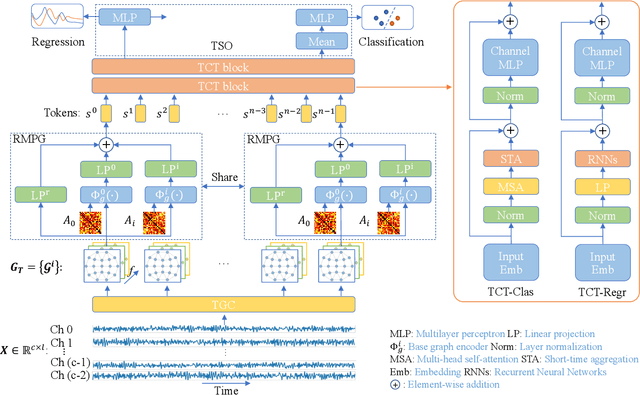
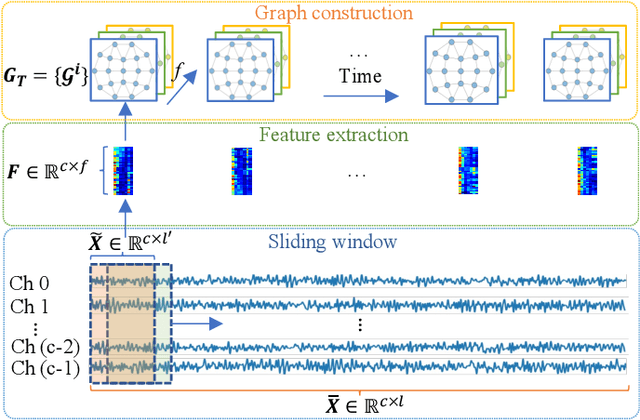
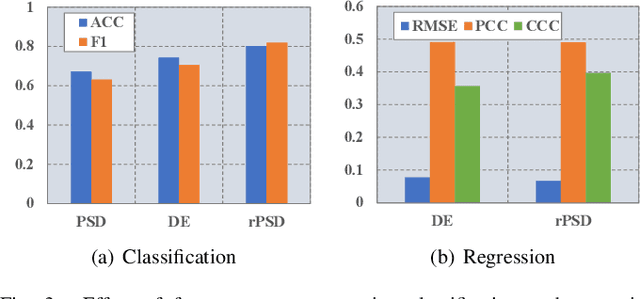
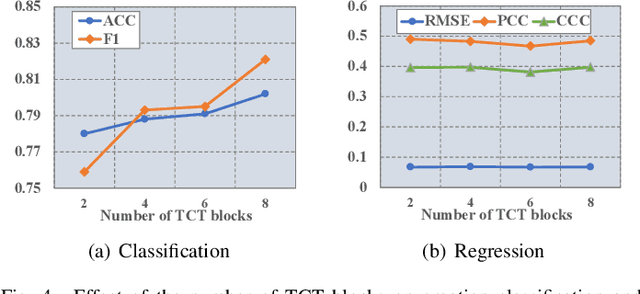
Integrating prior knowledge of neurophysiology into neural network architecture enhances the performance of emotion decoding. While numerous techniques emphasize learning spatial and short-term temporal patterns, there has been limited emphasis on capturing the vital long-term contextual information associated with emotional cognitive processes. In order to address this discrepancy, we introduce a novel transformer model called emotion transformer (EmT). EmT is designed to excel in both generalized cross-subject EEG emotion classification and regression tasks. In EmT, EEG signals are transformed into a temporal graph format, creating a sequence of EEG feature graphs using a temporal graph construction module (TGC). A novel residual multi-view pyramid GCN module (RMPG) is then proposed to learn dynamic graph representations for each EEG feature graph within the series, and the learned representations of each graph are fused into one token. Furthermore, we design a temporal contextual transformer module (TCT) with two types of token mixers to learn the temporal contextual information. Finally, the task-specific output module (TSO) generates the desired outputs. Experiments on four publicly available datasets show that EmT achieves higher results than the baseline methods for both EEG emotion classification and regression tasks. The code is available at https://github.com/yi-ding-cs/EmT.
EEG-Deformer: A Dense Convolutional Transformer for Brain-computer Interfaces
Apr 25, 2024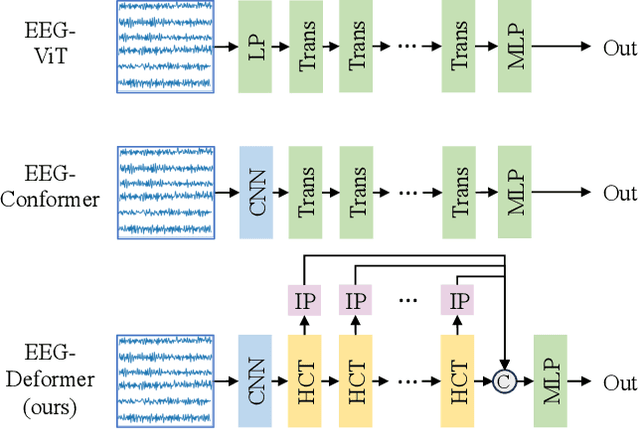
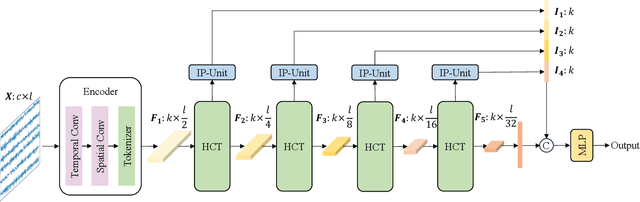
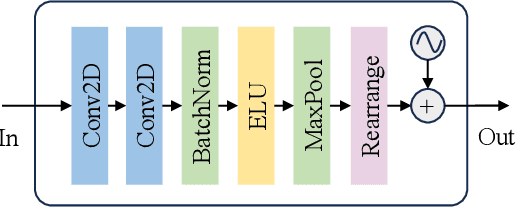
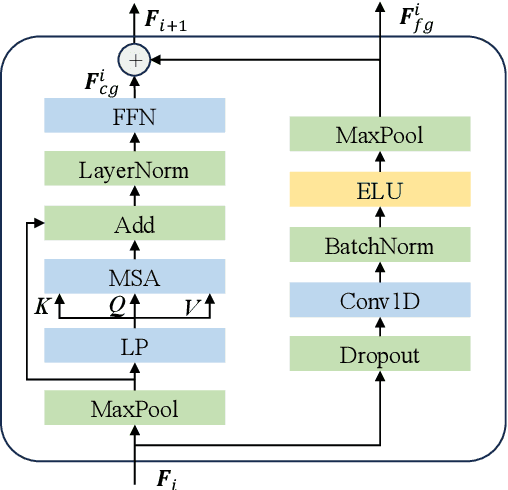
Effectively learning the temporal dynamics in electroencephalogram (EEG) signals is challenging yet essential for decoding brain activities using brain-computer interfaces (BCIs). Although Transformers are popular for their long-term sequential learning ability in the BCI field, most methods combining Transformers with convolutional neural networks (CNNs) fail to capture the coarse-to-fine temporal dynamics of EEG signals. To overcome this limitation, we introduce EEG-Deformer, which incorporates two main novel components into a CNN-Transformer: (1) a Hierarchical Coarse-to-Fine Transformer (HCT) block that integrates a Fine-grained Temporal Learning (FTL) branch into Transformers, effectively discerning coarse-to-fine temporal patterns; and (2) a Dense Information Purification (DIP) module, which utilizes multi-level, purified temporal information to enhance decoding accuracy. Comprehensive experiments on three representative cognitive tasks consistently verify the generalizability of our proposed EEG-Deformer, demonstrating that it either outperforms existing state-of-the-art methods or is comparable to them. Visualization results show that EEG-Deformer learns from neurophysiologically meaningful brain regions for the corresponding cognitive tasks. The source code can be found at https://github.com/yi-ding-cs/EEG-Deformer.