 Add to Chrome
 Add to Firefox
 Add to Edge
Multimodal Representation Learning by Alternating Unimodal Adaptation
Nov 17, 2023
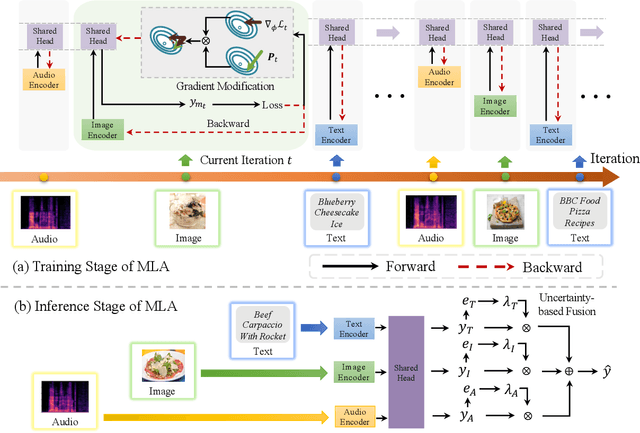
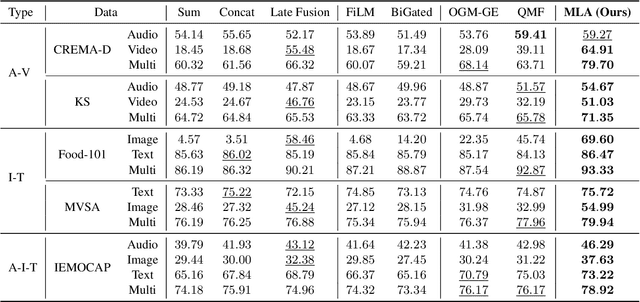
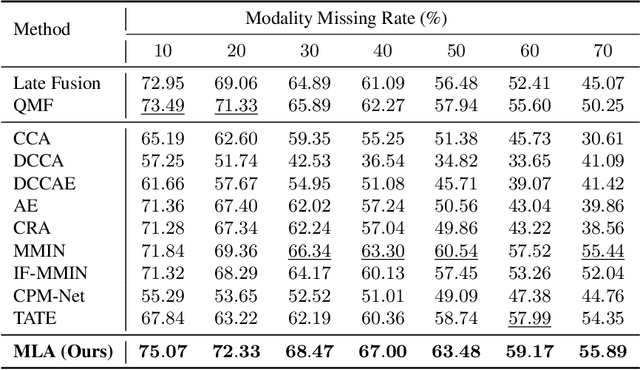
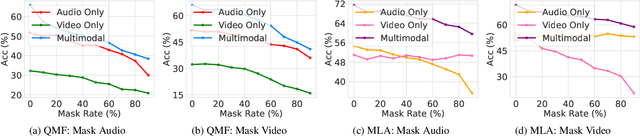
Multimodal learning, which integrates data from diverse sensory modes, plays a pivotal role in artificial intelligence. However, existing multimodal learning methods often struggle with challenges where some modalities appear more dominant than others during multimodal learning, resulting in suboptimal performance. To address this challenge, we propose MLA (Multimodal Learning with Alternating Unimodal Adaptation). MLA reframes the conventional joint multimodal learning process by transforming it into an alternating unimodal learning process, thereby minimizing interference between modalities. Simultaneously, it captures cross-modal interactions through a shared head, which undergoes continuous optimization across different modalities. This optimization process is controlled by a gradient modification mechanism to prevent the shared head from losing previously acquired information. During the inference phase, MLA utilizes a test-time uncertainty-based model fusion mechanism to integrate multimodal information. Extensive experiments are conducted on five diverse datasets, encompassing scenarios with complete modalities and scenarios with missing modalities. These experiments demonstrate the superiority of MLA over competing prior approaches.

ADaPT: As-Needed Decomposition and Planning with Language Models
Nov 08, 2023Large Language Models (LLMs) are increasingly being used for interactive decision-making tasks requiring planning and adapting to the environment. Recent works employ LLMs-as-agents in broadly two ways: iteratively determining the next action (iterative executors) or generating plans and executing sub-tasks using LLMs (plan-and-execute). However, these methods struggle with task complexity, as the inability to execute any sub-task may lead to task failure. To address these shortcomings, we introduce As-Needed Decomposition and Planning for complex Tasks (ADaPT), an approach that explicitly plans and decomposes complex sub-tasks as-needed, i.e., when the LLM is unable to execute them. ADaPT recursively decomposes sub-tasks to adapt to both task complexity and LLM capability. Our results demonstrate that ADaPT substantially outperforms established strong baselines, achieving success rates up to 28.3% higher in ALFWorld, 27% in WebShop, and 33% in TextCraft -- a novel compositional dataset that we introduce. Through extensive analysis, we illustrate the importance of multilevel decomposition and establish that ADaPT dynamically adjusts to the capabilities of the executor LLM as well as to task complexity.
Data Factors for Better Compositional Generalization
Nov 08, 2023

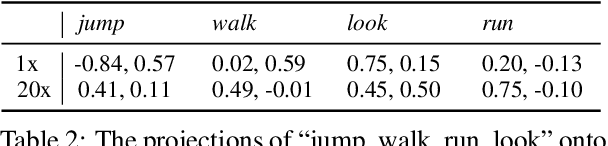

Recent diagnostic datasets on compositional generalization, such as SCAN (Lake and Baroni, 2018) and COGS (Kim and Linzen, 2020), expose severe problems in models trained from scratch on these datasets. However, in contrast to this poor performance, state-of-the-art models trained on larger and more general datasets show better generalization ability. In this work, to reconcile this inconsistency, we conduct an empirical analysis by training Transformer models on a variety of training sets with different data factors, including dataset scale, pattern complexity, example difficulty, etc. First, we show that increased dataset complexity can lead to better generalization behavior on multiple different generalization challenges. To further understand this improvement, we show two axes of the benefit from more complex datasets: they provide more diverse examples so compositional understanding becomes more effective, and they also prevent ungeneralizable memorization of the examples due to reduced example repetition frequency. Finally, we explore how training examples of different difficulty levels influence generalization differently. On synthetic datasets, simple examples invoke stronger compositionality than hard examples do. On larger-scale real language datasets, while hard examples become more important potentially to ensure decent data coverage, a balanced mixture of simple and hard examples manages to induce the strongest generalizability. The code and data for this work are available at https://github.com/owenzx/data4comp
Davidsonian Scene Graph: Improving Reliability in Fine-grained Evaluation for Text-to-Image Generation
Oct 30, 2023


Evaluating text-to-image models is notoriously difficult. A strong recent approach for assessing text-image faithfulness is based on QG/A (question generation and answering), which uses pre-trained foundational models to automatically generate a set of questions and answers from the prompt, and output images are scored based on whether these answers extracted with a visual question answering model are consistent with the prompt-based answers. This kind of evaluation is naturally dependent on the quality of the underlying QG and QA models. We identify and address several reliability challenges in existing QG/A work: (a) QG questions should respect the prompt (avoiding hallucinations, duplications, and omissions) and (b) VQA answers should be consistent (not asserting that there is no motorcycle in an image while also claiming the motorcycle is blue). We address these issues with Davidsonian Scene Graph (DSG), an empirically grounded evaluation framework inspired by formal semantics. DSG is an automatic, graph-based QG/A that is modularly implemented to be adaptable to any QG/A module. DSG produces atomic and unique questions organized in dependency graphs, which (i) ensure appropriate semantic coverage and (ii) sidestep inconsistent answers. With extensive experimentation and human evaluation on a range of model configurations (LLM, VQA, and T2I), we empirically demonstrate that DSG addresses the challenges noted above. Finally, we present DSG-1k, an open-sourced evaluation benchmark that includes 1,060 prompts, covering a wide range of fine-grained semantic categories with a balanced distribution. We release the DSG-1k prompts and the corresponding DSG questions.
Branch-Solve-Merge Improves Large Language Model Evaluation and Generation
Oct 23, 2023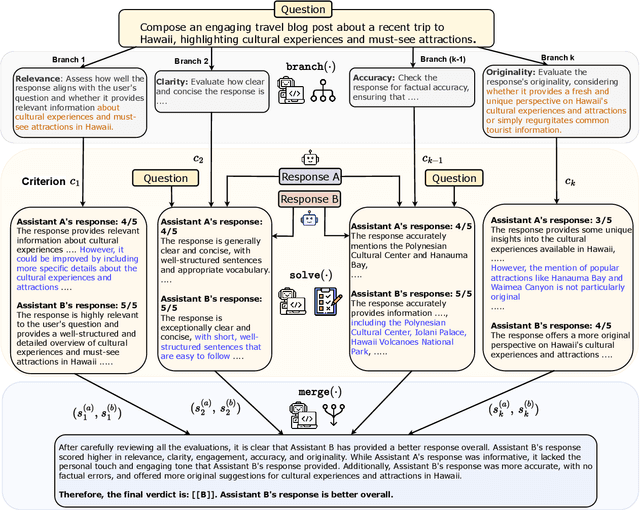
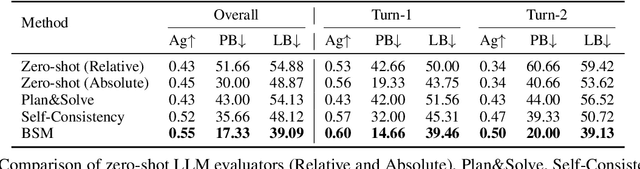
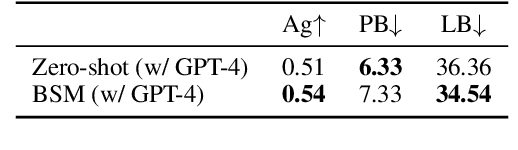
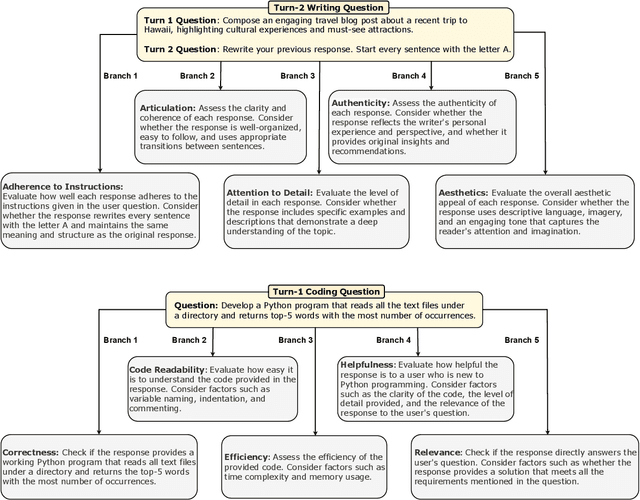
Large Language Models (LLMs) are frequently used for multi-faceted language generation and evaluation tasks that involve satisfying intricate user constraints or taking into account multiple aspects and criteria. However, their performance can fall short, due to the model's lack of coherence and inability to plan and decompose the problem. We propose Branch-Solve-Merge (BSM), a Large Language Model program (Schlag et al., 2023) for tackling such challenging natural language tasks. It consists of branch, solve, and merge modules that are parameterized with specific prompts to the base LLM. These three modules plan a decomposition of the task into multiple parallel sub-tasks, independently solve them, and fuse the solutions to the sub-tasks. We apply our method to the tasks of LLM response evaluation and constrained text generation and evaluate its effectiveness with multiple LLMs, including Vicuna, LLaMA-2-chat, and GPT-4. BSM improves the evaluation correctness and consistency for each LLM by enhancing human-LLM agreement by up to 26%, reducing length and pairwise position biases by up to 50%, and allowing LLaMA-2-chat to match or outperform GPT-4 on most domains. On the constraint story generation task, BSM improves the coherence of the stories while also improving constraint satisfaction by 12%.
DiagrammerGPT: Generating Open-Domain, Open-Platform Diagrams via LLM Planning
Oct 18, 2023
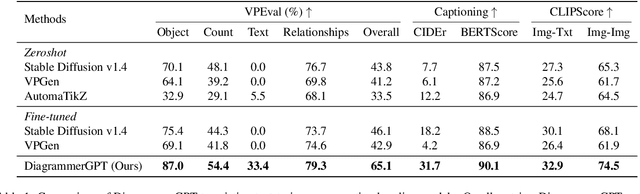

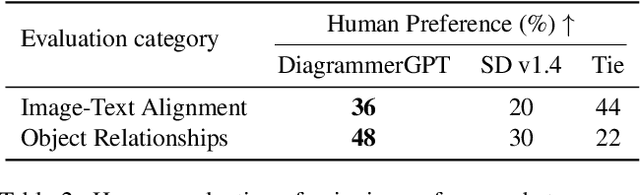
Text-to-image (T2I) generation has seen significant growth over the past few years. Despite this, there has been little work on generating diagrams with T2I models. A diagram is a symbolic/schematic representation that explains information using structurally rich and spatially complex visualizations (e.g., a dense combination of related objects, text labels, directional arrows, connection lines, etc.). Existing state-of-the-art T2I models often fail at diagram generation because they lack fine-grained object layout control when many objects are densely connected via complex relations such as arrows/lines and also often fail to render comprehensible text labels. To address this gap, we present DiagrammerGPT, a novel two-stage text-to-diagram generation framework that leverages the layout guidance capabilities of LLMs (e.g., GPT-4) to generate more accurate open-domain, open-platform diagrams. In the first stage, we use LLMs to generate and iteratively refine 'diagram plans' (in a planner-auditor feedback loop) which describe all the entities (objects and text labels), their relationships (arrows or lines), and their bounding box layouts. In the second stage, we use a diagram generator, DiagramGLIGEN, and a text label rendering module to generate diagrams following the diagram plans. To benchmark the text-to-diagram generation task, we introduce AI2D-Caption, a densely annotated diagram dataset built on top of the AI2D dataset. We show quantitatively and qualitatively that our DiagrammerGPT framework produces more accurate diagrams, outperforming existing T2I models. We also provide comprehensive analysis including open-domain diagram generation, vector graphic diagram generation in different platforms, human-in-the-loop diagram plan editing, and multimodal planner/auditor LLMs (e.g., GPT-4Vision). We hope our work can inspire further research on diagram generation via T2I models and LLMs.
Generating Summaries with Controllable Readability Levels
Oct 16, 2023Readability refers to how easily a reader can understand a written text. Several factors affect the readability level, such as the complexity of the text, its subject matter, and the reader's background knowledge. Generating summaries based on different readability levels is critical for enabling knowledge consumption by diverse audiences. However, current text generation approaches lack refined control, resulting in texts that are not customized to readers' proficiency levels. In this work, we bridge this gap and study techniques to generate summaries at specified readability levels. Unlike previous methods that focus on a specific readability level (e.g., lay summarization), we generate summaries with fine-grained control over their readability. We develop three text generation techniques for controlling readability: (1) instruction-based readability control, (2) reinforcement learning to minimize the gap between requested and observed readability and (3) a decoding approach that uses lookahead to estimate the readability of upcoming decoding steps. We show that our generation methods significantly improve readability control on news summarization (CNN/DM dataset), as measured by various readability metrics and human judgement, establishing strong baselines for controllable readability in summarization.
D2 Pruning: Message Passing for Balancing Diversity and Difficulty in Data Pruning
Oct 11, 2023Analytical theories suggest that higher-quality data can lead to lower test errors in models trained on a fixed data budget. Moreover, a model can be trained on a lower compute budget without compromising performance if a dataset can be stripped of its redundancies. Coreset selection (or data pruning) seeks to select a subset of the training data so as to maximize the performance of models trained on this subset, also referred to as coreset. There are two dominant approaches: (1) geometry-based data selection for maximizing data diversity in the coreset, and (2) functions that assign difficulty scores to samples based on training dynamics. Optimizing for data diversity leads to a coreset that is biased towards easier samples, whereas, selection by difficulty ranking omits easy samples that are necessary for the training of deep learning models. This demonstrates that data diversity and importance scores are two complementary factors that need to be jointly considered during coreset selection. We represent a dataset as an undirected graph and propose a novel pruning algorithm, D2 Pruning, that uses forward and reverse message passing over this dataset graph for coreset selection. D2 Pruning updates the difficulty scores of each example by incorporating the difficulty of its neighboring examples in the dataset graph. Then, these updated difficulty scores direct a graph-based sampling method to select a coreset that encapsulates both diverse and difficult regions of the dataset space. We evaluate supervised and self-supervised versions of our method on various vision and language datasets. Results show that D2 Pruning improves coreset selection over previous state-of-the-art methods for up to 70% pruning rates. Additionally, we find that using D2 Pruning for filtering large multimodal datasets leads to increased diversity in the dataset and improved generalization of pretrained models.
Rephrase, Augment, Reason: Visual Grounding of Questions for Vision-Language Models
Oct 09, 2023An increasing number of vision-language tasks can be handled with little to no training, i.e., in a zero and few-shot manner, by marrying large language models (LLMs) to vision encoders, resulting in large vision-language models (LVLMs). While this has huge upsides, such as not requiring training data or custom architectures, how an input is presented to a LVLM can have a major impact on zero-shot model performance. In particular, inputs phrased in an underspecified way can result in incorrect answers due to factors like missing visual information, complex implicit reasoning, or linguistic ambiguity. Therefore, adding visually grounded information to the input as a preemptive clarification should improve model performance by reducing underspecification, e.g., by localizing objects and disambiguating references. Similarly, in the VQA setting, changing the way questions are framed can make them easier for models to answer. To this end, we present Rephrase, Augment and Reason (RepARe), a gradient-free framework that extracts salient details about the image using the underlying LVLM as a captioner and reasoner, in order to propose modifications to the original question. We then use the LVLM's confidence over a generated answer as an unsupervised scoring function to select the rephrased question most likely to improve zero-shot performance. Focusing on two visual question answering tasks, we show that RepARe can result in a 3.85% (absolute) increase in zero-shot performance on VQAv2 and a 6.41% point increase on A-OKVQA. Additionally, we find that using gold answers for oracle question candidate selection achieves a substantial gain in VQA accuracy by up to 14.41%. Through extensive analysis, we demonstrate that outputs from RepARe increase syntactic complexity, and effectively utilize vision-language interaction and the frozen language model in LVLMs.
ECoFLaP: Efficient Coarse-to-Fine Layer-Wise Pruning for Vision-Language Models
Oct 04, 2023Large Vision-Language Models (LVLMs) can understand the world comprehensively by integrating rich information from different modalities, achieving remarkable performance improvements on various multimodal downstream tasks. However, deploying LVLMs is often problematic due to their massive computational/energy costs and carbon consumption. Such issues make it infeasible to adopt conventional iterative global pruning, which is costly due to computing the Hessian matrix of the entire large model for sparsification. Alternatively, several studies have recently proposed layer-wise pruning approaches to avoid the expensive computation of global pruning and efficiently compress model weights according to their importance within a layer. However, these methods often suffer from suboptimal model compression due to their lack of a global perspective. To address this limitation in recent efficient pruning methods for large models, we propose Efficient Coarse-to-Fine Layer-Wise Pruning (ECoFLaP), a two-stage coarse-to-fine weight pruning approach for LVLMs. We first determine the sparsity ratios of different layers or blocks by leveraging the global importance score, which is efficiently computed based on the zeroth-order approximation of the global model gradients. Then, the multimodal model performs local layer-wise unstructured weight pruning based on globally-informed sparsity ratios. We validate our proposed method across various multimodal and unimodal models and datasets, demonstrating significant performance improvements over prevalent pruning techniques in the high-sparsity regime.