 Add to Chrome
 Add to Firefox
 Add to Edge
Duet: Dual-Robot Understanding via Efficient Teaching
Jun 18, 2026
Dual-robot collaboration enables tasks that exceed the reach and payload of a single robot, such as collaboratively transporting objects across environments and executing coordinated handovers. Data acquisition is the primary bottleneck for training these systems. To this end, we introduce DUET, a dual-robot learning framework for mobile manipulation. For efficient data collection, we create a unified dual-embodiment synchronized VR-based teleoperation system for in-domain heterogeneous robot data collection. We further develop a complementary tracking pipeline that records human-human coordination and collaborative mobile manipulation priors. To allow efficient learning, we introduce an Action Chunking Transformer based architecture that first pretrains collaborative policies on efficient human-human demonstrations, before finetuning them on a minimal set of real-robot teleoperation trajectories. We develop a benchmark of four collaborative tasks to evaluate our framework using a Unitree G1 humanoid and a Dexmate Vega1 mobile manipulator. The results demonstrate that harnessing human priors not only yields superior task performance compared to baselines trained only on robot data, but also reduces the total human effort required for data collection. Our human data collection pipeline achieves 5.4x acceleration on average from teleoperation, but we perform equally or better than robot-only data trained policies across all tasks. Our project page is available at https://zhaoy37.github.io/Duet/.

TimeLDM: Latent Diffusion Model for Unconditional Time Series Generation
Jul 05, 2024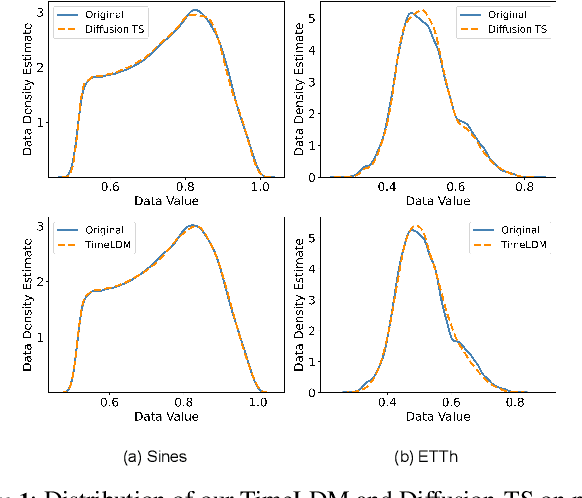


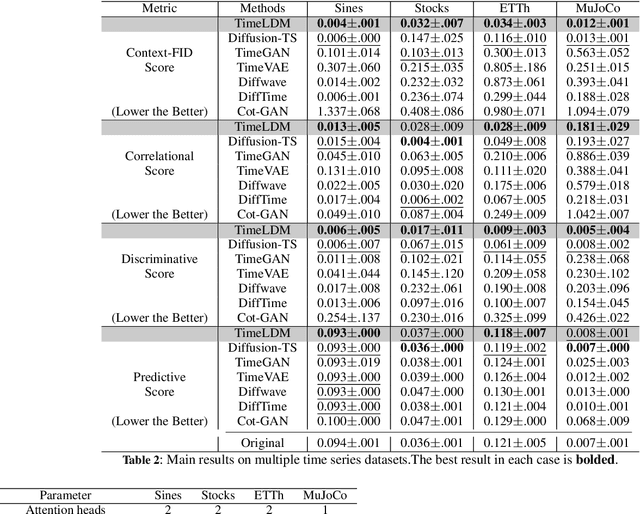
Time series generation is a crucial research topic in the area of deep learning, which can be used for data augmentation, imputing missing values, and forecasting. Currently, latent diffusion models are ascending to the forefront of generative modeling for many important data representations. Being the most pivotal in the computer vision domain, latent diffusion models have also recently attracted interest in other communities, including NLP, Speech, and Geometric Space. In this work, we propose TimeLDM, a novel latent diffusion model for high-quality time series generation. TimeLDM is composed of a variational autoencoder that encodes time series into an informative and smoothed latent content and a latent diffusion model operating in the latent space to generate latent information. We evaluate the ability of our method to generate synthetic time series with simulated and realistic datasets, benchmark the performance against existing state-of-the-art methods. Qualitatively and quantitatively, we find that the proposed TimeLDM persistently delivers high-quality generated time series. Sores from Context-FID and Discriminative indicate that TimeLDM consistently and significantly outperforms current state-of-the-art benchmarks with an average improvement of 3.4$\times$ and 3.8$\times$, respectively. Further studies demonstrate that our method presents better performance on different lengths of time series data generation. To the best of our knowledge, this is the first study to explore the potential of the latent diffusion model for unconditional time series generation and establish a new baseline for synthetic time series.
2D3D-MATR: 2D-3D Matching Transformer for Detection-free Registration between Images and Point Clouds
Aug 14, 2023The commonly adopted detect-then-match approach to registration finds difficulties in the cross-modality cases due to the incompatible keypoint detection and inconsistent feature description. We propose, 2D3D-MATR, a detection-free method for accurate and robust registration between images and point clouds. Our method adopts a coarse-to-fine pipeline where it first computes coarse correspondences between downsampled patches of the input image and the point cloud and then extends them to form dense correspondences between pixels and points within the patch region. The coarse-level patch matching is based on transformer which jointly learns global contextual constraints with self-attention and cross-modality correlations with cross-attention. To resolve the scale ambiguity in patch matching, we construct a multi-scale pyramid for each image patch and learn to find for each point patch the best matching image patch at a proper resolution level. Extensive experiments on two public benchmarks demonstrate that 2D3D-MATR outperforms the previous state-of-the-art P2-Net by around $20$ percentage points on inlier ratio and over $10$ points on registration recall. Our code and models are available at https://github.com/minhaolee/2D3DMATR.