 Add to Chrome
 Add to Firefox
 Add to Edge
Low-Complexity Hybrid Precoding for Cell-Free Massive MU-MIMO ISAC Systems
Jun 15, 2026
Integrated sensing and communication (ISAC) in cell-free (CF) massive multi-user multiple-input multiple-output (MU-MIMO) system is a promising architecture for high-rate communications and high-accuracy multi-target sensing. However, centralized coordination among distributed access points (APs) incurs substantial fronthaul overhead and computation complexity. This paper proposes a low-complexity hybrid precoding framework for CF massive MU-MIMO ISAC systems with partially-connected architectures at the APs. By applying hybrid architecture at the APs, the proposed framework converts the original high-dimensional channel information into a low-dimensional effective channel, enabling digital precoding over the compressed channel domain and thereby substantially reducing both fronthaul overhead and baseband computational complexity. We formulate the joint hybrid precoding design as an ergodic sum-rate (ESR) maximization problem with position error bound (PEB) constraints to ensure multi-target sensing accuracy. An efficient alternating optimization (AO)-based solver is then developed, where the PEB constraint is reformulated into tractable convex constraints, while the digital-domain optimization is carried out over the reduced-dimensional effective channel and the analog precoding is refined on the constant-modulus manifold. For dynamic user topology, we further propose multi-branch (MB) rate-splitting (RS) minimum mean-square-error Tomlinson-Harashima precoding (MMSE-THP) update algorithm that combines multi-branch ordering with recursive MMSE-THP matrix updates, enabling common and private digital precodings to be refreshed without repeated full matrix recomputation. Simulation results demonstrate that the proposed scheme achieves high ESR and accurate multi-target sensing while reducing computational complexity by 87.02\% compared with conventional baselines.

Scalable GNN-Based Power Allocation for Rate-Splitting Cell-Free Massive MIMO Systems
Jun 01, 2026Cell-free massive multiple-input multiple-output (CF-mMIMO) systems provide enhanced coverage and capacity for next-generation wireless networks. However, CF-mMIMO systems face significant challenges in downlink power allocation (PA) due to imperfect channel state information (CSI), severe multi-user interference (MUI), and high computational complexity. To address these issues, rate-splitting multiple access (RSMA) is adopted as a robust interference management strategy. Accordingly, this paper proposes an unsupervised and scalable graph neural network (GNN) framework for PA in rate-splitting CF-mMIMO (RS-CF-mMIMO) systems, relying exclusively on large-scale fading (LSF) coefficients without instantaneous CSI. To resolve the dimensionality mismatch in dynamic networks, we introduce a slice-based adaptive layer that projects variable-dimension features into a fixed latent space. This mechanism enables a unified model to generalize across diverse topologies without retraining. Within this architecture, the sum spectral efficiency (SE) is maximized under per-AP power constraints, assuming maximum-ratio precoding for common streams and regularized zero-forcing precoding for private streams. We also derive a weighted minimum mean-square error-alternating direction method of multipliers (WMMSE-ADMM) algorithm as a performance upper bound. Extensive simulations verify that the proposed GNN framework achieves near-optimal SE and outperforms unsupervised deep neural networks (DNNs) across diverse system sizes and pilot assignment schemes. Furthermore, the scalable variant maintains robust performance while reducing the trainable parameter count by over 57% relative to DNNs and decreasing inference latency by up to three orders of magnitude compared with WMMSE-ADMM.
4D-CAT: Synthesis of 4D Coronary Artery Trees from Systole and Diastole
Sep 03, 2024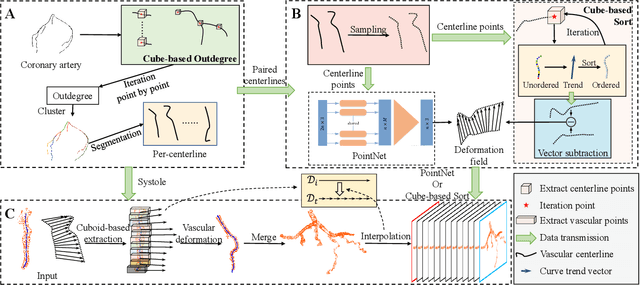
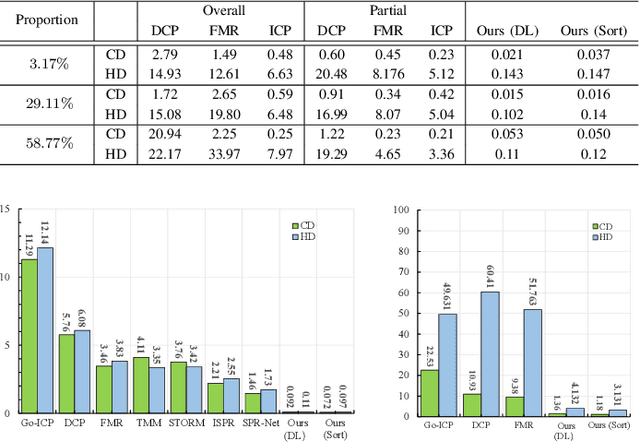
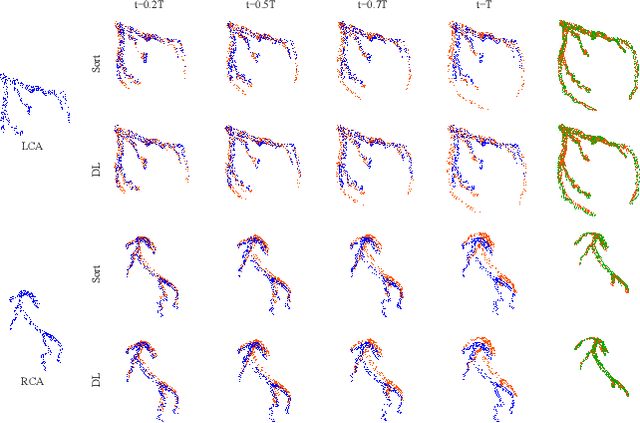
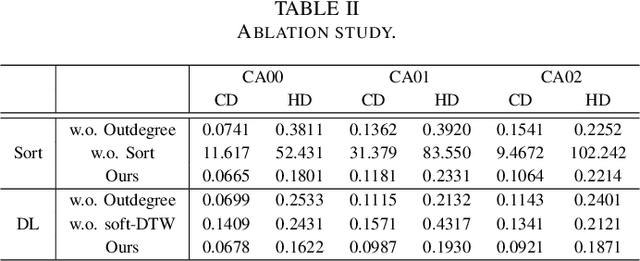
The three-dimensional vascular model reconstructed from CT images is widely used in medical diagnosis. At different phases, the beating of the heart can cause deformation of vessels, resulting in different vascular imaging states and false positive diagnostic results. The 4D model can simulate a complete cardiac cycle. Due to the dose limitation of contrast agent injection in patients, it is valuable to synthesize a 4D coronary artery trees through finite phases imaging. In this paper, we propose a method for generating a 4D coronary artery trees, which maps the systole to the diastole through deformation field prediction, interpolates on the timeline, and the motion trajectory of points are obtained. Specifically, the centerline is used to represent vessels and to infer deformation fields using cube-based sorting and neural networks. Adjacent vessel points are aggregated and interpolated based on the deformation field of the centerline point to obtain displacement vectors of different phases. Finally, the proposed method is validated through experiments to achieve the registration of non-rigid vascular points and the generation of 4D coronary trees.