 Add to Chrome
 Add to Firefox
 Add to Edge
LottieGPT: Tokenizing Vector Animation for Autoregressive Generation
Apr 13, 2026
Despite rapid progress in video generation, existing models are incapable of producing vector animation, a dominant and highly expressive form of multimedia on the Internet. Vector animations offer resolution-independence, compactness, semantic structure, and editable parametric motion representations, yet current generative models operate exclusively in raster space and thus cannot synthesize them. Meanwhile, recent advances in large multimodal models demonstrate strong capabilities in generating structured data such as slides, 3D meshes, LEGO sequences, and indoor layouts, suggesting that native vector animation generation may be achievable. In this work, we present the first framework for tokenizing and autoregressively generating vector animations. We adopt Lottie, a widely deployed JSON-based animation standard, and design a tailored Lottie Tokenizer that encodes layered geometric primitives, transforms, and keyframe-based motion into a compact and semantically aligned token sequence. To support large-scale training, we also construct LottieAnimation-660K, the largest and most diverse vector animation dataset to date, consisting of 660k real-world Lottie animation and 15M static Lottie image files curated from broad Internet sources. Building upon these components, we finetune Qwen-VL to create LottieGPT, a native multimodal model capable of generating coherent, editable vector animations directly from natural language or visual prompts. Experiments show that our tokenizer dramatically reduces sequence length while preserving structural fidelity, enabling effective autoregressive learning of dynamic vector content. LottieGPT exhibits strong generalization across diverse animation styles and outperforms previous state-of-the-art models on SVG generation (a special case of single-frame vector animation).

HAVE-FUN: Human Avatar Reconstruction from Few-Shot Unconstrained Images
Nov 27, 2023As for human avatar reconstruction, contemporary techniques commonly necessitate the acquisition of costly data and struggle to achieve satisfactory results from a small number of casual images. In this paper, we investigate this task from a few-shot unconstrained photo album. The reconstruction of human avatars from such data sources is challenging because of limited data amount and dynamic articulated poses. For handling dynamic data, we integrate a skinning mechanism with deep marching tetrahedra (DMTet) to form a drivable tetrahedral representation, which drives arbitrary mesh topologies generated by the DMTet for the adaptation of unconstrained images. To effectively mine instructive information from few-shot data, we devise a two-phase optimization method with few-shot reference and few-shot guidance. The former focuses on aligning avatar identity with reference images, while the latter aims to generate plausible appearances for unseen regions. Overall, our framework, called HaveFun, can undertake avatar reconstruction, rendering, and animation. Extensive experiments on our developed benchmarks demonstrate that HaveFun exhibits substantially superior performance in reconstructing the human body and hand. Project website: https://seanchenxy.github.io/HaveFunWeb/.
DT-NeRF: Decomposed Triplane-Hash Neural Radiance Fields for High-Fidelity Talking Portrait Synthesis
Sep 14, 2023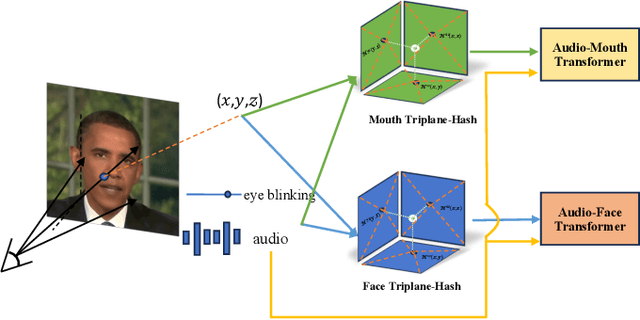
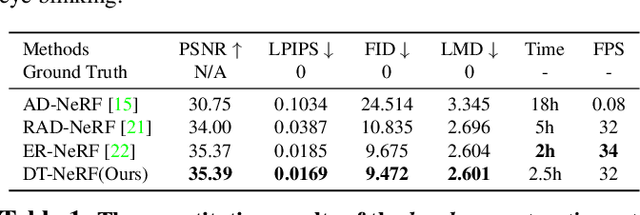
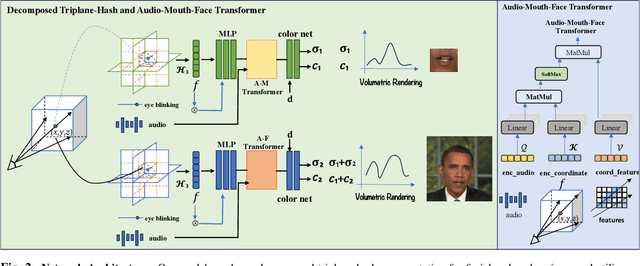
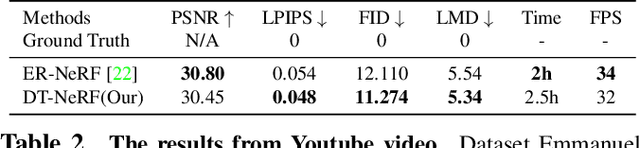
In this paper, we present the decomposed triplane-hash neural radiance fields (DT-NeRF), a framework that significantly improves the photorealistic rendering of talking faces and achieves state-of-the-art results on key evaluation datasets. Our architecture decomposes the facial region into two specialized triplanes: one specialized for representing the mouth, and the other for the broader facial features. We introduce audio features as residual terms and integrate them as query vectors into our model through an audio-mouth-face transformer. Additionally, our method leverages the capabilities of Neural Radiance Fields (NeRF) to enrich the volumetric representation of the entire face through additive volumetric rendering techniques. Comprehensive experimental evaluations corroborate the effectiveness and superiority of our proposed approach.