 Add to Chrome
 Add to Firefox
 Add to Edge
Learning Task-Sufficient World Models by Synergizing Agentic Exploration and Structured Modeling
Jul 05, 2026
Learning and planning in imagination using world models provides an effective paradigm for training agents for decision-making. However, existing approaches often rely on high-dimensional latent spaces or generic visual embeddings that retain many factors irrelevant to control, limiting efficiency and generalization across tasks. To this end, we study how agents can learn world models with representations that are task-specific, minimal, and sufficient for decision-making. We achieve this via a closed-loop synergy between the agent and the world model, in which structured world-model learning distills task-sufficient representations from informative interaction data. On the agent side, agents actively probe the environment to collect informative trajectories that expose task-relevant latent factors, guided by an adaptive curriculum. On the world-model side, we learn structured representations over observations to distill compact, task-sufficient latent states from the collected interaction data. This synergy enables the empirical recovery of task-sufficient latent representations that capture all control-relevant factors. Leveraging these representations, the resulting policies achieve improved sample efficiency and generalization, including generalization across skills, object-skill compositions, and previously unseen tasks on standard continuous-control and robotic-manipulation benchmarks.

RARM: Confidence-Gated Progress Reward Modeling for RL in Manipulation
Jun 24, 2026Reinforcement learning for robot manipulation is often bottlenecked by reward design, especially in long-horizon tasks: sparse success rewards provide weak supervision, while hand-crafted dense rewards are tedious to design and generalize poorly across tasks. Progress-based reward models offer a promising alternative by estimating how far an observation has advanced toward task completion, but existing approaches often require task-specific demonstrations or progress labels, and can assign high rewards to visually plausible but physically incorrect states. We introduce the Reference-Anchored Reward Model (RARM), a lightweight visual comparator that converts a single successful demonstration into a dense, progress-aware reward. RARM is trained once on general-purpose videos with a contrastive temporal objective, requiring no robot-specific data, task-specific reward labels, or per-task reward engineering. At deployment, RARM matches rollout clips to reference clips and rewards only confident forward progress, suppressing uncertain matches that may otherwise produce false-positive rewards. Across 9 simulated manipulation tasks from LIBERO and MetaWorld and 4 real-world tasks, RARM achieves the best overall success rates in subsequent RL training, with particularly large gains on long-horizon tasks such as cloth folding, where unreliable progress estimates are especially harmful.
Back to Parsimonious Latents: Learning Task-Centric World Models from Visual Foundations
May 25, 2026World models enable agents to predict future dynamics conditioned on actions, making the choice of latent representation central to planning and control. Such representations are often either learned directly from pixels with limited semantic structure or inherited from frozen visual foundation models with excessive task-irrelevant detail, yielding state spaces that are poorly matched to downstream planning and control. This is especially challenging in reward-free offline settings, where the model must learn from fixed trajectories without reward supervision or online interaction. To address this, we propose TC-WM, a framework for turning foundation-model embeddings into compact, task-sufficient world representations. The key design is to treat the pretrained embedding space as a semantic scaffold rather than as the final state space: TC-WM linearly projects high-dimensional visual embeddings into a compact latent as the dynamic space, aligns a subspace with the agent's physical state via contrastive learning, and reconstructs embeddings to preserve useful visual structure. This combines the generality of foundation features with the controllability of task-centric dynamics. Theoretically, we show that TC-WM suffices to identify the underlying task-centric latent factors up to a simple transformation. Empirically, TC-WM enables test-time planning across diverse environments (e.g., Robomimic and D4RL), achieving better world-modeling quality and more precise control than state-of-the-art approaches.
QwT-v2: Practical, Effective and Efficient Post-Training Quantization
May 27, 2025Network quantization is arguably one of the most practical network compression approaches for reducing the enormous resource consumption of modern deep neural networks. They usually require diverse and subtle design choices for specific architecture and tasks. Instead, the QwT method is a simple and general approach which introduces lightweight additional structures to improve quantization. But QwT incurs extra parameters and latency. More importantly, QwT is not compatible with many hardware platforms. In this paper, we propose QwT-v2, which not only enjoys all advantages of but also resolves major defects of QwT. By adopting a very lightweight channel-wise affine compensation (CWAC) module, QwT-v2 introduces significantly less extra parameters and computations compared to QwT, and at the same time matches or even outperforms QwT in accuracy. The compensation module of QwT-v2 can be integrated into quantization inference engines with little effort, which not only effectively removes the extra costs but also makes it compatible with most existing hardware platforms.
Unified Multimodal Understanding and Generation Models: Advances, Challenges, and Opportunities
May 05, 2025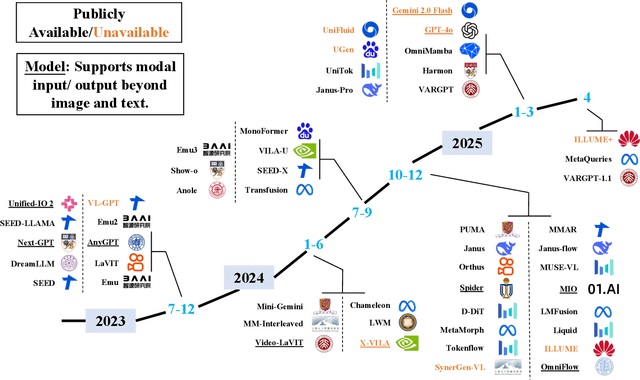
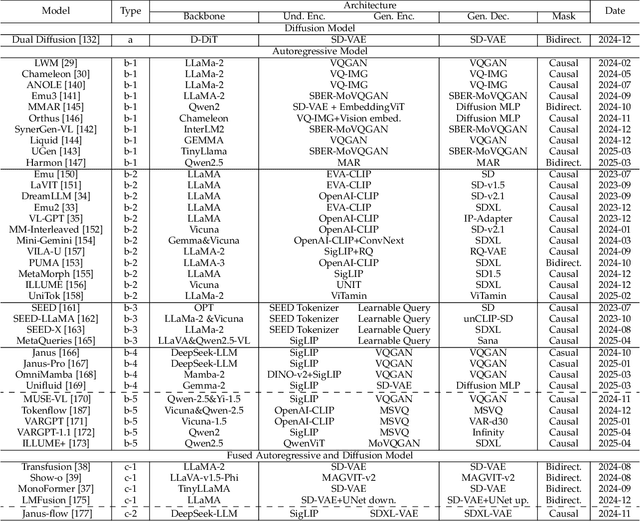
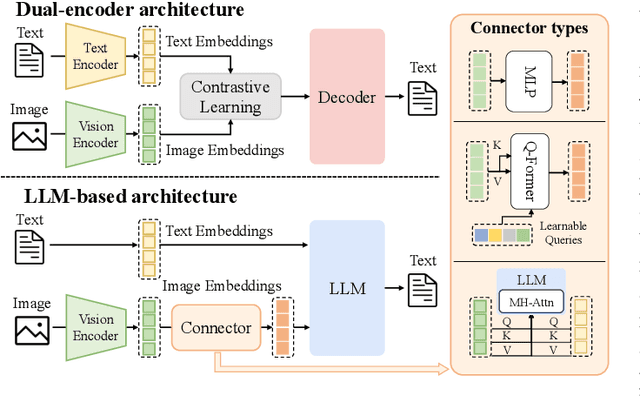

Recent years have seen remarkable progress in both multimodal understanding models and image generation models. Despite their respective successes, these two domains have evolved independently, leading to distinct architectural paradigms: While autoregressive-based architectures have dominated multimodal understanding, diffusion-based models have become the cornerstone of image generation. Recently, there has been growing interest in developing unified frameworks that integrate these tasks. The emergence of GPT-4o's new capabilities exemplifies this trend, highlighting the potential for unification. However, the architectural differences between the two domains pose significant challenges. To provide a clear overview of current efforts toward unification, we present a comprehensive survey aimed at guiding future research. First, we introduce the foundational concepts and recent advancements in multimodal understanding and text-to-image generation models. Next, we review existing unified models, categorizing them into three main architectural paradigms: diffusion-based, autoregressive-based, and hybrid approaches that fuse autoregressive and diffusion mechanisms. For each category, we analyze the structural designs and innovations introduced by related works. Additionally, we compile datasets and benchmarks tailored for unified models, offering resources for future exploration. Finally, we discuss the key challenges facing this nascent field, including tokenization strategy, cross-modal attention, and data. As this area is still in its early stages, we anticipate rapid advancements and will regularly update this survey. Our goal is to inspire further research and provide a valuable reference for the community. The references associated with this survey will be available on GitHub soon.
Infant Cry Detection Using Causal Temporal Representation
Mar 08, 2025This paper addresses a major challenge in acoustic event detection, in particular infant cry detection in the presence of other sounds and background noises: the lack of precise annotated data. We present two contributions for supervised and unsupervised infant cry detection. The first is an annotated dataset for cry segmentation, which enables supervised models to achieve state-of-the-art performance. Additionally, we propose a novel unsupervised method, Causal Representation Spare Transition Clustering (CRSTC), based on causal temporal representation, which helps address the issue of data scarcity more generally. By integrating the detected cry segments, we significantly improve the performance of downstream infant cry classification, highlighting the potential of this approach for infant care applications.
CHATS: Combining Human-Aligned Optimization and Test-Time Sampling for Text-to-Image Generation
Feb 18, 2025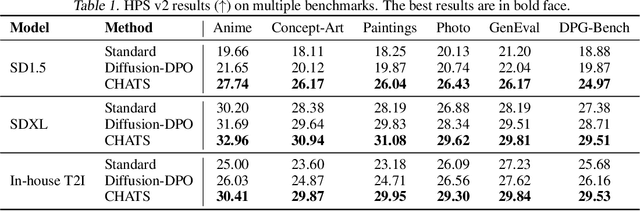
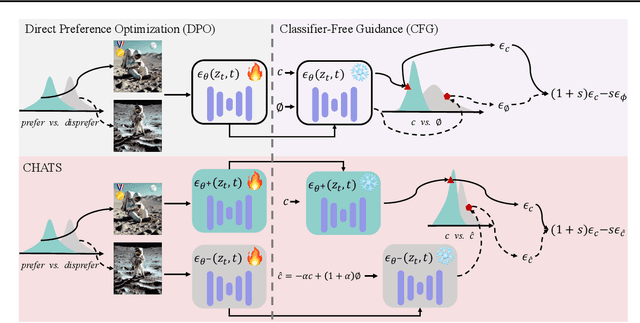
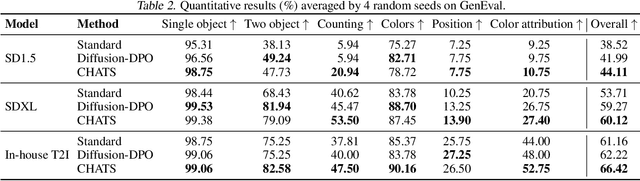
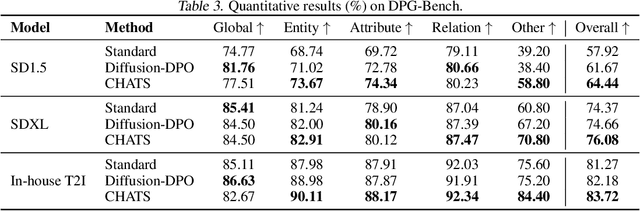
Diffusion models have emerged as a dominant approach for text-to-image generation. Key components such as the human preference alignment and classifier-free guidance play a crucial role in ensuring generation quality. However, their independent application in current text-to-image models continues to face significant challenges in achieving strong text-image alignment, high generation quality, and consistency with human aesthetic standards. In this work, we for the first time, explore facilitating the collaboration of human performance alignment and test-time sampling to unlock the potential of text-to-image models. Consequently, we introduce CHATS (Combining Human-Aligned optimization and Test-time Sampling), a novel generative framework that separately models the preferred and dispreferred distributions and employs a proxy-prompt-based sampling strategy to utilize the useful information contained in both distributions. We observe that CHATS exhibits exceptional data efficiency, achieving strong performance with only a small, high-quality funetuning dataset. Extensive experiments demonstrate that CHATS surpasses traditional preference alignment methods, setting new state-of-the-art across various standard benchmarks.
Quantization without Tears
Nov 22, 2024
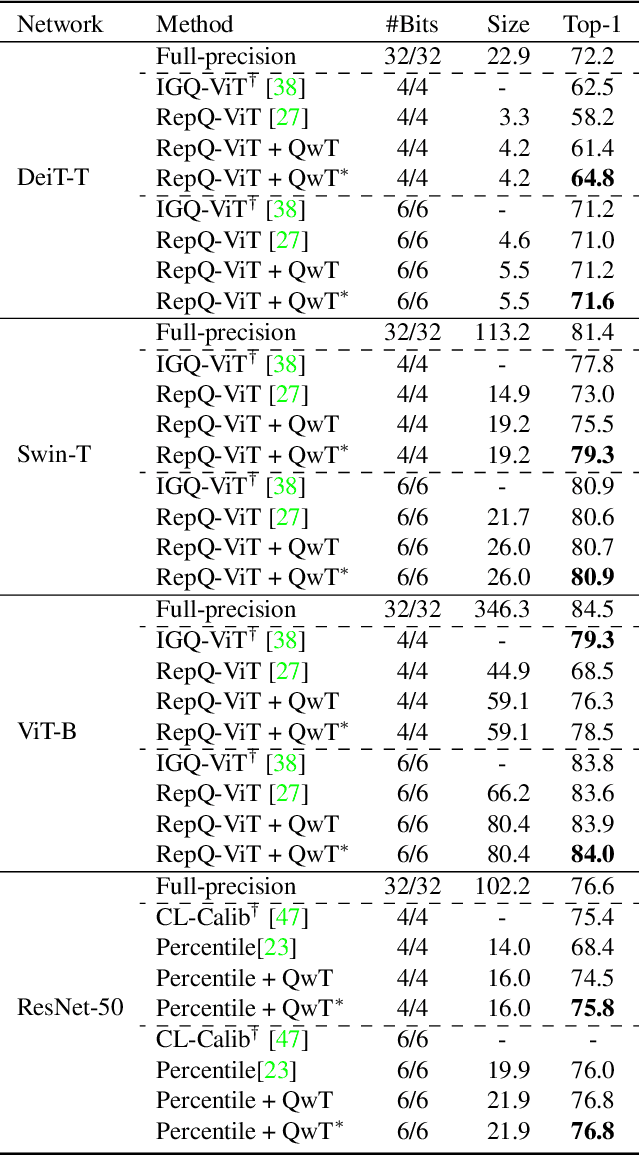
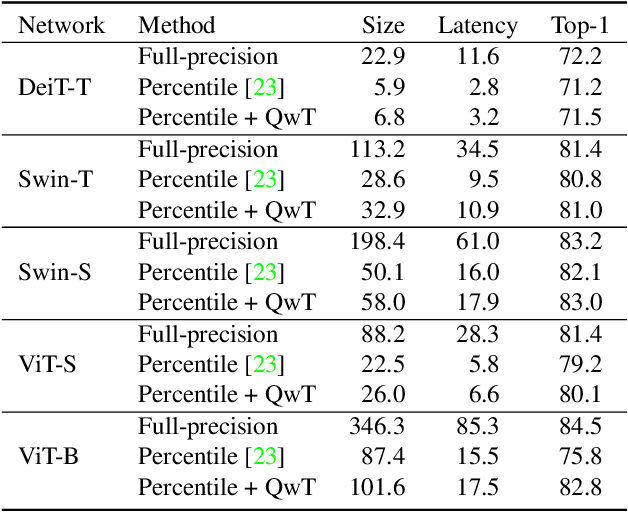
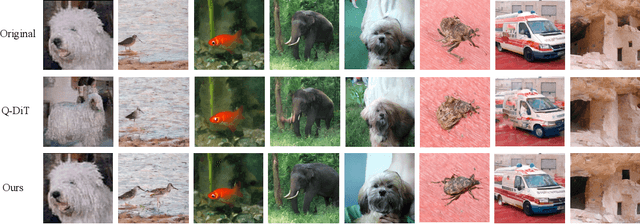
Deep neural networks, while achieving remarkable success across diverse tasks, demand significant resources, including computation, GPU memory, bandwidth, storage, and energy. Network quantization, as a standard compression and acceleration technique, reduces storage costs and enables potential inference acceleration by discretizing network weights and activations into a finite set of integer values. However, current quantization methods are often complex and sensitive, requiring extensive task-specific hyperparameters, where even a single misconfiguration can impair model performance, limiting generality across different models and tasks. In this paper, we propose Quantization without Tears (QwT), a method that simultaneously achieves quantization speed, accuracy, simplicity, and generality. The key insight of QwT is to incorporate a lightweight additional structure into the quantized network to mitigate information loss during quantization. This structure consists solely of a small set of linear layers, keeping the method simple and efficient. More importantly, it provides a closed-form solution, allowing us to improve accuracy effortlessly under 2 minutes. Extensive experiments across various vision, language, and multimodal tasks demonstrate that QwT is both highly effective and versatile. In fact, our approach offers a robust solution for network quantization that combines simplicity, accuracy, and adaptability, which provides new insights for the design of novel quantization paradigms.
Benchmarking Sub-Genre Classification For Mainstage Dance Music
Sep 10, 2024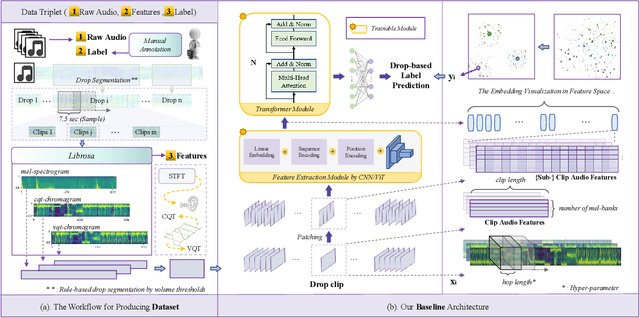

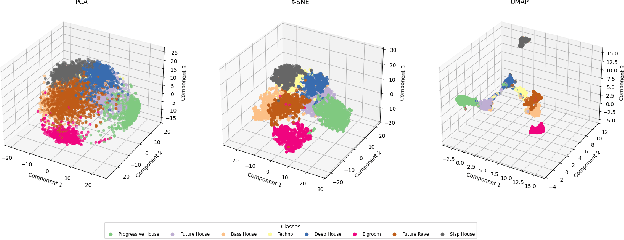

Music classification, with a wide range of applications, is one of the most prominent tasks in music information retrieval. To address the absence of comprehensive datasets and high-performing methods in the classification of mainstage dance music, this work introduces a novel benchmark comprising a new dataset and a baseline. Our dataset extends the number of sub-genres to cover most recent mainstage live sets by top DJs worldwide in music festivals. A continuous soft labeling approach is employed to account for tracks that span multiple sub-genres, preserving the inherent sophistication. For the baseline, we developed deep learning models that outperform current state-of-the-art multimodel language models, which struggle to identify house music sub-genres, emphasizing the need for specialized models trained on fine-grained datasets. Our benchmark is applicable to serve for application scenarios such as music recommendation, DJ set curation, and interactive multimedia, where we also provide video demos. Our code is on \url{https://anonymous.4open.science/r/Mainstage-EDM-Benchmark/}.
Minimal Interaction Edge Tuning: A New Paradigm for Visual Adaptation
Jun 26, 2024The rapid scaling of large vision pretrained models makes fine-tuning tasks more and more difficult on edge devices with low computational resources. We explore a new visual adaptation paradigm called edge tuning, which treats large pretrained models as standalone feature extractors that run on powerful cloud servers. The fine-tuning carries out on edge devices with small networks which require low computational resources. Existing methods that are potentially suitable for our edge tuning paradigm are discussed. But, three major drawbacks hinder their application in edge tuning: low adaptation capability, large adapter network, and high information transfer overhead. To address these issues, we propose Minimal Interaction Edge Tuning, or MIET, which reveals that the sum of intermediate features from pretrained models not only has minimal information transfer but also has high adaptation capability. With a lightweight attention-based adaptor network, MIET achieves information transfer efficiency, parameter efficiency, computational and memory efficiency, and at the same time demonstrates competitive results on various visual adaptation benchmarks.