 Add to Chrome
 Add to Firefox
 Add to Edge
Learning Roller-Skating Motions of Humanoid Robots Based on Adversarial Motion Priors
Jul 12, 2026
Humanoid roller-skating is difficult because the robot must coordinate whole-body balance, rolling contacts, and velocity-dependent posture regulation. This paper presents an adversarial motion prior based reinforcement learning framework for two humanoid roller-skating gaits: Pump Glide skating and Push Glide skating. The two gait datasets are collected independently through motion capture and retargeted to the humanoid robot separately. The retargeted data are then smoothed and resampled into reference motion states for AMP training. The two gaits are learned by independent AMP training pipelines with separate reference datasets, separate policies, and independent reward architectures. Simulation experiments are designed to evaluate gait quality, velocity tracking, turning, and gait-specific reward ablations.

Booster Lab: A Data-Centric Pipeline for Learning Deployable Humanoid Locomotion Policies
Jun 26, 2026Humanoid robot motion learning requires not only task-oriented control policies but also physically feasible and natural behaviors that can be transferred to real robots. However, robot-feasible motion data are often scarce: raw human demonstrations may be incompatible with the robot morphology, open-source clips vary in quality, and simulation-collected robot trajectories still require feasibility checking. To address these challenges, we propose a data-centric training and deployment pipeline that integrates motion data curation, real-to-sim model adaptation, AMP-based reinforcement learning, and sim-to-real deployment. We validate the framework on the Booster T1 robot and further provide preliminary cross-platform validation on Booster K1.
TSD: A Physics-Inspired Trajectory Saliency Detector for Efficient Imitation Learning
Jun 22, 2026For imitation learning in robotic manipulation, high data collection costs result in the scarcity of high quality data. In this paper, we leverage the inherent heterogeneity of trajectories to address this challenge. Based on our observations of manipulation tasks, we categorize motions into transitional, precise, and agile types, defining the latter two as trajectory saliency due to their criticality to task success in contrast to the prevalent but less relevant transitional motions. Therefore, we propose the Trajectory Saliency Detector (TSD), a training-free and plug-and-play framework to identify trajectory saliency. TSD employs two physically-grounded metrics: spatial entropy to capture fine-grained manipulation and centripetal acceleration to detect agile maneuvering. We further leverage TSD to develop a dataset compression method that reduces training costs and a dataset expansion strategy that improves data collection efficiency. Extensive experiments in both simulation and real-world settings demonstrate that models trained on TSD-condensed datasets achieve comparable or even superior performance with 25% less data on average. These results validate the effectiveness of our dataset compression and expansion strategies, thereby confirming the utility of TSD. Consequently, TSD offers a scalable and cost-effective pathway to synthesize information-dense datasets for efficient robot learning. Project page: https://trajectory-saliency-detector.github.io/trajectory-saliency-detector/
Learning Vision-Driven Reactive Soccer Skills for Humanoid Robots
Nov 06, 2025Humanoid soccer poses a representative challenge for embodied intelligence, requiring robots to operate within a tightly coupled perception-action loop. However, existing systems typically rely on decoupled modules, resulting in delayed responses and incoherent behaviors in dynamic environments, while real-world perceptual limitations further exacerbate these issues. In this work, we present a unified reinforcement learning-based controller that enables humanoid robots to acquire reactive soccer skills through the direct integration of visual perception and motion control. Our approach extends Adversarial Motion Priors to perceptual settings in real-world dynamic environments, bridging motion imitation and visually grounded dynamic control. We introduce an encoder-decoder architecture combined with a virtual perception system that models real-world visual characteristics, allowing the policy to recover privileged states from imperfect observations and establish active coordination between perception and action. The resulting controller demonstrates strong reactivity, consistently executing coherent and robust soccer behaviors across various scenarios, including real RoboCup matches.
CBMC-V3: A CNS-inspired Control Framework Towards Manipulation Agility with SNN
Nov 06, 2025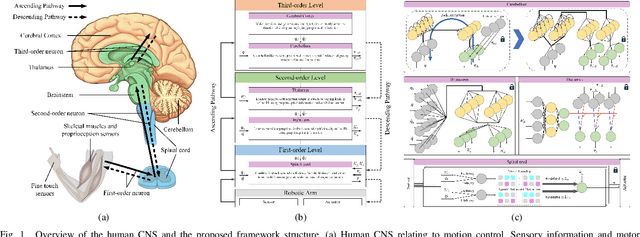
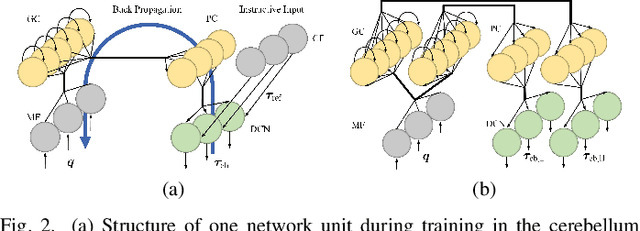
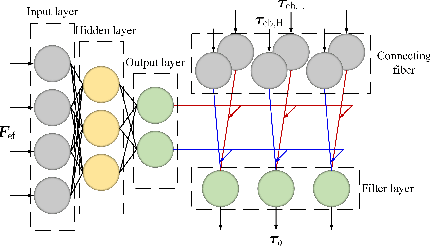
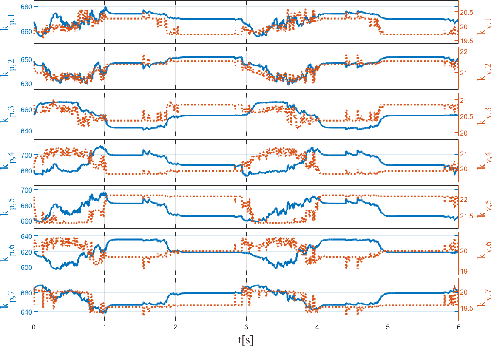
As robotic arm applications extend beyond industrial settings into healthcare, service, and daily life, existing control algorithms struggle to achieve the agile manipulation required for complex environments with dynamic trajectories, unpredictable interactions, and diverse objects. This paper presents a biomimetic control framework based on Spiking Neural Networks (SNN), inspired by the human Central Nervous System (CNS), to achieve agile control in such environments. The proposed framework features five control modules (cerebral cortex, cerebellum, thalamus, brainstem, spinal cord), three hierarchical control levels (first-order, second-order, third-order), and two information pathways (ascending, descending). Each module is fully implemented using SNN. The spinal cord module uses spike encoding and Leaky Integrate-and-Fire (LIF) neurons for feedback control. The brainstem module employs a network of LIF and non-spiking LIF neurons to dynamically adjust spinal cord parameters via reinforcement learning. The thalamus module similarly adjusts the cerebellum's torque outputs. The cerebellum module uses a recurrent SNN to learn the robotic arm's dynamics through regression, providing feedforward gravity compensation torques. The framework is validated both in simulation and on real-world robotic arm platform under various loads and trajectories. Results demonstrate that our method outperforms the industrial-grade position control in manipulation agility.
Booster Gym: An End-to-End Reinforcement Learning Framework for Humanoid Robot Locomotion
Jun 18, 2025Recent advancements in reinforcement learning (RL) have led to significant progress in humanoid robot locomotion, simplifying the design and training of motion policies in simulation. However, the numerous implementation details make transferring these policies to real-world robots a challenging task. To address this, we have developed a comprehensive code framework that covers the entire process from training to deployment, incorporating common RL training methods, domain randomization, reward function design, and solutions for handling parallel structures. This library is made available as a community resource, with detailed descriptions of its design and experimental results. We validate the framework on the Booster T1 robot, demonstrating that the trained policies seamlessly transfer to the physical platform, enabling capabilities such as omnidirectional walking, disturbance resistance, and terrain adaptability. We hope this work provides a convenient tool for the robotics community, accelerating the development of humanoid robots. The code can be found in https://github.com/BoosterRobotics/booster_gym.
HiFAR: Multi-Stage Curriculum Learning for High-Dynamics Humanoid Fall Recovery
Feb 28, 2025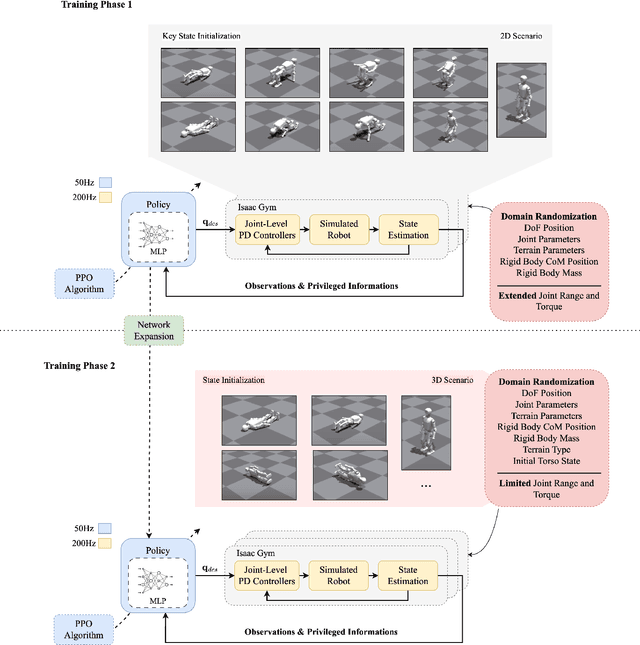
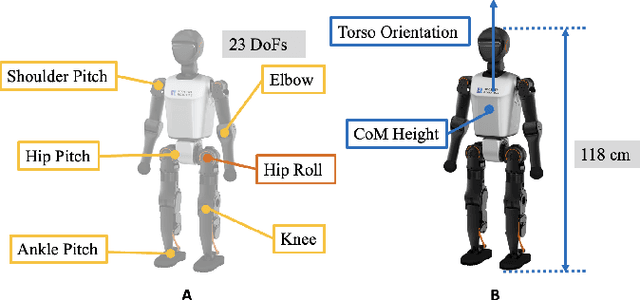
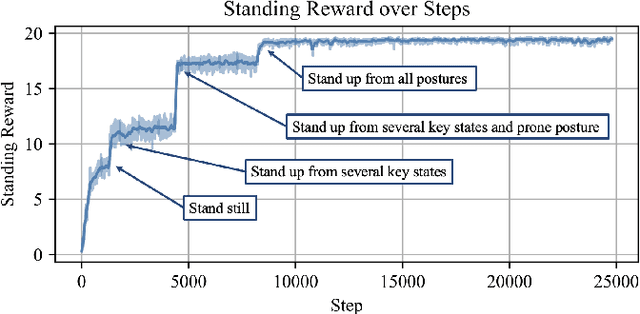
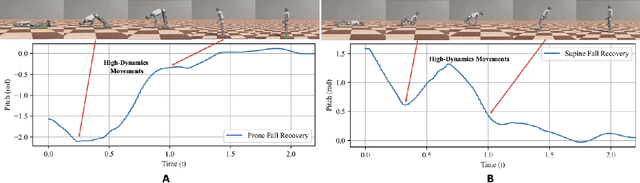
Humanoid robots encounter considerable difficulties in autonomously recovering from falls, especially within dynamic and unstructured environments. Conventional control methodologies are often inadequate in addressing the complexities associated with high-dimensional dynamics and the contact-rich nature of fall recovery. Meanwhile, reinforcement learning techniques are hindered by issues related to sparse rewards, intricate collision scenarios, and discrepancies between simulation and real-world applications. In this study, we introduce a multi-stage curriculum learning framework, termed HiFAR. This framework employs a staged learning approach that progressively incorporates increasingly complex and high-dimensional recovery tasks, thereby facilitating the robot's acquisition of efficient and stable fall recovery strategies. Furthermore, it enables the robot to adapt its policy to effectively manage real-world fall incidents. We assess the efficacy of the proposed method using a real humanoid robot, showcasing its capability to autonomously recover from a diverse range of falls with high success rates, rapid recovery times, robustness, and generalization.
Robust Quadrupedal Locomotion via Risk-Averse Policy Learning
Sep 01, 2023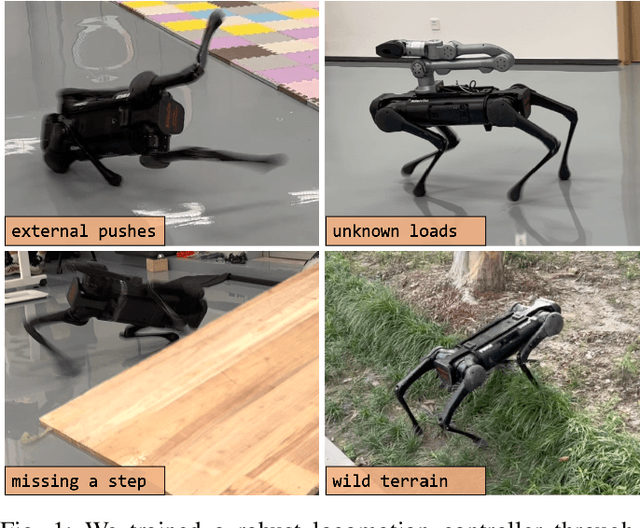
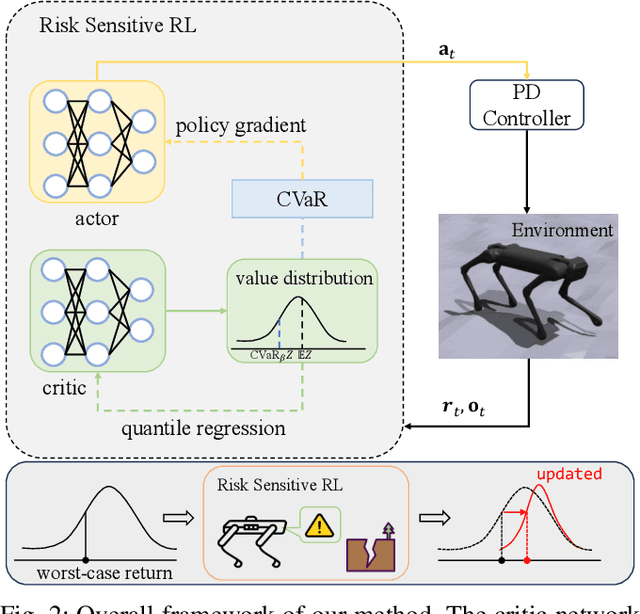
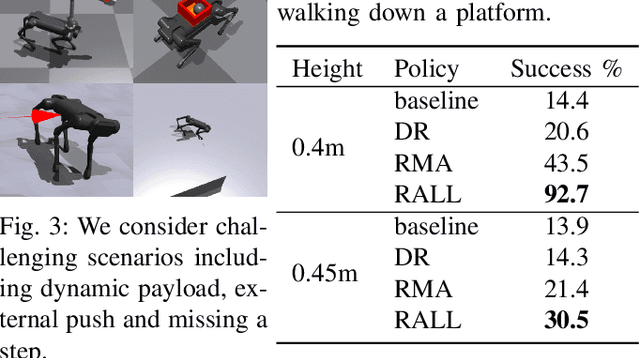
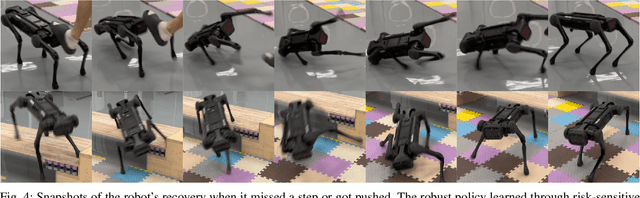
The robustness of legged locomotion is crucial for quadrupedal robots in challenging terrains. Recently, Reinforcement Learning (RL) has shown promising results in legged locomotion and various methods try to integrate privileged distillation, scene modeling, and external sensors to improve the generalization and robustness of locomotion policies. However, these methods are hard to handle uncertain scenarios such as abrupt terrain changes or unexpected external forces. In this paper, we consider a novel risk-sensitive perspective to enhance the robustness of legged locomotion. Specifically, we employ a distributional value function learned by quantile regression to model the aleatoric uncertainty of environments, and perform risk-averse policy learning by optimizing the worst-case scenarios via a risk distortion measure. Extensive experiments in both simulation environments and a real Aliengo robot demonstrate that our method is efficient in handling various external disturbances, and the resulting policy exhibits improved robustness in harsh and uncertain situations in legged locomotion. Videos are available at https://risk-averse-locomotion.github.io/.
Prioritized Hierarchical Compliance Control for Dual-Arm Robot Stable Clamping
Dec 20, 2021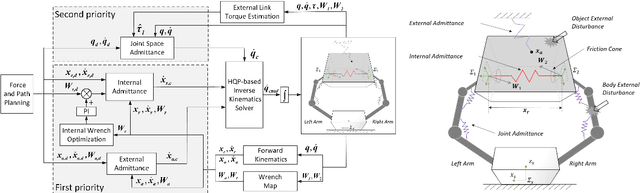
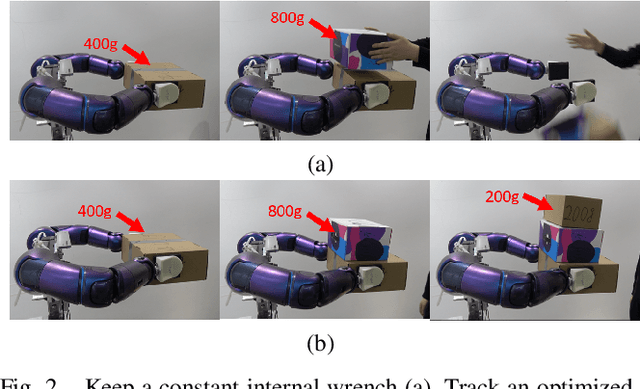
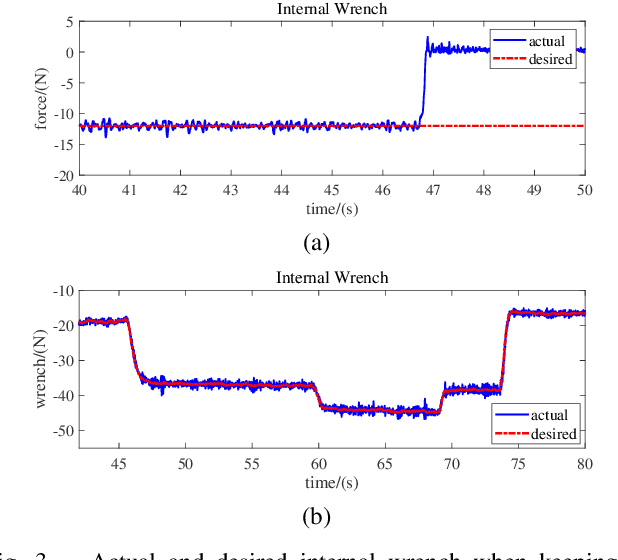
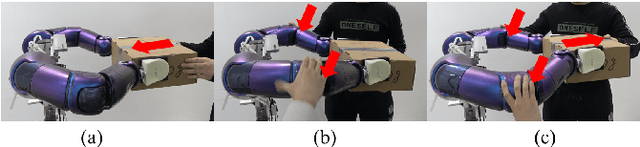
When a dual-arm robot clamps a rigid object in an environment for human beings, the environment or the collaborating human will impose incidental disturbance on the operated object or the robot arm, leading to clamping failure, damaging the robot even hurting the human. This research proposes a prioritized hierarchical compliance control to simultaneously deal with the two types of disturbances in the dual-arm robot clamping. First, we use hierarchical quadratic programming (HQP) to solve the robot inverse kinematics under the joint constraints and prioritize the compliance for the disturbance on the object over that on the robot arm. Second, we estimate the disturbance forces throughout the momentum observer with the F/T sensors and adopt admittance control to realize the compliances. Finally, we perform the verify experiments on a 14-DOF position-controlled dual-arm robot WalkerX, clamping a rigid object stably while realizing the compliance against the disturbances.
Recursive Hierarchical Projection for Whole-Body Control with Task Priority Transition
Sep 22, 2021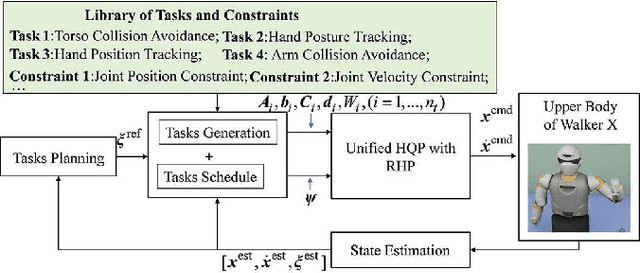
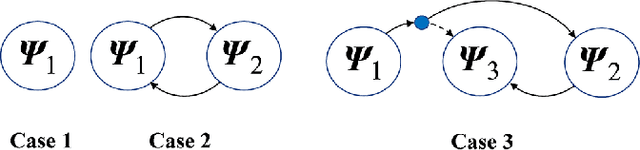
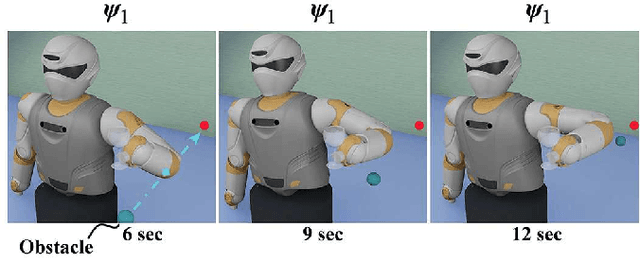
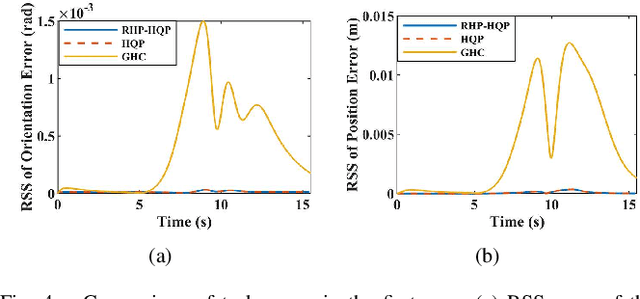
Redundant robots are desired to execute multitasks with different priorities simultaneously. The task priorities are necessary to be transitioned for complex task scheduling of whole-body control (WBC). Many methods focused on guaranteeing the control continuity during task priority transition, however either increased the computation consumption or sacrificed the accuracy of tasks inevitably. This work formulates the WBC problem with task priority transition as an Hierarchical Quadratic Programming (HQP) with Recursive Hierarchical Projection (RHP) matrices. The tasks of each level are solved recursively through HQP. We propose the RHP matrix to form the continuously changing projection of each level so that the task priority transition is achieved without increasing computation consumption. Additionally, the recursive approach solves the WBC problem without losing the accuracy of tasks. We verify the effectiveness of this scheme by the comparative simulations of the reactive collision avoidance through multi-tasks priority transitions.