 Add to Chrome
 Add to Firefox
 Add to Edge
TSD: A Physics-Inspired Trajectory Saliency Detector for Efficient Imitation Learning
Jun 22, 2026
For imitation learning in robotic manipulation, high data collection costs result in the scarcity of high quality data. In this paper, we leverage the inherent heterogeneity of trajectories to address this challenge. Based on our observations of manipulation tasks, we categorize motions into transitional, precise, and agile types, defining the latter two as trajectory saliency due to their criticality to task success in contrast to the prevalent but less relevant transitional motions. Therefore, we propose the Trajectory Saliency Detector (TSD), a training-free and plug-and-play framework to identify trajectory saliency. TSD employs two physically-grounded metrics: spatial entropy to capture fine-grained manipulation and centripetal acceleration to detect agile maneuvering. We further leverage TSD to develop a dataset compression method that reduces training costs and a dataset expansion strategy that improves data collection efficiency. Extensive experiments in both simulation and real-world settings demonstrate that models trained on TSD-condensed datasets achieve comparable or even superior performance with 25% less data on average. These results validate the effectiveness of our dataset compression and expansion strategies, thereby confirming the utility of TSD. Consequently, TSD offers a scalable and cost-effective pathway to synthesize information-dense datasets for efficient robot learning. Project page: https://trajectory-saliency-detector.github.io/trajectory-saliency-detector/

CBMC-V3: A CNS-inspired Control Framework Towards Manipulation Agility with SNN
Nov 06, 2025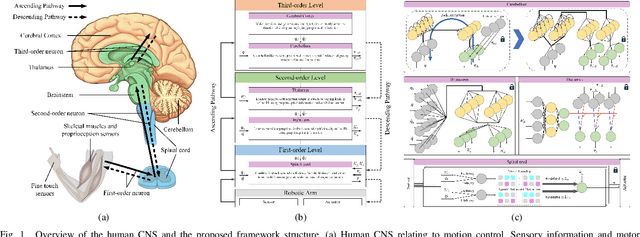
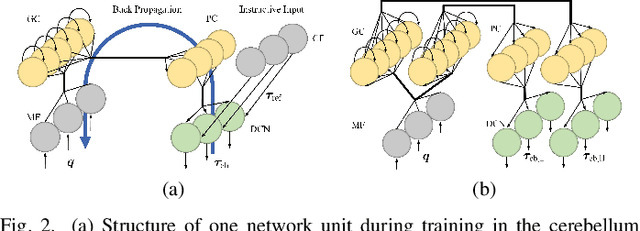
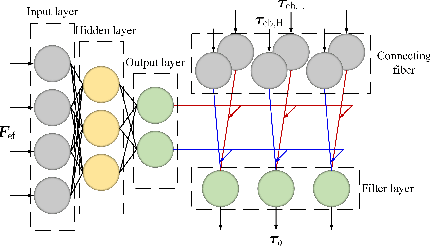
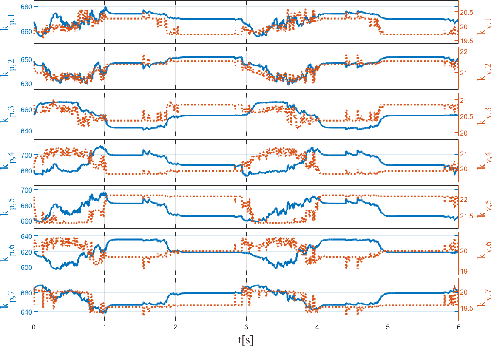
As robotic arm applications extend beyond industrial settings into healthcare, service, and daily life, existing control algorithms struggle to achieve the agile manipulation required for complex environments with dynamic trajectories, unpredictable interactions, and diverse objects. This paper presents a biomimetic control framework based on Spiking Neural Networks (SNN), inspired by the human Central Nervous System (CNS), to achieve agile control in such environments. The proposed framework features five control modules (cerebral cortex, cerebellum, thalamus, brainstem, spinal cord), three hierarchical control levels (first-order, second-order, third-order), and two information pathways (ascending, descending). Each module is fully implemented using SNN. The spinal cord module uses spike encoding and Leaky Integrate-and-Fire (LIF) neurons for feedback control. The brainstem module employs a network of LIF and non-spiking LIF neurons to dynamically adjust spinal cord parameters via reinforcement learning. The thalamus module similarly adjusts the cerebellum's torque outputs. The cerebellum module uses a recurrent SNN to learn the robotic arm's dynamics through regression, providing feedforward gravity compensation torques. The framework is validated both in simulation and on real-world robotic arm platform under various loads and trajectories. Results demonstrate that our method outperforms the industrial-grade position control in manipulation agility.