 Add to Chrome
 Add to Firefox
 Add to Edge
Metis: Bridging Text and Code Memory for Self-Evolving Agents
Jun 23, 2026
Self-evolving agents improve over time by distilling experience from past executions and reusing it in future tasks. Existing systems represent such experience either as natural-language text injected into the agent context or as code exposed as callable tools. However, the choice between these representations is typically made at design time rather than derived from the characteristics of the experience itself, leaving the trade-offs between them poorly understood. We present the first controlled study that isolates text memory and code memory over an identical set of experiences. Our results show that the two forms exhibit complementary trade-offs in construction cost, execution efficiency, and transferability, such that neither representation alone is sufficient. Guided by these findings, we propose Metis, a self-evolving agent system built on a hierarchical dual-representation memory. Metis organizes textual experience into execution plans, environment facts, and common pitfalls, and selectively crystallizes recurring plans into validated callable tools. This design combines the broad applicability of text memory with the execution efficiency of code memory while incurring tool-generation cost only when justified by repeated reuse. We evaluate Metis on AppWorld, a challenging benchmark for interactive agents. The results show that Metis improves task accuracy by up to 20.6% over ReAct while reducing execution cost by up to 22.8%. Compared with representative self-evolving agent systems, Metis consistently achieves a better balance between accuracy, execution efficiency, and memory-construction cost.

LoPA: Scaling dLLM Inference via Lookahead Parallel Decoding
Dec 22, 2025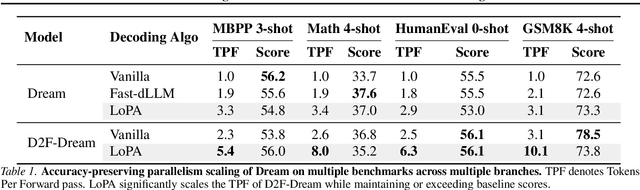
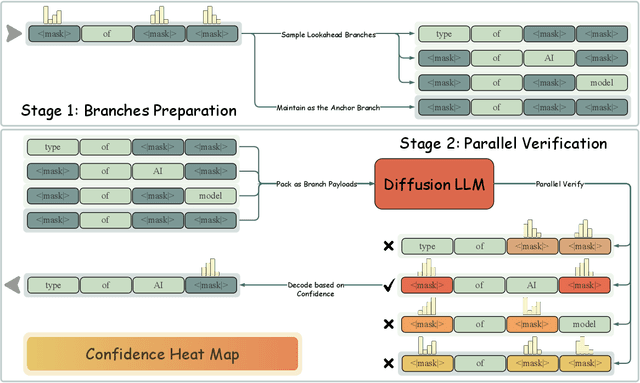
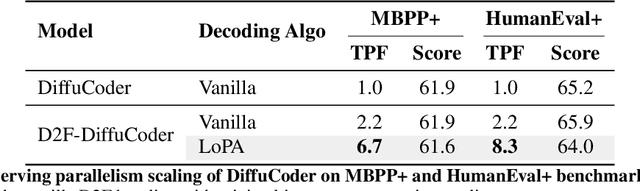
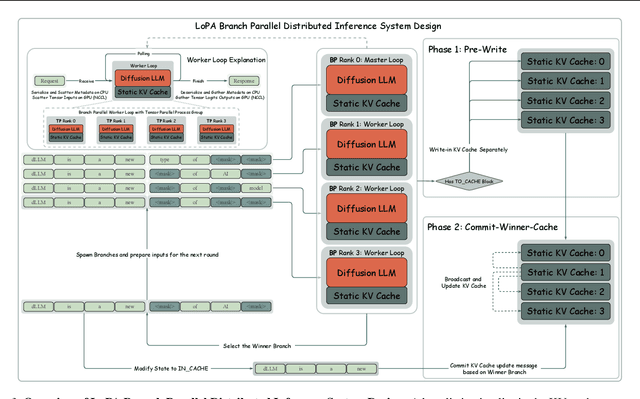
Diffusion Large Language Models (dLLMs) have demonstrated significant potential for high-speed inference. However, current confidence-driven decoding strategies are constrained by limited parallelism, typically achieving only 1--3 tokens per forward pass (TPF). In this work, we identify that the degree of parallelism during dLLM inference is highly sensitive to the Token Filling Order (TFO). Then, we introduce Lookahead PArallel Decoding LoPA, a training-free, plug-and-play algorithm, to identify a superior TFO and hence accelerate inference. LoPA concurrently explores distinct candidate TFOs via parallel branches, and selects the one with the highest potential for future parallelism based on branch confidence. We apply LoPA to the state-of-the-art D2F model and observe a substantial enhancement in decoding efficiency. Notably, LoPA increases the TPF of D2F-Dream to 10.1 on the GSM8K while maintaining performance superior to the Dream baseline. Furthermore, to facilitate this unprecedented degree of parallelism, we develop a specialized multi-device inference system featuring Branch Parallelism (BP), which achieves a single-sample throughput of 1073.9 tokens per second under multi-GPU deployment. The code is available at https://github.com/zhijie-group/LoPA.
Tackling the Dynamicity in a Production LLM Serving System with SOTA Optimizations via Hybrid Prefill/Decode/Verify Scheduling on Efficient Meta-kernels
Dec 24, 2024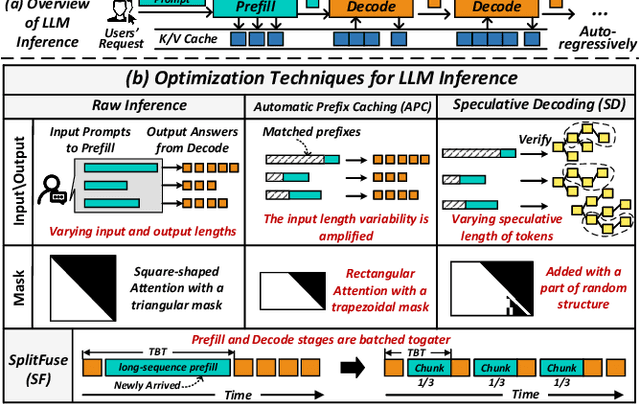

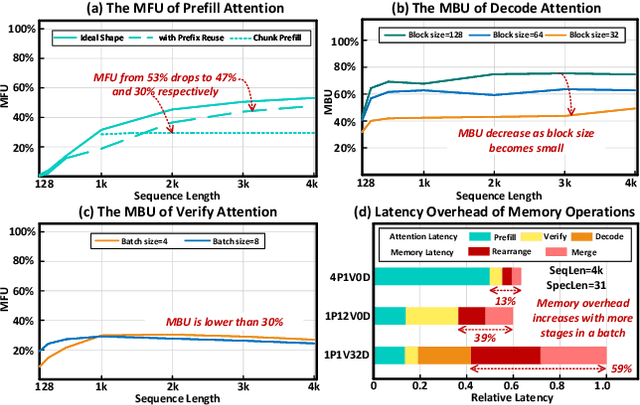
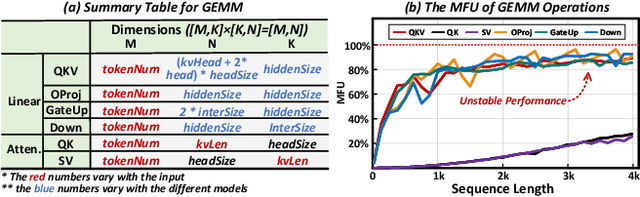
Meeting growing demands for low latency and cost efficiency in production-grade large language model (LLM) serving systems requires integrating advanced optimization techniques. However, dynamic and unpredictable input-output lengths of LLM, compounded by these optimizations, exacerbate the issues of workload variability, making it difficult to maintain high efficiency on AI accelerators, especially DSAs with tile-based programming models. To address this challenge, we introduce XY-Serve, a versatile, Ascend native, end-to-end production LLM-serving system. The core idea is an abstraction mechanism that smooths out the workload variability by decomposing computations into unified, hardware-friendly, fine-grained meta primitives. For attention, we propose a meta-kernel that computes the basic pattern of matmul-softmax-matmul with architectural-aware tile sizes. For GEMM, we introduce a virtual padding scheme that adapts to dynamic shape changes while using highly efficient GEMM primitives with assorted fixed tile sizes. XY-Serve sits harmoniously with vLLM. Experimental results show up to 89% end-to-end throughput improvement compared with current publicly available baselines on Ascend NPUs. Additionally, our approach outperforms existing GEMM (average 14.6% faster) and attention (average 21.5% faster) kernels relative to existing libraries. While the work is Ascend native, we believe the approach can be readily applicable to SIMT architectures as well.