 Add to Chrome
 Add to Firefox
 Add to Edge
Cripping AI: Reimagining AI Through Lived Disability Experiences
May 03, 2026
Drawing on crip theory, this paper proposes cripping AI as a guiding framework to center lived disability experiences in AI research and development. Moving beyond calls to make AI "accessible" to people with disabilities, cripping AI seeks to: (1) reveal and dismantle ableist assumptions embedded in how AI is imagined, designed, and evaluated; (2) center disabled ways of knowing (i.e., cripistemologies); (3) respect disabled labor in co-creating accessible practices. We demonstrate how to apply our framework with three cases: deafness and sign language AI, blindness and visual assistive AI, and stuttering and speech AI. We end by outlining three directions for future work, including cripping AI with diverse human bodyminds, across the entire AI pipeline and ecosystem, and in collaboration with other justice-oriented AI efforts.

Designing Spatial Architectures for Sparse Attention: STAR Accelerator via Cross-Stage Tiling
Dec 24, 2025Large language models (LLMs) rely on self-attention for contextual understanding, demanding high-throughput inference and large-scale token parallelism (LTPP). Existing dynamic sparsity accelerators falter under LTPP scenarios due to stage-isolated optimizations. Revisiting the end-to-end sparsity acceleration flow, we identify an overlooked opportunity: cross-stage coordination can substantially reduce redundant computation and memory access. We propose STAR, a cross-stage compute- and memory-efficient algorithm-hardware co-design tailored for Transformer inference under LTPP. STAR introduces a leading-zero-based sparsity prediction using log-domain add-only operations to minimize prediction overhead. It further employs distributed sorting and a sorted updating FlashAttention mechanism, guided by a coordinated tiling strategy that enables fine-grained stage interaction for improved memory efficiency and latency. These optimizations are supported by a dedicated STAR accelerator architecture, achieving up to 9.2$\times$ speedup and 71.2$\times$ energy efficiency over A100, and surpassing SOTA accelerators by up to 16.1$\times$ energy and 27.1$\times$ area efficiency gains. Further, we deploy STAR onto a multi-core spatial architecture, optimizing dataflow and execution orchestration for ultra-long sequence processing. Architectural evaluation shows that, compared to the baseline design, Spatial-STAR achieves a 20.1$\times$ throughput improvement.
"It's trained by non-disabled people": Evaluating How Image Quality Affects Product Captioning with VLMs
Nov 12, 2025Vision-Language Models (VLMs) are increasingly used by blind and low-vision (BLV) people to identify and understand products in their everyday lives, such as food, personal products, and household goods. Despite their prevalence, we lack an empirical understanding of how common image quality issues, like blur and misframing of items, affect the accuracy of VLM-generated captions and whether resulting captions meet BLV people's information needs. Grounded in a survey with 86 BLV people, we systematically evaluate how image quality issues affect captions generated by VLMs. We show that the best model recognizes products in images with no quality issues with 98% accuracy, but drops to 75% accuracy overall when quality issues are present, worsening considerably as issues compound. We discuss the need for model evaluations that center on disabled people's experiences throughout the process and offer concrete recommendations for HCI and ML researchers to make VLMs more reliable for BLV people.
Tackling the Dynamicity in a Production LLM Serving System with SOTA Optimizations via Hybrid Prefill/Decode/Verify Scheduling on Efficient Meta-kernels
Dec 24, 2024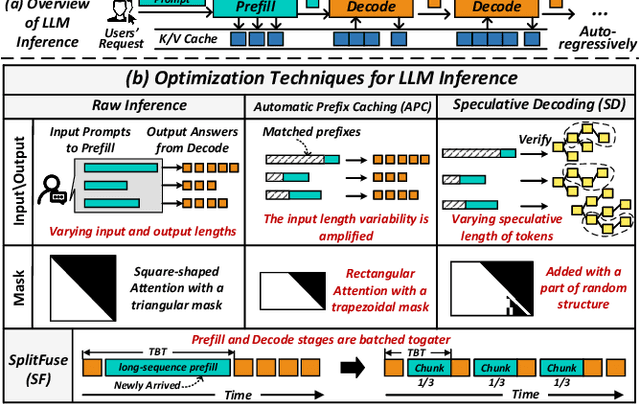

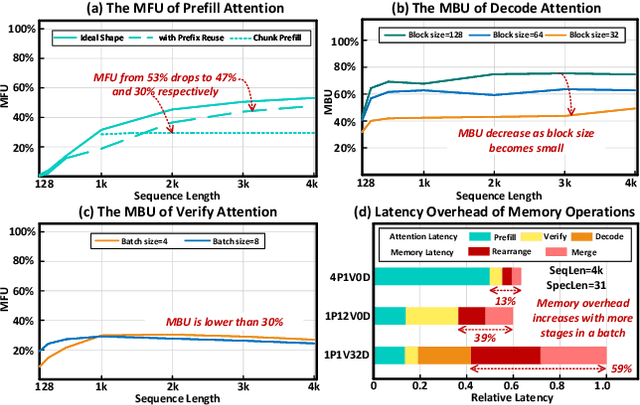
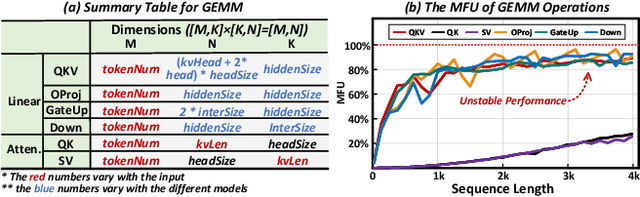
Meeting growing demands for low latency and cost efficiency in production-grade large language model (LLM) serving systems requires integrating advanced optimization techniques. However, dynamic and unpredictable input-output lengths of LLM, compounded by these optimizations, exacerbate the issues of workload variability, making it difficult to maintain high efficiency on AI accelerators, especially DSAs with tile-based programming models. To address this challenge, we introduce XY-Serve, a versatile, Ascend native, end-to-end production LLM-serving system. The core idea is an abstraction mechanism that smooths out the workload variability by decomposing computations into unified, hardware-friendly, fine-grained meta primitives. For attention, we propose a meta-kernel that computes the basic pattern of matmul-softmax-matmul with architectural-aware tile sizes. For GEMM, we introduce a virtual padding scheme that adapts to dynamic shape changes while using highly efficient GEMM primitives with assorted fixed tile sizes. XY-Serve sits harmoniously with vLLM. Experimental results show up to 89% end-to-end throughput improvement compared with current publicly available baselines on Ascend NPUs. Additionally, our approach outperforms existing GEMM (average 14.6% faster) and attention (average 21.5% faster) kernels relative to existing libraries. While the work is Ascend native, we believe the approach can be readily applicable to SIMT architectures as well.