 Add to Chrome
 Add to Firefox
 Add to Edge
CForce: Boosting Parallel Decoding for dLLMs via Consistency Forcing
Aug 14, 2026
Diffusion large language models (dLLMs) accelerate language generation by predicting multiple masks in a single forward pass. However, existing dLLMs can suffer from unreliable predictions in early denoising stages under aggressive parallelism strategies, leading to errors that can propagate to later stages. To tackle this issue, we present Consistency Forcing (CForce) for dLLMs, a distillation method to force the mask predictions of early stages to align with those of later stages. CForce trains the model on pre-collected self-rollout trajectories, thereby improving training-inference alignment. We introduce Confidence Adaptive KL Divergence as a distillation objective to conjoin the merits of forward and reverse KL. We further provide a theoretical analysis for the consistency objective to explain why CForce can approximately minimize the prediction error of early stages. Critically, the same formulation applies to both mask-to-token decoding and edit-capable decoding; in the edit-capable case, later token-to-token refinements provide additional supervision for earlier masked-state predictions. Experiments on non-edit and edit-capable LLaDA models show improved speed-quality trade-offs, especially under high-parallelism decoding budgets. Code is available at: https://github.com/inclusionAI/dFactory.

Multi-Block Diffusion Language Models
Jun 30, 2026Block Diffusion Language Models (BD-LMs) improve diffusion-based text generation with KV caching and flexible-length generation. A natural next step is to extend them from Single-Block Diffusion (SingleBD) to Multi-Block Diffusion (MultiBD), where a running-set of consecutive blocks is decoded concurrently for inter-block parallelism. However, existing BD-LMs are mostly trained under teacher forcing, where the model observes only one noisy block conditioned on a clean prefix. While the recent diffusion forcing strategy introduces visibility among multiple noisy blocks, its training states still differ from MultiBD inference, where decoding operates on a bounded running-set with heterogeneous slot-wise noise patterns. To bridge this gap, we propose Multi-Block Diffusion Language Models (MBD-LMs), obtained by post-training BD-LMs with Multi-block Teacher Forcing (MultiTF). MultiTF integrates teacher forcing and diffusion forcing by training on bounded noise-groups conditioned on clean prefixes, with randomized noise-schedulers that better match MultiBD inference states. To make MultiBD practically executable, we further introduce an optimized decoding algorithm based on the Block Buffer mechanism that preserves prefix-cache reuse, keeps input shapes static, and translates increased decoding parallelism into wall-clock acceleration. Empirically, MBD-LLaDA2-Mini increases average Tokens Per Forward pass (TPF) from 3.47 to 6.19 and improves average accuracy from 79.95% to 81.03%; when combined with DMax, MBD-LLaDA2-Mini-DMax reaches an average TPF of 9.34 with only a 1.02% accuracy drop on math and code benchmarks.
LoPA: Scaling dLLM Inference via Lookahead Parallel Decoding
Dec 22, 2025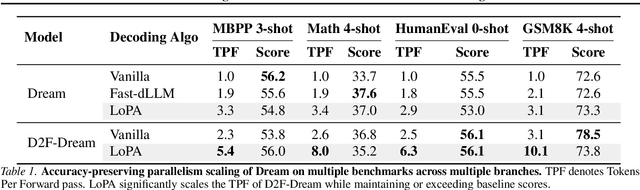
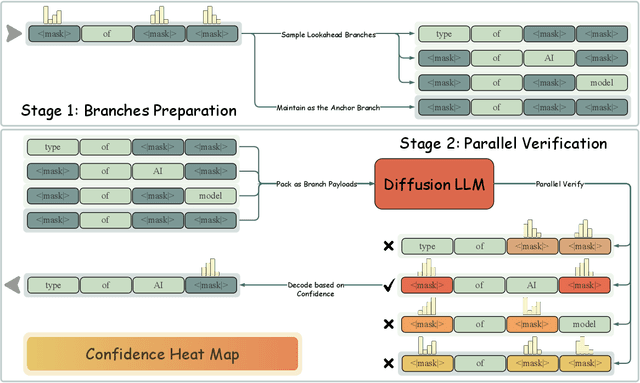
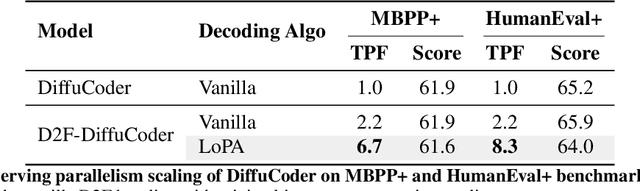
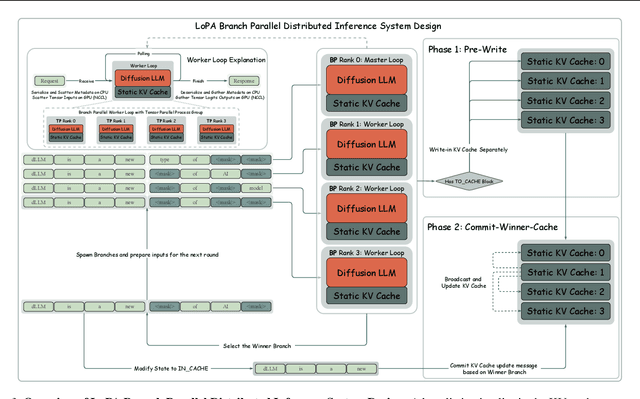
Diffusion Large Language Models (dLLMs) have demonstrated significant potential for high-speed inference. However, current confidence-driven decoding strategies are constrained by limited parallelism, typically achieving only 1--3 tokens per forward pass (TPF). In this work, we identify that the degree of parallelism during dLLM inference is highly sensitive to the Token Filling Order (TFO). Then, we introduce Lookahead PArallel Decoding LoPA, a training-free, plug-and-play algorithm, to identify a superior TFO and hence accelerate inference. LoPA concurrently explores distinct candidate TFOs via parallel branches, and selects the one with the highest potential for future parallelism based on branch confidence. We apply LoPA to the state-of-the-art D2F model and observe a substantial enhancement in decoding efficiency. Notably, LoPA increases the TPF of D2F-Dream to 10.1 on the GSM8K while maintaining performance superior to the Dream baseline. Furthermore, to facilitate this unprecedented degree of parallelism, we develop a specialized multi-device inference system featuring Branch Parallelism (BP), which achieves a single-sample throughput of 1073.9 tokens per second under multi-GPU deployment. The code is available at https://github.com/zhijie-group/LoPA.
Show-o Turbo: Towards Accelerated Unified Multimodal Understanding and Generation
Feb 08, 2025There has been increasing research interest in building unified multimodal understanding and generation models, among which Show-o stands as a notable representative, demonstrating great promise for both text-to-image and image-to-text generation. The inference of Show-o involves progressively denoising image tokens and autoregressively decoding text tokens, and hence, unfortunately, suffers from inefficiency issues from both sides. This paper introduces Show-o Turbo to bridge the gap. We first identify a unified denoising perspective for the generation of images and text in Show-o based on the parallel decoding of text tokens. We then propose to extend consistency distillation (CD), a qualified approach for shortening the denoising process of diffusion models, to the multimodal denoising trajectories of Show-o. We introduce a trajectory segmentation strategy and a curriculum learning procedure to improve the training convergence. Empirically, in text-to-image generation, Show-o Turbo displays a GenEval score of 0.625 at 4 sampling steps without using classifier-free guidance (CFG), outperforming that of the original Show-o with 8 steps and CFG; in image-to-text generation, Show-o Turbo exhibits a 1.5x speedup without significantly sacrificing performance. The code is available at https://github.com/zhijie-group/Show-o-Turbo.
High-Dimensional Data Set Simplification by Laplace-Beltrami Operator
Mar 23, 2020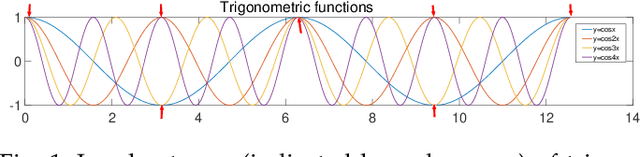
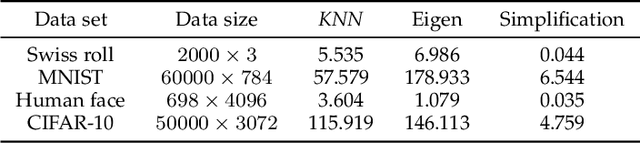
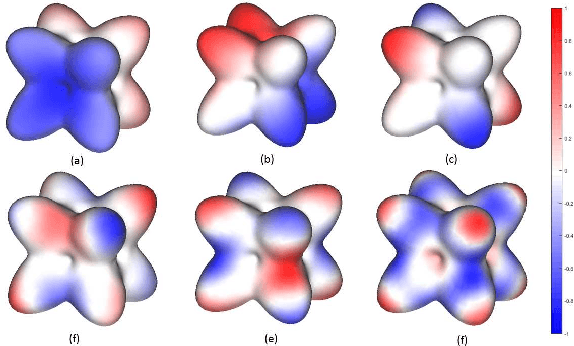

With the development of the Internet and other digital technologies, the speed of data generation has become considerably faster than the speed of data processing. Because big data typically contain massive redundant information, it is possible to significantly simplify a big data set while maintaining the key information it contains. In this paper, we develop a big data simplification method based on the eigenvalues and eigenfunctions of the Laplace-Beltrami operator (LBO). Specifically, given a data set that can be considered as an unorganized data point set in high-dimensional space, a discrete LBO defined on the big data set is constructed and its eigenvalues and eigenvectors are calculated. Then, the local extremum and the saddle points of the eigenfunctions are proposed to be the feature points of a data set in high-dimensional space, constituting a simplified data set. Moreover, we develop feature point detection methods for the functions defined on an unorganized data point set in high-dimensional space, and devise metrics for measuring the fidelity of the simplified data set to the original set. Finally, examples and applications are demonstrated to validate the efficiency and effectiveness of the proposed methods, demonstrating that data set simplification is a method for processing a maximum-sized data set using a limited data processing capability.