 Add to Chrome
 Add to Firefox
 Add to Edge
PLSQLBench: Benchmarking LLM Systems for Executable Procedural Database Programming
Aug 16, 2026
We present PLSQLBench, to our knowledge the first benchmark for evaluating whether LLMs can write executable PL/SQL programs, with correctness measured through execution-based tests. Existing LLM evaluations largely target general-purpose code generation or declarative text-to-SQL, leaving procedural database programming underexplored. PLSQLBench contains 2,865 instances: 2,594 single-turn tasks and 271 multi-turn conversations spanning 978 turns. The benchmark combines complex schema-grounded tasks over enterprise-style Spider 2 databases, simpler schema-grounded tasks derived from Spider, and MBPP-derived procedural problems, covering varying levels of database grounding and procedural complexity. Experiments with eight LLMs reveal recurring difficulties in schema grounding, PL/SQL dialect fidelity, procedural control flow, exception handling, and cross-turn consistency. Tool-augmented LLM agents improve performance on several schema-grounded evaluations, although substantial gaps remain. These results highlight procedural database programming capabilities not directly assessed by conventional code generation or text-to-SQL benchmarks. Our code is available at https://github.com/oracle-samples/plsqlbench.

JTPRO: A Joint Tool-Prompt Reflective Optimization Framework for Language Agents
Apr 20, 2026Large language model (LLM) agents augmented with external tools often struggle as number of tools grow large and become domain-specific. In such settings, ambiguous tool descriptions and under-specified agent instructions frequently lead to tool mis-selection and incorrect slot/value instantiation. We hypothesize that this is due to two root causes: generic, one-size-fits-all prompts that ignore tool-specific nuances, and underspecified tool schemas that lack clear guidance on when and how to use each tool and how to format its parameters. We introduce Joint Tool-Prompt Reflective Optimization (JTPRO), a framework for improving tool-calling reliability in trace-supervised settings by iteratively using rollout-driven reflection to co-optimize global instructions and per-tool schema/argument descriptions for accurate tool selection and argument instantiation in large tool inventories. JTPRO is designed to preserve only tool-local cues needed for correct disambiguation and slot filling. We evaluate JTPRO across multi-tool benchmarks, which account for different number of tools using three metrics: Tool Selection Accuracy (TSA), Slot Filling Accuracy(SFA), and Overall Success Rate(OSR) (correct tool + correct slots + correct values). JTPRO consistently outperforms strong baselines, including CoT-style agents, and reflective prompt optimizers such as GEPA by 5%-20% (relative) on OSR. Ablations show that joint optimization of instructions and tool schemas is more effective and robust than optimizing either component in isolation.
Routesplain: Towards Faithful and Intervenable Routing for Software-related Tasks
Nov 12, 2025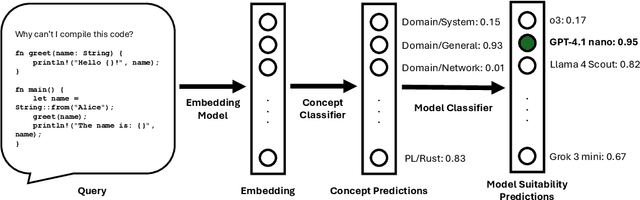
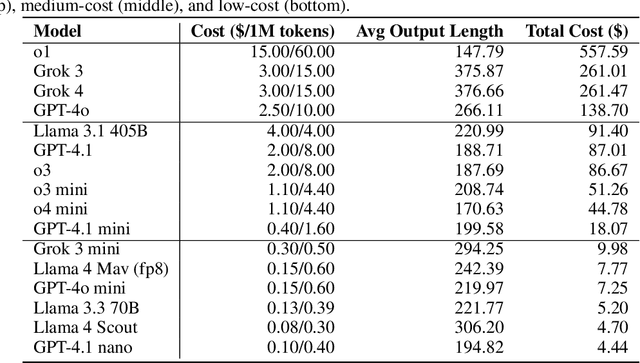
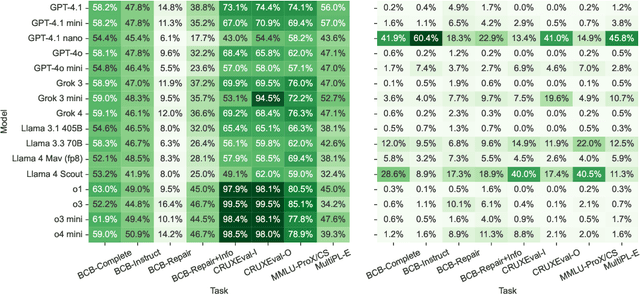
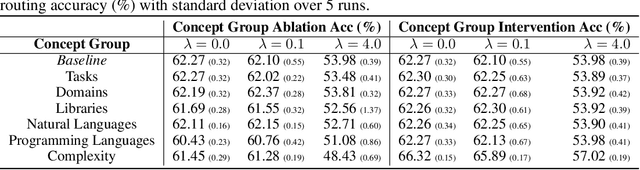
LLMs now tackle a wide range of software-related tasks, yet we show that their performance varies markedly both across and within these tasks. Routing user queries to the appropriate LLMs can therefore help improve response quality while reducing cost. Prior work, however, has focused mainly on general-purpose LLM routing via black-box models. We introduce Routesplain, the first LLM router for software-related tasks, including multilingual code generation and repair, input/output prediction, and computer science QA. Unlike existing routing approaches, Routesplain first extracts human-interpretable concepts from each query (e.g., task, domain, reasoning complexity) and only routes based on these concepts, thereby providing intelligible, faithful rationales. We evaluate Routesplain on 16 state-of-the-art LLMs across eight software-related tasks; Routesplain outperforms individual models both in terms of accuracy and cost, and equals or surpasses all black-box baselines, with concept-level intervention highlighting avenues for further router improvements.
FlexDoc: Parameterized Sampling for Diverse Multilingual Synthetic Documents for Training Document Understanding Models
Oct 02, 2025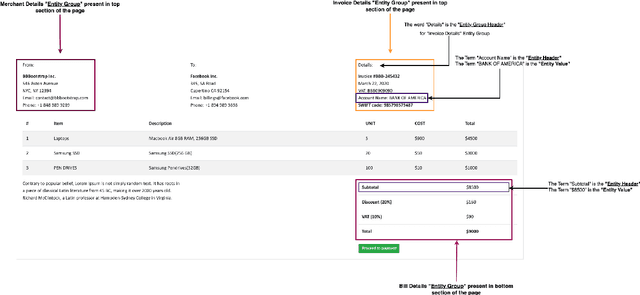
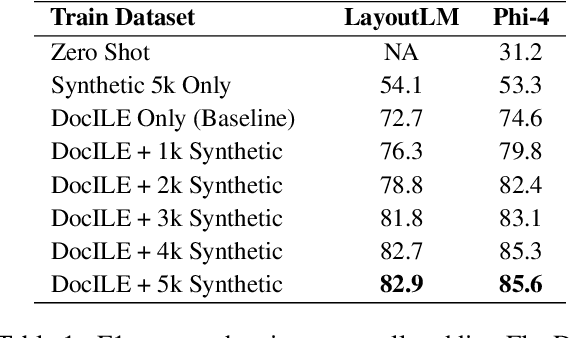
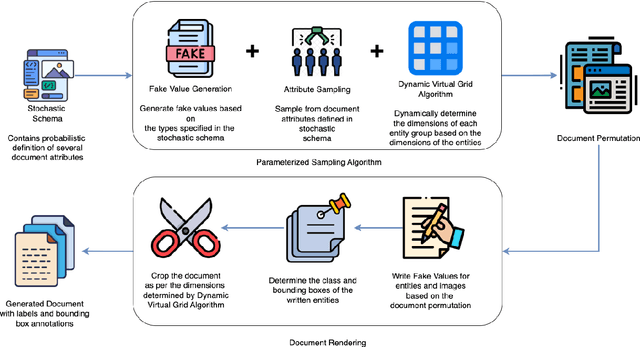
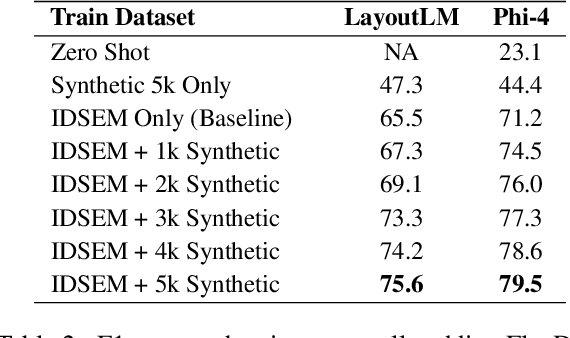
Developing document understanding models at enterprise scale requires large, diverse, and well-annotated datasets spanning a wide range of document types. However, collecting such data is prohibitively expensive due to privacy constraints, legal restrictions, and the sheer volume of manual annotation needed - costs that can scale into millions of dollars. We introduce FlexDoc, a scalable synthetic data generation framework that combines Stochastic Schemas and Parameterized Sampling to produce realistic, multilingual semi-structured documents with rich annotations. By probabilistically modeling layout patterns, visual structure, and content variability, FlexDoc enables the controlled generation of diverse document variants at scale. Experiments on Key Information Extraction (KIE) tasks demonstrate that FlexDoc-generated data improves the absolute F1 Score by up to 11% when used to augment real datasets, while reducing annotation effort by over 90% compared to traditional hard-template methods. The solution is in active deployment, where it has accelerated the development of enterprise-grade document understanding models while significantly reducing data acquisition and annotation costs.