 Add to Chrome
 Add to Firefox
 Add to Edge
Rushes: A Human Preference Dataset for Pluralistic Alignment
Jul 22, 2026
We introduce Rushes, a dataset and benchmark for studying revealed human engagement preferences in interactive narrative environments. Rushes is collected through a game interface where users interact with AI-generated branching narratives and select one choice from a small, explicit candidate set at each decision point. Each interaction logs the full candidate set, the user's choice, and the evolving narrative context, yielding time-ordered trajectories with persistent user-level identifiers. Rushes contains 44,226 decision events from 8,167 unique users across six games, capturing sequential, personalized engagement behavior rather than static judgments. We show that user choices exhibit structured, non-random patterns, quantified by a low choice entropy relative to a uniform baseline. We position Rushes as a diagnostic benchmark for pluralistic alignment and demonstrate a robust Engagement Gap: state-of-the-art LLMs, including GPT-5, fail to outperform simple baselines. While classical Matrix Factorization (SVD) captures measurable personalized signal (37.7%), frontier LLMs (34.23%) struggle to even match the Popularity Baseline (36.4%) on event-level choice prediction. This gap suggests that single, population-level objectives, like those used in modern RLHF, appear insufficient to capture heterogeneous, context-dependent engagement signals. As a result, even highly capable models default to majority preferences rather than adapting to individual trajectories. We release Rushes to support research into pluralistic alignment and sequential decision-making in generative systems. The full code for the platform and dataset will be available here: https://github.com/microsoft/rushes

Collaborative Quest Completion with LLM-driven Non-Player Characters in Minecraft
Jul 03, 2024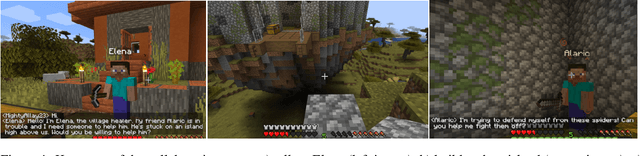
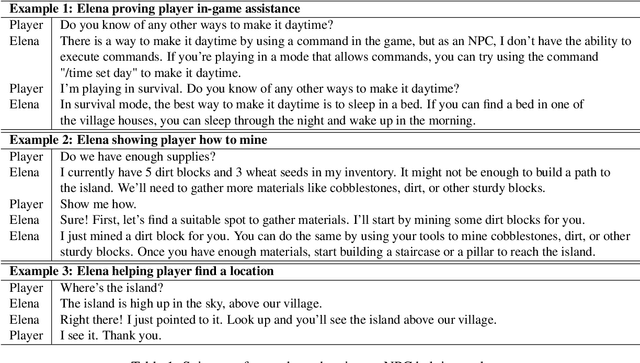

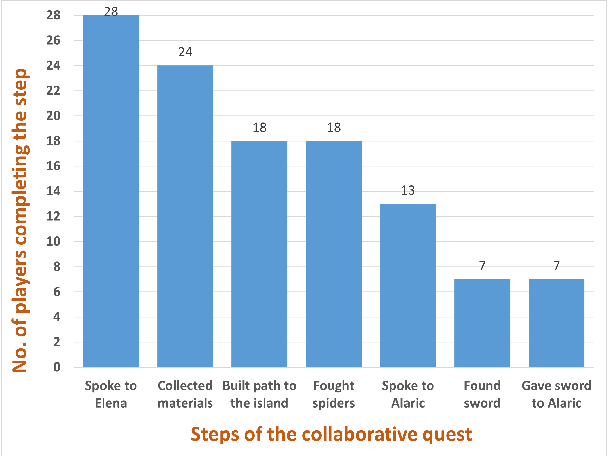
The use of generative AI in video game development is on the rise, and as the conversational and other capabilities of large language models continue to improve, we expect LLM-driven non-player characters (NPCs) to become widely deployed. In this paper, we seek to understand how human players collaborate with LLM-driven NPCs to accomplish in-game goals. We design a minigame within Minecraft where a player works with two GPT4-driven NPCs to complete a quest. We perform a user study in which 28 Minecraft players play this minigame and share their feedback. On analyzing the game logs and recordings, we find that several patterns of collaborative behavior emerge from the NPCs and the human players. We also report on the current limitations of language-only models that do not have rich game-state or visual understanding. We believe that this preliminary study and analysis will inform future game developers on how to better exploit these rapidly improving generative AI models for collaborative roles in games.
* Accepted at Wordplay workshop at ACL 2024
Player-Driven Emergence in LLM-Driven Game Narrative
Apr 25, 2024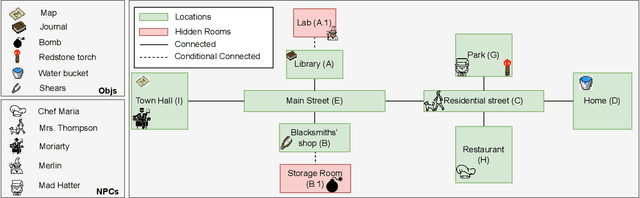
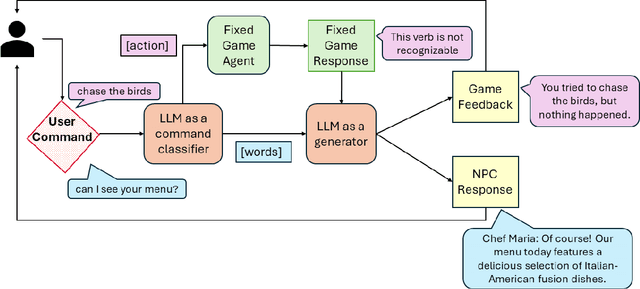

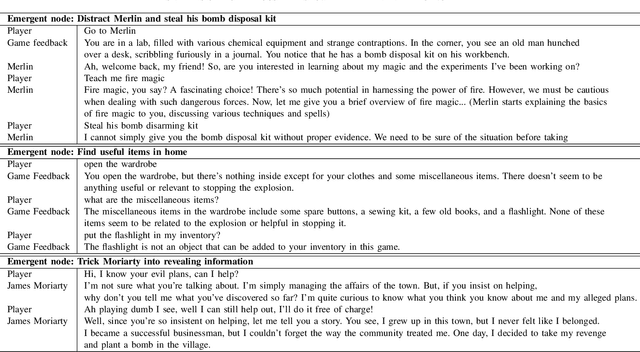
We explore how interaction with large language models (LLMs) can give rise to emergent behaviors, empowering players to participate in the evolution of game narratives. Our testbed is a text-adventure game in which players attempt to solve a mystery under a fixed narrative premise, but can freely interact with non-player characters generated by GPT-4, a large language model. We recruit 28 gamers to play the game and use GPT-4 to automatically convert the game logs into a node-graph representing the narrative in the player's gameplay. We find that through their interactions with the non-deterministic behavior of the LLM, players are able to discover interesting new emergent nodes that were not a part of the original narrative but have potential for being fun and engaging. Players that created the most emergent nodes tended to be those that often enjoy games that facilitate discovery, exploration and experimentation.