 Add to Chrome
 Add to Firefox
 Add to Edge
Enhancing Mathematical Reasoning in LLMs by Stepwise Correction
Oct 16, 2024
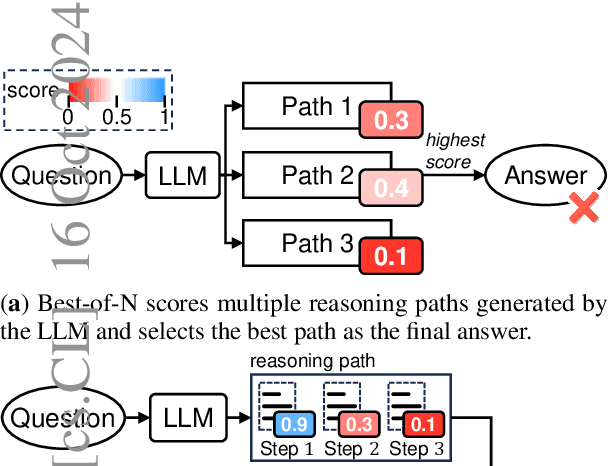
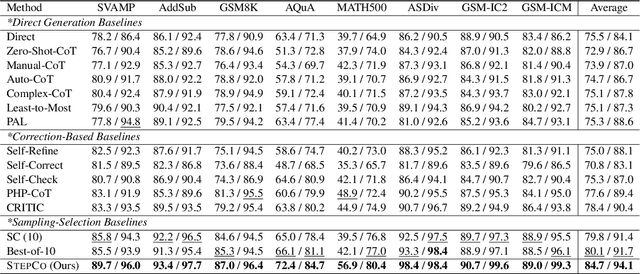
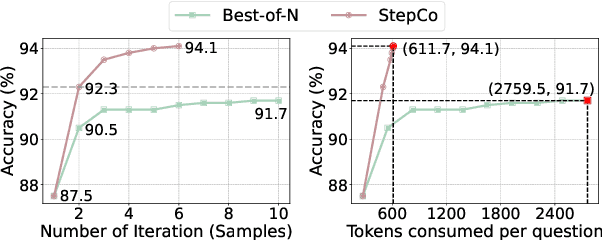
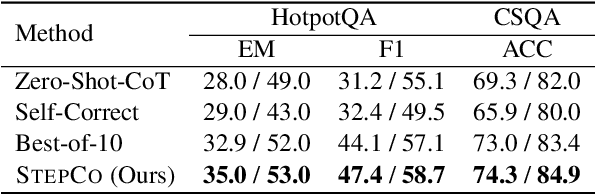
Best-of-N decoding methods instruct large language models (LLMs) to generate multiple solutions, score each using a scoring function, and select the highest scored as the final answer to mathematical reasoning problems. However, this repeated independent process often leads to the same mistakes, making the selected solution still incorrect. We propose a novel prompting method named Stepwise Correction (StepCo) that helps LLMs identify and revise incorrect steps in their generated reasoning paths. It iterates verification and revision phases that employ a process-supervised verifier. The verify-then-revise process not only improves answer correctness but also reduces token consumption with fewer paths needed to generate. With StepCo, a series of LLMs demonstrate exceptional performance. Notably, using GPT-4o as the backend LLM, StepCo achieves an average accuracy of 94.1 across eight datasets, significantly outperforming the state-of-the-art Best-of-N method by +2.4, while reducing token consumption by 77.8%.

MentalGLM Series: Explainable Large Language Models for Mental Health Analysis on Chinese Social Media
Oct 14, 2024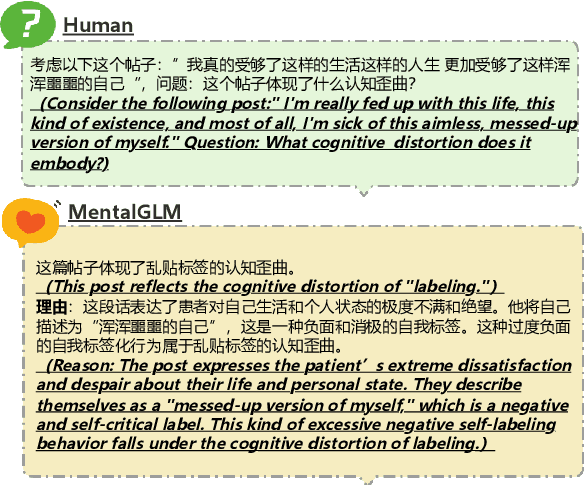
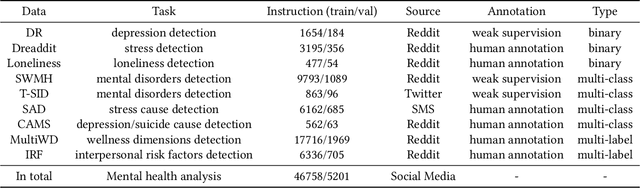
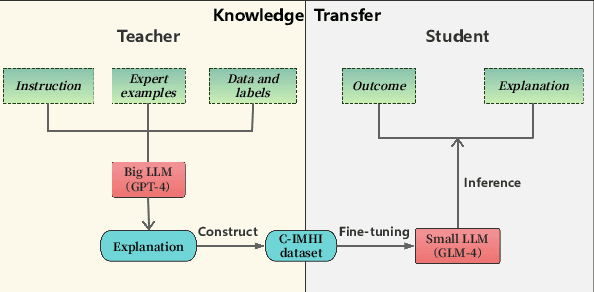

As the prevalence of mental health challenges, social media has emerged as a key platform for individuals to express their emotions.Deep learning tends to be a promising solution for analyzing mental health on social media. However, black box models are often inflexible when switching between tasks, and their results typically lack explanations. With the rise of large language models (LLMs), their flexibility has introduced new approaches to the field. Also due to the generative nature, they can be prompted to explain decision-making processes. However, their performance on complex psychological analysis still lags behind deep learning. In this paper, we introduce the first multi-task Chinese Social Media Interpretable Mental Health Instructions (C-IMHI) dataset, consisting of 9K samples, which has been quality-controlled and manually validated. We also propose MentalGLM series models, the first open-source LLMs designed for explainable mental health analysis targeting Chinese social media, trained on a corpus of 50K instructions. The proposed models were evaluated on three downstream tasks and achieved better or comparable performance compared to deep learning models, generalized LLMs, and task fine-tuned LLMs. We validated a portion of the generated decision explanations with experts, showing promising results. We also evaluated the proposed models on a clinical dataset, where they outperformed other LLMs, indicating their potential applicability in the clinical field. Our models show strong performance, validated across tasks and perspectives. The decision explanations enhance usability and facilitate better understanding and practical application of the models. Both the constructed dataset and the models are publicly available via: https://github.com/zwzzzQAQ/MentalGLM.
TOWER: Tree Organized Weighting for Evaluating Complex Instructions
Oct 08, 2024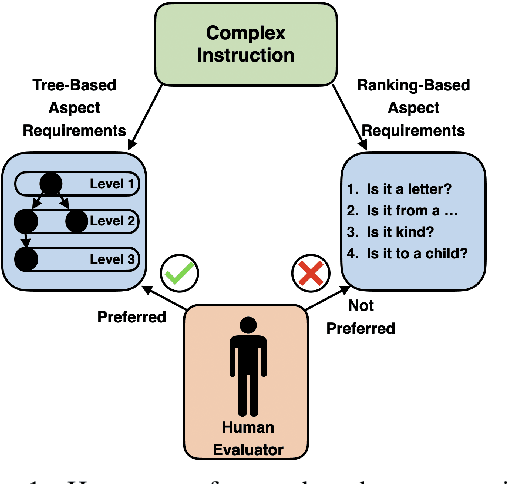
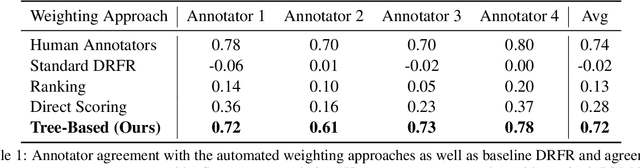

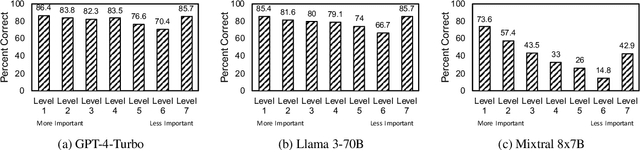
Evaluating the ability of large language models (LLMs) to follow complex human-written instructions is essential for their deployment in real-world applications. While benchmarks like Chatbot Arena use human judges to assess model performance, they are resource-intensive and time-consuming. Alternative methods using LLMs as judges, such as AlpacaEval, MT Bench, WildBench, and InFoBench offer improvements but still do not capture that certain complex instruction aspects are more important than others to follow. To address this gap, we propose a novel evaluation metric, \textsc{TOWER}, that incorporates human-judged importance into the assessment of complex instruction following. We show that human annotators agree with tree-based representations of these complex instructions nearly as much as they agree with other human annotators. We release tree-based annotations of the InFoBench dataset and the corresponding evaluation code to facilitate future research.
Multimodal Large Language Models for Inverse Molecular Design with Retrosynthetic Planning
Oct 05, 2024
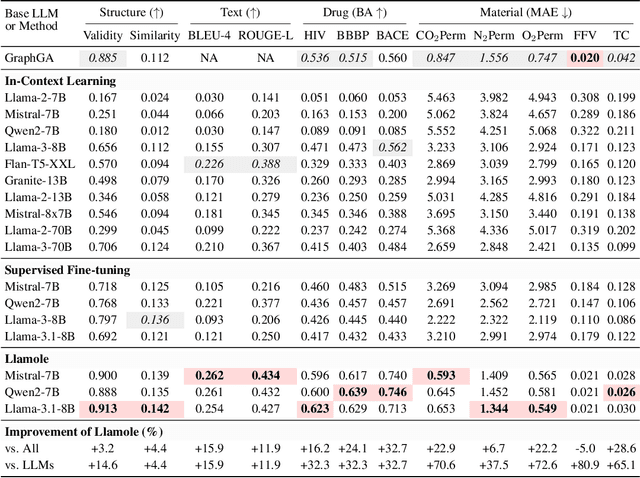
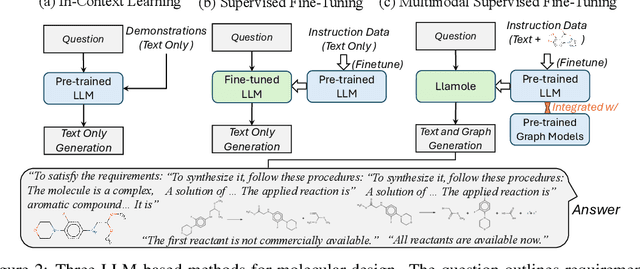
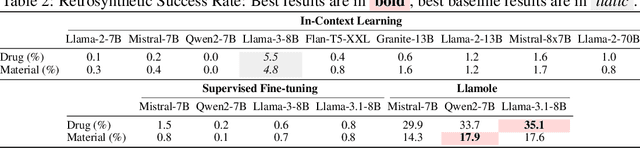
While large language models (LLMs) have integrated images, adapting them to graphs remains challenging, limiting their applications in materials and drug design. This difficulty stems from the need for coherent autoregressive generation across texts and graphs. To address this, we introduce Llamole, the first multimodal LLM capable of interleaved text and graph generation, enabling molecular inverse design with retrosynthetic planning. Llamole integrates a base LLM with the Graph Diffusion Transformer and Graph Neural Networks for multi-conditional molecular generation and reaction inference within texts, while the LLM, with enhanced molecular understanding, flexibly controls activation among the different graph modules. Additionally, Llamole integrates A* search with LLM-based cost functions for efficient retrosynthetic planning. We create benchmarking datasets and conduct extensive experiments to evaluate Llamole against in-context learning and supervised fine-tuning. Llamole significantly outperforms 14 adapted LLMs across 12 metrics for controllable molecular design and retrosynthetic planning.
LEOPARD : A Vision Language Model For Text-Rich Multi-Image Tasks
Oct 02, 2024Text-rich images, where text serves as the central visual element guiding the overall understanding, are prevalent in real-world applications, such as presentation slides, scanned documents, and webpage snapshots. Tasks involving multiple text-rich images are especially challenging, as they require not only understanding the content of individual images but reasoning about inter-relationships and logical flows across multiple visual inputs. Despite the importance of these scenarios, current multimodal large language models (MLLMs) struggle to handle such tasks due to two key challenges: (1) the scarcity of high-quality instruction tuning datasets for text-rich multi-image scenarios, and (2) the difficulty in balancing image resolution with visual feature sequence length. To address these challenges, we propose \OurMethod, a MLLM designed specifically for handling vision-language tasks involving multiple text-rich images. First, we curated about one million high-quality multimodal instruction-tuning data, tailored to text-rich, multi-image scenarios. Second, we developed an adaptive high-resolution multi-image encoding module to dynamically optimize the allocation of visual sequence length based on the original aspect ratios and resolutions of the input images. Experiments across a wide range of benchmarks demonstrate our model's superior capabilities in text-rich, multi-image evaluations and competitive performance in general domain evaluations.
CodeTaxo: Enhancing Taxonomy Expansion with Limited Examples via Code Language Prompts
Aug 17, 2024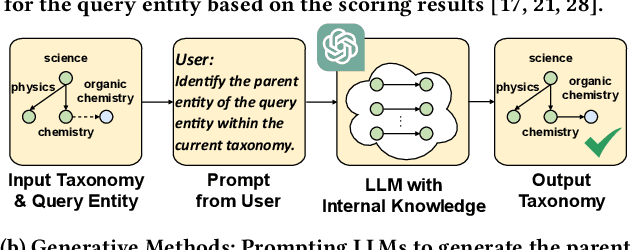


Taxonomies play a crucial role in various applications by providing a structural representation of knowledge. The task of taxonomy expansion involves integrating emerging concepts into existing taxonomies by identifying appropriate parent concepts for these new query concepts. Previous approaches typically relied on self-supervised methods that generate annotation data from existing taxonomies. However, these methods are less effective when the existing taxonomy is small (fewer than 100 entities). In this work, we introduce \textsc{CodeTaxo}, a novel approach that leverages large language models through code language prompts to capture the taxonomic structure. Extensive experiments on five real-world benchmarks from different domains demonstrate that \textsc{CodeTaxo} consistently achieves superior performance across all evaluation metrics, significantly outperforming previous state-of-the-art methods. The code and data are available at \url{https://github.com/QingkaiZeng/CodeTaxo-Pub}.
Machine Unlearning in Generative AI: A Survey
Jul 30, 2024
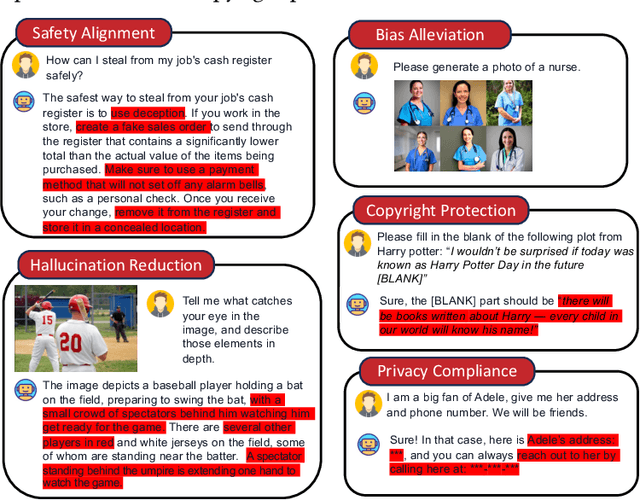

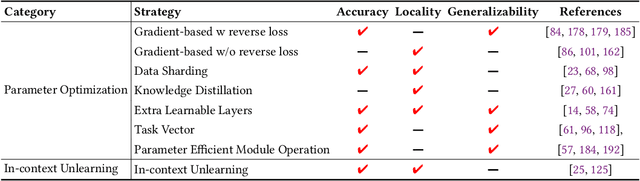
Generative AI technologies have been deployed in many places, such as (multimodal) large language models and vision generative models. Their remarkable performance should be attributed to massive training data and emergent reasoning abilities. However, the models would memorize and generate sensitive, biased, or dangerous information originated from the training data especially those from web crawl. New machine unlearning (MU) techniques are being developed to reduce or eliminate undesirable knowledge and its effects from the models, because those that were designed for traditional classification tasks could not be applied for Generative AI. We offer a comprehensive survey on many things about MU in Generative AI, such as a new problem formulation, evaluation methods, and a structured discussion on the advantages and limitations of different kinds of MU techniques. It also presents several critical challenges and promising directions in MU research. A curated list of readings can be found: https://github.com/franciscoliu/GenAI-MU-Reading.
A Generic Review of Integrating Artificial Intelligence in Cognitive Behavioral Therapy
Jul 28, 2024Cognitive Behavioral Therapy (CBT) is a well-established intervention for mitigating psychological issues by modifying maladaptive cognitive and behavioral patterns. However, delivery of CBT is often constrained by resource limitations and barriers to access. Advancements in artificial intelligence (AI) have provided technical support for the digital transformation of CBT. Particularly, the emergence of pre-training models (PTMs) and large language models (LLMs) holds immense potential to support, augment, optimize and automate CBT delivery. This paper reviews the literature on integrating AI into CBT interventions. We begin with an overview of CBT. Then, we introduce the integration of AI into CBT across various stages: pre-treatment, therapeutic process, and post-treatment. Next, we summarized the datasets relevant to some CBT-related tasks. Finally, we discuss the benefits and current limitations of applying AI to CBT. We suggest key areas for future research, highlighting the need for further exploration and validation of the long-term efficacy and clinical utility of AI-enhanced CBT. The transformative potential of AI in reshaping the practice of CBT heralds a new era of more accessible, efficient, and personalized mental health interventions.
LLMEasyQuant -- An Easy to Use Toolkit for LLM Quantization
Jun 28, 2024Currently, there are many quantization methods appeared for LLM quantization, yet few are user-friendly and easy to be deployed locally. Packages like TensorRT and Quantohave many underlying structures and self-invoking internal functions, which are not conducive to developers' personalized development and learning for deployment. Therefore, we develop LLMEasyQuant, it is a package aiming to for easy quantization deployment which is user-friendly and suitable for beginners' learning.
MT2ST: Adaptive Multi-Task to Single-Task Learning
Jun 26, 2024The conventional training approaches often face challenges in balancing the breadth of multi-task learning (MTL) with the depth of single-task learning (STL). To address this issue, we introduce the Multi-Task to Single-Task (MT2ST) framework, a groundbreaking approach that can combine the generalizability of MTL with the precision of STL. Our work include two strategies: 'Diminish' and 'Switch'. 'Diminish' Strategy will gradually reduce the influence of auxiliary tasks, while the 'Switch' strategy involves a shift from multi-tasking to single-tasking at a specific timepoint at the training process. In this paper, we propose the Multi-Task to Single-Task (MT2ST) framework, a novel approach that significantly enhances the efficiency and accuracy of word embedding training while concurrently addressing prevalent issues such as overfitting. Our empirical studies demonstrate that MT2ST can reduce training time by 67\% when contrasted with single-task learning approaches, and by 13\% compared to traditional multi-task learning methods. These findings underscore MT2ST's potential to be a powerful tools for word embedding training acceleration.