 Add to Chrome
 Add to Firefox
 Add to Edge
Understanding Generalization and Forgetting in In-Context Continual Learning
May 27, 2026
In-context learning (ICL) derives its power from enabling Large Language Models to adapt to new tasks via prompt-based reasoning alone, entirely bypassing the need for parameter updates. Existing theories primarily study ICL in single-task settings, while real-world prompts often contain sequences of heterogeneous tasks, leaving a gap in understanding whether Large Language Models implicitly perform continual learning during inference. To bridge this gap, we propose the first theoretical framework for in-context continual learning, modeling how a pretrained Transformer processes multiple sequential tasks within a single prompt through shared attention mechanisms. Focusing on linear and masked linear self-attention, we derive error expressions for model predictions under sequential task prompts and analyze their generalization and forgetting behavior. Our results reveal that standard attention mechanisms inevitably induce intertask interference by uniformly or causally aggregating historical contexts, leading to systematic bias. We further provide a bias-variance-interference decomposition of prediction error, characterizing when historical in-context information yields positive transfer or provable negative transfer. This analysis exposes fundamental limits of attention-based continual inference and offers theoretical explanations for order sensitivity and performance degradation in long prompts.

Benign Overfitting in Adversarial Training for Vision Transformers
Apr 21, 2026Despite the remarkable success of Vision Transformers (ViTs) across a wide range of vision tasks, recent studies have revealed that they remain vulnerable to adversarial examples, much like Convolutional Neural Networks (CNNs). A common empirical defense strategy is adversarial training, yet the theoretical underpinnings of its robustness in ViTs remain largely unexplored. In this work, we present the first theoretical analysis of adversarial training under simplified ViT architectures. We show that, when trained under a signal-to-noise ratio that satisfies a certain condition and within a moderate perturbation budget, adversarial training enables ViTs to achieve nearly zero robust training loss and robust generalization error under certain regimes. Remarkably, this leads to strong generalization even in the presence of overfitting, a phenomenon known as \emph{benign overfitting}, previously only observed in CNNs (with adversarial training). Experiments on both synthetic and real-world datasets further validate our theoretical findings.
Provable Effects of Data Replay in Continual Learning: A Feature Learning Perspective
Feb 02, 2026Continual learning (CL) aims to train models on a sequence of tasks while retaining performance on previously learned ones. A core challenge in this setting is catastrophic forgetting, where new learning interferes with past knowledge. Among various mitigation strategies, data-replay methods, where past samples are periodically revisited, are considered simple yet effective, especially when memory constraints are relaxed. However, the theoretical effectiveness of full data replay, where all past data is accessible during training, remains largely unexplored. In this paper, we present a comprehensive theoretical framework for analyzing full data-replay training in continual learning from a feature learning perspective. Adopting a multi-view data model, we identify the signal-to-noise ratio (SNR) as a critical factor affecting forgetting. Focusing on task-incremental binary classification across $M$ tasks, our analysis verifies two key conclusions: (1) forgetting can still occur under full replay when the cumulative noise from later tasks dominates the signal from earlier ones; and (2) with sufficient signal accumulation, data replay can recover earlier tasks-even if their initial learning was poor. Notably, we uncover a novel insight into task ordering: prioritizing higher-signal tasks not only facilitates learning of lower-signal tasks but also helps prevent catastrophic forgetting. We validate our theoretical findings through synthetic and real-world experiments that visualize the interplay between signal learning and noise memorization across varying SNRs and task correlation regimes.
Finding Differentially Private Second Order Stationary Points in Stochastic Minimax Optimization
Feb 01, 2026We provide the first study of the problem of finding differentially private (DP) second-order stationary points (SOSP) in stochastic (non-convex) minimax optimization. Existing literature either focuses only on first-order stationary points for minimax problems or on SOSP for classical stochastic minimization problems. This work provides, for the first time, a unified and detailed treatment of both empirical and population risks. Specifically, we propose a purely first-order method that combines a nested gradient descent--ascent scheme with SPIDER-style variance reduction and Gaussian perturbations to ensure privacy. A key technical device is a block-wise ($q$-period) analysis that controls the accumulation of stochastic variance and privacy noise without summing over the full iteration horizon, yielding a unified treatment of both empirical-risk and population formulations. Under standard smoothness, Hessian-Lipschitzness, and strong concavity assumptions, we establish high-probability guarantees for reaching an $(α,\sqrt{ρ_Φα})$-approximate second-order stationary point with $α= \mathcal{O}( (\frac{\sqrt{d}}{n\varepsilon})^{2/3})$ for empirical risk objectives and $\mathcal{O}(\frac{1}{n^{1/3}} + (\frac{\sqrt{d}}{n\varepsilon})^{1/2})$ for population objectives, matching the best known rates for private first-order stationarity.
Understanding the Impact of Differentially Private Training on Memorization of Long-Tailed Data
Feb 01, 2026Recent research shows that modern deep learning models achieve high predictive accuracy partly by memorizing individual training samples. Such memorization raises serious privacy concerns, motivating the widespread adoption of differentially private training algorithms such as DP-SGD. However, a growing body of empirical work shows that DP-SGD often leads to suboptimal generalization performance, particularly on long-tailed data that contain a large number of rare or atypical samples. Despite these observations, a theoretical understanding of this phenomenon remains largely unexplored, and existing differential privacy analysis are difficult to extend to the nonconvex and nonsmooth neural networks commonly used in practice. In this work, we develop the first theoretical framework for analyzing DP-SGD on long-tailed data from a feature learning perspective. We show that the test error of DP-SGD-trained models on the long-tailed subpopulation is significantly larger than the overall test error over the entire dataset. Our analysis further characterizes the training dynamics of DP-SGD, demonstrating how gradient clipping and noise injection jointly adversely affect the model's ability to memorize informative but underrepresented samples. Finally, we validate our theoretical findings through extensive experiments on both synthetic and real-world datasets.
In-Run Data Shapley for Adam Optimizer
Jan 30, 2026Reliable data attribution is essential for mitigating bias and reducing computational waste in modern machine learning, with the Shapley value serving as the theoretical gold standard. While recent "In-Run" methods bypass the prohibitive cost of retraining by estimating contributions dynamically, they heavily rely on the linear structure of Stochastic Gradient Descent (SGD) and fail to capture the complex dynamics of adaptive optimizers like Adam. In this work, we demonstrate that data attribution is inherently optimizer-dependent: we show that SGD-based proxies diverge significantly from true contributions under Adam (Pearson $R \approx 0.11$), rendering them ineffective for modern training pipelines. To bridge this gap, we propose Adam-Aware In-Run Data Shapley. We derive a closed-form approximation that restores additivity by redefining utility under a fixed-state assumption and enable scalable computation via a novel Linearized Ghost Approximation. This technique linearizes the variance-dependent scaling term, allowing us to compute pairwise gradient dot-products without materializing per-sample gradients. Extensive experiments show that our method achieves near-perfect fidelity to ground-truth marginal contributions ($R > 0.99$) while retaining $\sim$95\% of standard training throughput. Furthermore, our Adam-aware attribution significantly outperforms SGD-based baselines in data attribution downstream tasks.
Rethinking Coupled Tensor Analysis for Hyperspectral Super-Resolution: Recoverable Modeling Under Endmember Variability
Dec 22, 2025This work revisits the hyperspectral super-resolution (HSR) problem, i.e., fusing a pair of spatially co-registered hyperspectral (HSI) and multispectral (MSI) images to recover a super-resolution image (SRI) that enhances the spatial resolution of the HSI. Coupled tensor decomposition (CTD)-based methods have gained traction in this domain, offering recoverability guarantees under various assumptions. Existing models such as canonical polyadic decomposition (CPD) and Tucker decomposition provide strong expressive power but lack physical interpretability. The block-term decomposition model with rank-$(L_r, L_r, 1)$ terms (the LL1 model) yields interpretable factors under the linear mixture model (LMM) of spectral images, but LMM assumptions are often violated in practice -- primarily due to nonlinear effects such as endmember variability (EV). To address this, we propose modeling spectral images using a more flexible block-term tensor decomposition with rank-$(L_r, M_r, N_r)$ terms (the LMN model). This modeling choice retains interpretability, subsumes CPD, Tucker, and LL1 as special cases, and robustly accounts for non-ideal effects such as EV, offering a balanced tradeoff between expressiveness and interpretability for HSR. Importantly, under the LMN model for HSI and MSI, recoverability of the SRI can still be established under proper conditions -- providing strong theoretical support. Extensive experiments on synthetic and real datasets further validate the effectiveness and robustness of the proposed method compared with existing CTD-based approaches.
Beyond Ordinary Lipschitz Constraints: Differentially Private Stochastic Optimization with Tsybakov Noise Condition
Sep 04, 2025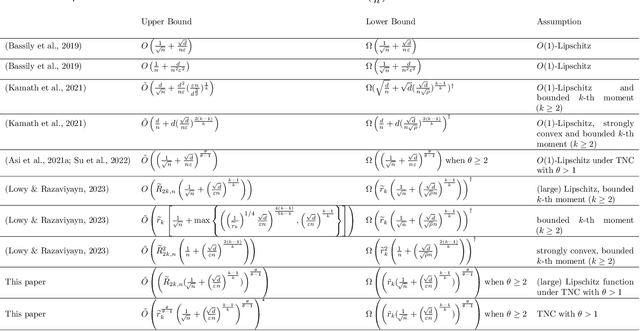
We study Stochastic Convex Optimization in the Differential Privacy model (DP-SCO). Unlike previous studies, here we assume the population risk function satisfies the Tsybakov Noise Condition (TNC) with some parameter $\theta>1$, where the Lipschitz constant of the loss could be extremely large or even unbounded, but the $\ell_2$-norm gradient of the loss has bounded $k$-th moment with $k\geq 2$. For the Lipschitz case with $\theta\geq 2$, we first propose an $(\varepsilon, \delta)$-DP algorithm whose utility bound is $\Tilde{O}\left(\left(\tilde{r}_{2k}(\frac{1}{\sqrt{n}}+(\frac{\sqrt{d}}{n\varepsilon}))^\frac{k-1}{k}\right)^\frac{\theta}{\theta-1}\right)$ in high probability, where $n$ is the sample size, $d$ is the model dimension, and $\tilde{r}_{2k}$ is a term that only depends on the $2k$-th moment of the gradient. It is notable that such an upper bound is independent of the Lipschitz constant. We then extend to the case where $\theta\geq \bar{\theta}> 1$ for some known constant $\bar{\theta}$. Moreover, when the privacy budget $\varepsilon$ is small enough, we show an upper bound of $\tilde{O}\left(\left(\tilde{r}_{k}(\frac{1}{\sqrt{n}}+(\frac{\sqrt{d}}{n\varepsilon}))^\frac{k-1}{k}\right)^\frac{\theta}{\theta-1}\right)$ even if the loss function is not Lipschitz. For the lower bound, we show that for any $\theta\geq 2$, the private minimax rate for $\rho$-zero Concentrated Differential Privacy is lower bounded by $\Omega\left(\left(\tilde{r}_{k}(\frac{1}{\sqrt{n}}+(\frac{\sqrt{d}}{n\sqrt{\rho}}))^\frac{k-1}{k}\right)^\frac{\theta}{\theta-1}\right)$.
Differentially Private Sparse Linear Regression with Heavy-tailed Responses
Jun 07, 2025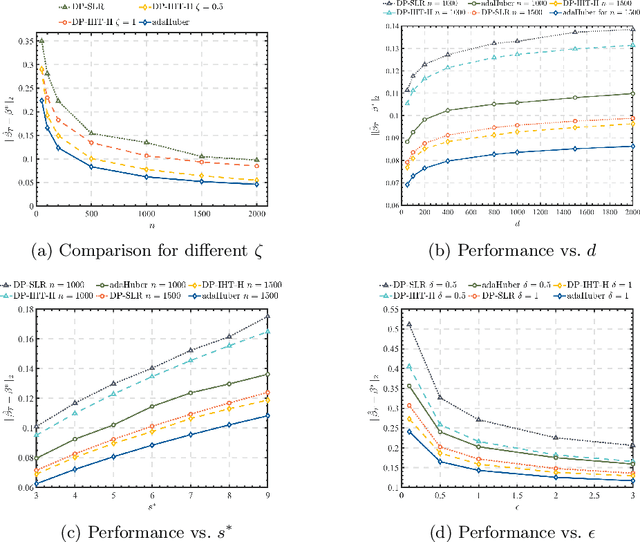
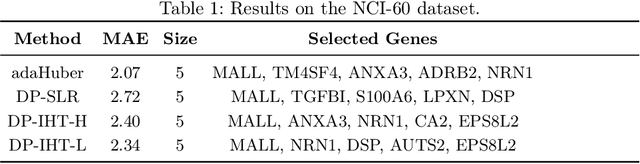
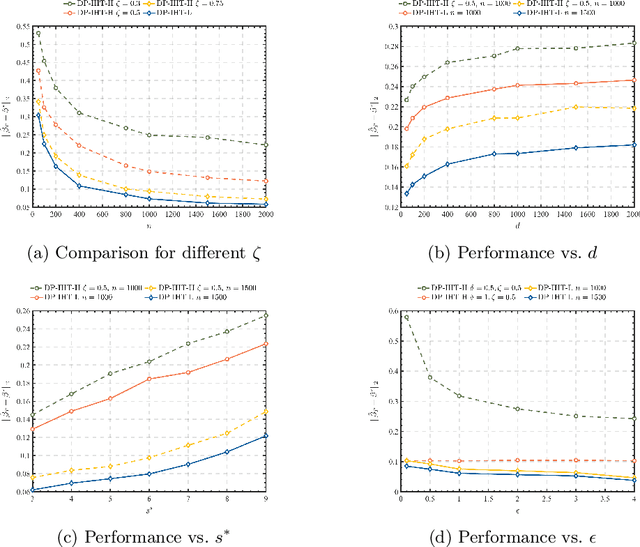
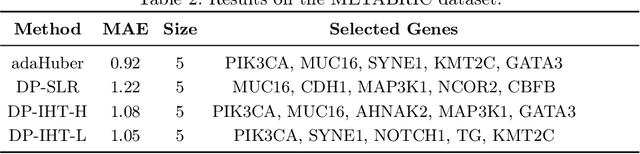
As a fundamental problem in machine learning and differential privacy (DP), DP linear regression has been extensively studied. However, most existing methods focus primarily on either regular data distributions or low-dimensional cases with irregular data. To address these limitations, this paper provides a comprehensive study of DP sparse linear regression with heavy-tailed responses in high-dimensional settings. In the first part, we introduce the DP-IHT-H method, which leverages the Huber loss and private iterative hard thresholding to achieve an estimation error bound of \( \tilde{O}\biggl( s^{* \frac{1 }{2}} \cdot \biggl(\frac{\log d}{n}\biggr)^{\frac{\zeta}{1 + \zeta}} + s^{* \frac{1 + 2\zeta}{2 + 2\zeta}} \cdot \biggl(\frac{\log^2 d}{n \varepsilon}\biggr)^{\frac{\zeta}{1 + \zeta}} \biggr) \) under the $(\varepsilon, \delta)$-DP model, where $n$ is the sample size, $d$ is the dimensionality, $s^*$ is the sparsity of the parameter, and $\zeta \in (0, 1]$ characterizes the tail heaviness of the data. In the second part, we propose DP-IHT-L, which further improves the error bound under additional assumptions on the response and achieves \( \tilde{O}\Bigl(\frac{(s^*)^{3/2} \log d}{n \varepsilon}\Bigr). \) Compared to the first result, this bound is independent of the tail parameter $\zeta$. Finally, through experiments on synthetic and real-world datasets, we demonstrate that our methods outperform standard DP algorithms designed for ``regular'' data.
Nearly Optimal Differentially Private ReLU Regression
Mar 08, 2025In this paper, we investigate one of the most fundamental nonconvex learning problems, ReLU regression, in the Differential Privacy (DP) model. Previous studies on private ReLU regression heavily rely on stringent assumptions, such as constant bounded norms for feature vectors and labels. We relax these assumptions to a more standard setting, where data can be i.i.d. sampled from $O(1)$-sub-Gaussian distributions. We first show that when $\varepsilon = \tilde{O}(\sqrt{\frac{1}{N}})$ and there is some public data, it is possible to achieve an upper bound of $\Tilde{O}(\frac{d^2}{N^2 \varepsilon^2})$ for the excess population risk in $(\epsilon, \delta)$-DP, where $d$ is the dimension and $N$ is the number of data samples. Moreover, we relax the requirement of $\epsilon$ and public data by proposing and analyzing a one-pass mini-batch Generalized Linear Model Perceptron algorithm (DP-MBGLMtron). Additionally, using the tracing attack argument technique, we demonstrate that the minimax rate of the estimation error for $(\varepsilon, \delta)$-DP algorithms is lower bounded by $\Omega(\frac{d^2}{N^2 \varepsilon^2})$. This shows that DP-MBGLMtron achieves the optimal utility bound up to logarithmic factors. Experiments further support our theoretical results.