 Add to Chrome
 Add to Firefox
 Add to Edge
SymbOmni: Evolving Agentic Omni Models via Symbolic Concept Learning
Jul 13, 2026
Visual generation is increasingly ubiquitous in diverse domains, from text-to-image/video synthesis to multimodal interactive creation. Yet prevailing monolithic models remain fundamentally constrained by their inability to learn cumulatively and evolve autonomously, which is a limitation we term the "perpetual novice" problem. They lack mechanisms for structuring experience into reusable knowledge and therefore rely on brittle, "from-scratch" reasoning for each task, resulting in poor compositional generalization and inefficient knowledge retention. Motivated by these limitations, we propose SymbOmni, an agentic omni-model designed for cumulative evolution through Symbolic Concept Learning. At its core is the Symbolic Concept Box, an optimizable memory module that abstracts low-level operations into reusable Symbolic Workflow Instructions. SymbOmni operates through an induction-transduction cycle: experiences are abstracted into symbolic concepts (induction), which are then adaptively composed to solve novel tasks (transduction). The training is done by verbalized backpropagation with language-based feedback to enable continuous self-improvement without gradient-based model fine-tuning. Comprehensive experiments validate that (I) SymbOmni significantly outperforms existing agent-based systems for iterative creation and also surpasses closed-source models (e.g., Nano Banana, GPT-Image-1) in both image quality and task success rates; (II) SymbOmni effectively reduces token consumption by over 40% while maintaining competitive generation quality; and (III) SymbOmni enables effective continual learning by achieving cumulative gains across multiple online-learning benchmarks and setting a new state of the art.

Streaming Autoregressive Video Generation via Diagonal Distillation
Mar 11, 2026Large pretrained diffusion models have significantly enhanced the quality of generated videos, and yet their use in real-time streaming remains limited. Autoregressive models offer a natural framework for sequential frame synthesis but require heavy computation to achieve high fidelity. Diffusion distillation can compress these models into efficient few-step variants, but existing video distillation approaches largely adapt image-specific methods that neglect temporal dependencies. These techniques often excel in image generation but underperform in video synthesis, exhibiting reduced motion coherence, error accumulation over long sequences, and a latency-quality trade-off. We identify two factors that result in these limitations: insufficient utilization of temporal context during step reduction and implicit prediction of subsequent noise levels in next-chunk prediction (i.e., exposure bias). To address these issues, we propose Diagonal Distillation, which operates orthogonally to existing approaches and better exploits temporal information across both video chunks and denoising steps. Central to our approach is an asymmetric generation strategy: more steps early, fewer steps later. This design allows later chunks to inherit rich appearance information from thoroughly processed early chunks, while using partially denoised chunks as conditional inputs for subsequent synthesis. By aligning the implicit prediction of subsequent noise levels during chunk generation with the actual inference conditions, our approach mitigates error propagation and reduces oversaturation in long-range sequences. We further incorporate implicit optical flow modeling to preserve motion quality under strict step constraints. Our method generates a 5-second video in 2.61 seconds (up to 31 FPS), achieving a 277.3x speedup over the undistilled model.
Learning from a Generative Oracle: Domain Adaptation for Restoration
Dec 11, 2025Pre-trained image restoration models often fail on real-world, out-of-distribution degradations due to significant domain gaps. Adapting to these unseen domains is challenging, as out-of-distribution data lacks ground truth, and traditional adaptation methods often require complex architectural changes. We propose LEGO (Learning from a Generative Oracle), a practical three-stage framework for post-training domain adaptation without paired data. LEGO converts this unsupervised challenge into a tractable pseudo-supervised one. First, we obtain initial restorations from the pre-trained model. Second, we leverage a frozen, large-scale generative oracle to refine these estimates into high-quality pseudo-ground-truths. Third, we fine-tune the original model using a mixed-supervision strategy combining in-distribution data with these new pseudo-pairs. This approach adapts the model to the new distribution without sacrificing its original robustness or requiring architectural modifications. Experiments demonstrate that LEGO effectively bridges the domain gap, significantly improving performance on diverse real-world benchmarks.
Reference-Guided Identity Preserving Face Restoration
May 28, 2025Preserving face identity is a critical yet persistent challenge in diffusion-based image restoration. While reference faces offer a path forward, existing reference-based methods often fail to fully exploit their potential. This paper introduces a novel approach that maximizes reference face utility for improved face restoration and identity preservation. Our method makes three key contributions: 1) Composite Context, a comprehensive representation that fuses multi-level (high- and low-level) information from the reference face, offering richer guidance than prior singular representations. 2) Hard Example Identity Loss, a novel loss function that leverages the reference face to address the identity learning inefficiencies found in the existing identity loss. 3) A training-free method to adapt the model to multi-reference inputs during inference. The proposed method demonstrably restores high-quality faces and achieves state-of-the-art identity preserving restoration on benchmarks such as FFHQ-Ref and CelebA-Ref-Test, consistently outperforming previous work.
The Power of Context: How Multimodality Improves Image Super-Resolution
Mar 18, 2025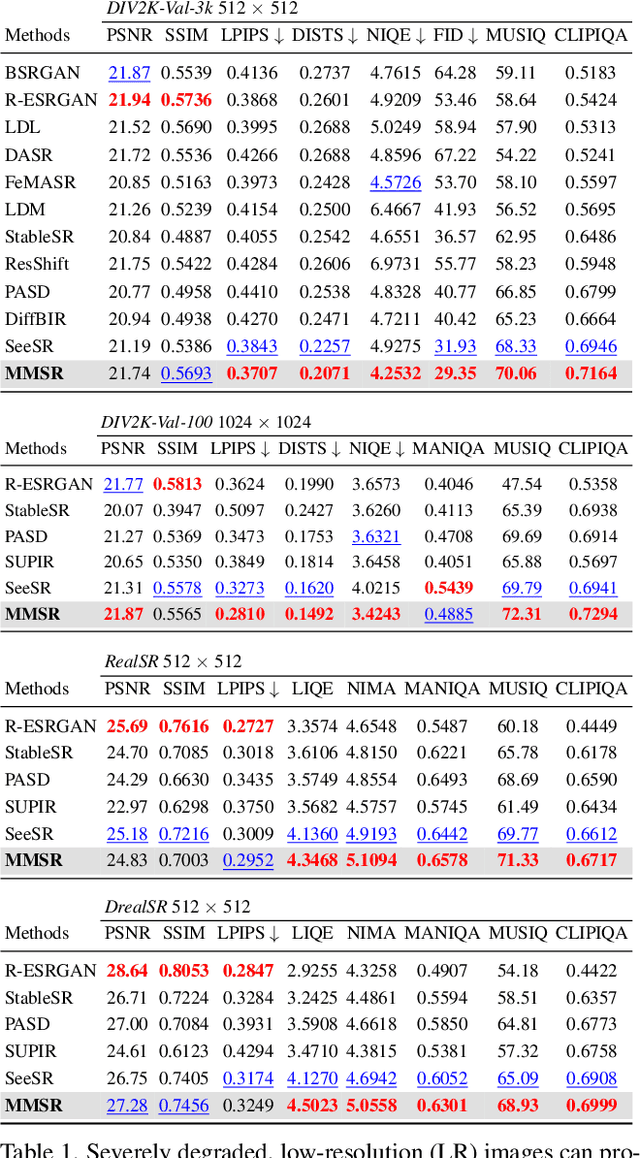
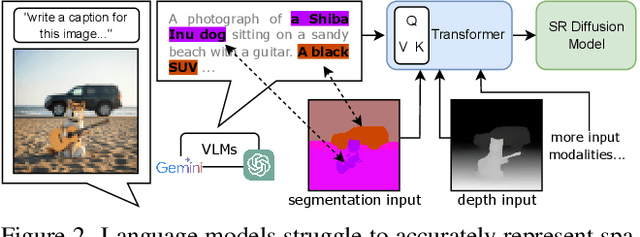
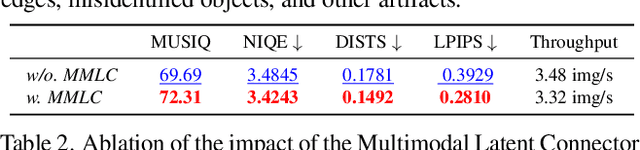
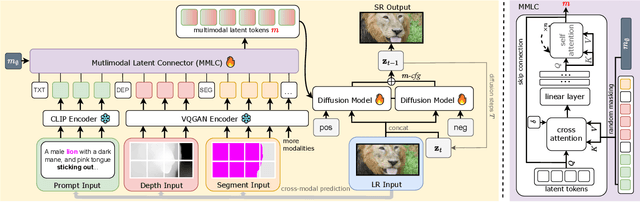
Single-image super-resolution (SISR) remains challenging due to the inherent difficulty of recovering fine-grained details and preserving perceptual quality from low-resolution inputs. Existing methods often rely on limited image priors, leading to suboptimal results. We propose a novel approach that leverages the rich contextual information available in multiple modalities -- including depth, segmentation, edges, and text prompts -- to learn a powerful generative prior for SISR within a diffusion model framework. We introduce a flexible network architecture that effectively fuses multimodal information, accommodating an arbitrary number of input modalities without requiring significant modifications to the diffusion process. Crucially, we mitigate hallucinations, often introduced by text prompts, by using spatial information from other modalities to guide regional text-based conditioning. Each modality's guidance strength can also be controlled independently, allowing steering outputs toward different directions, such as increasing bokeh through depth or adjusting object prominence via segmentation. Extensive experiments demonstrate that our model surpasses state-of-the-art generative SISR methods, achieving superior visual quality and fidelity. See project page at https://mmsr.kfmei.com/.
Bigger is not Always Better: Scaling Properties of Latent Diffusion Models
Apr 01, 2024We study the scaling properties of latent diffusion models (LDMs) with an emphasis on their sampling efficiency. While improved network architecture and inference algorithms have shown to effectively boost sampling efficiency of diffusion models, the role of model size -- a critical determinant of sampling efficiency -- has not been thoroughly examined. Through empirical analysis of established text-to-image diffusion models, we conduct an in-depth investigation into how model size influences sampling efficiency across varying sampling steps. Our findings unveil a surprising trend: when operating under a given inference budget, smaller models frequently outperform their larger equivalents in generating high-quality results. Moreover, we extend our study to demonstrate the generalizability of the these findings by applying various diffusion samplers, exploring diverse downstream tasks, evaluating post-distilled models, as well as comparing performance relative to training compute. These findings open up new pathways for the development of LDM scaling strategies which can be employed to enhance generative capabilities within limited inference budgets.
Latent Feature-Guided Diffusion Models for Shadow Removal
Dec 04, 2023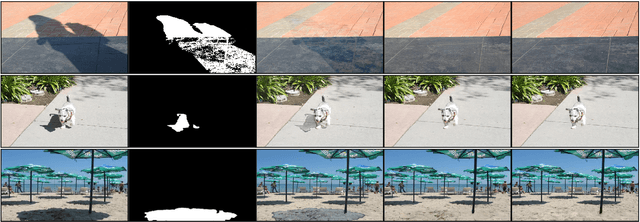
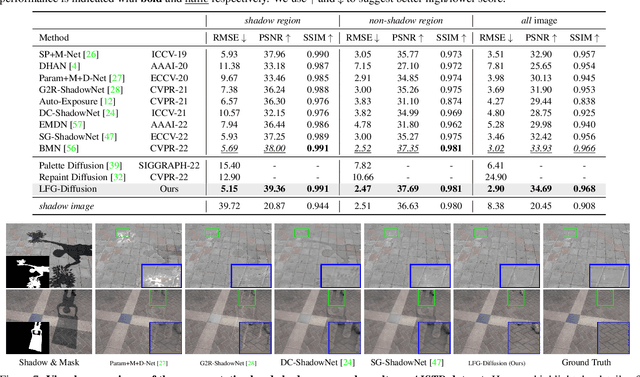
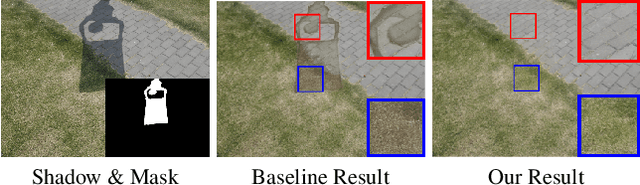
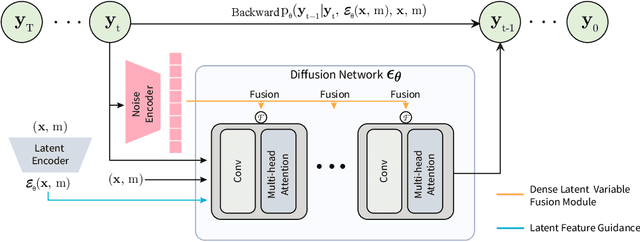
Recovering textures under shadows has remained a challenging problem due to the difficulty of inferring shadow-free scenes from shadow images. In this paper, we propose the use of diffusion models as they offer a promising approach to gradually refine the details of shadow regions during the diffusion process. Our method improves this process by conditioning on a learned latent feature space that inherits the characteristics of shadow-free images, thus avoiding the limitation of conventional methods that condition on degraded images only. Additionally, we propose to alleviate potential local optima during training by fusing noise features with the diffusion network. We demonstrate the effectiveness of our approach which outperforms the previous best method by 13% in terms of RMSE on the AISTD dataset. Further, we explore instance-level shadow removal, where our model outperforms the previous best method by 82% in terms of RMSE on the DESOBA dataset.
Conditional Diffusion Distillation
Oct 02, 2023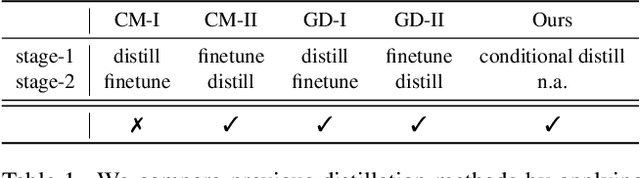
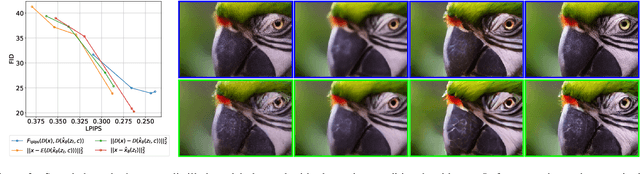

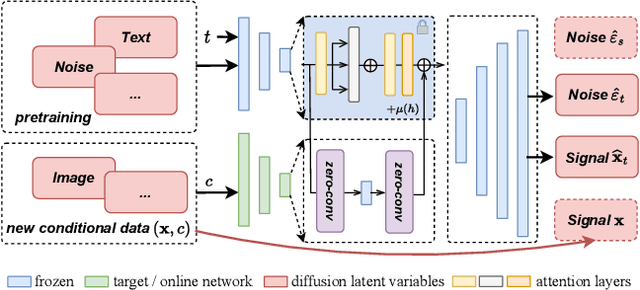
Generative diffusion models provide strong priors for text-to-image generation and thereby serve as a foundation for conditional generation tasks such as image editing, restoration, and super-resolution. However, one major limitation of diffusion models is their slow sampling time. To address this challenge, we present a novel conditional distillation method designed to supplement the diffusion priors with the help of image conditions, allowing for conditional sampling with very few steps. We directly distill the unconditional pre-training in a single stage through joint-learning, largely simplifying the previous two-stage procedures that involve both distillation and conditional finetuning separately. Furthermore, our method enables a new parameter-efficient distillation mechanism that distills each task with only a small number of additional parameters combined with the shared frozen unconditional backbone. Experiments across multiple tasks including super-resolution, image editing, and depth-to-image generation demonstrate that our method outperforms existing distillation techniques for the same sampling time. Notably, our method is the first distillation strategy that can match the performance of the much slower fine-tuned conditional diffusion models.
T1: Scaling Diffusion Probabilistic Fields to High-Resolution on Unified Visual Modalities
May 24, 2023Diffusion Probabilistic Field (DPF) models the distribution of continuous functions defined over metric spaces. While DPF shows great potential for unifying data generation of various modalities including images, videos, and 3D geometry, it does not scale to a higher data resolution. This can be attributed to the ``scaling property'', where it is difficult for the model to capture local structures through uniform sampling. To this end, we propose a new model comprising of a view-wise sampling algorithm to focus on local structure learning, and incorporating additional guidance, e.g., text description, to complement the global geometry. The model can be scaled to generate high-resolution data while unifying multiple modalities. Experimental results on data generation in various modalities demonstrate the effectiveness of our model, as well as its potential as a foundation framework for scalable modality-unified visual content generation.
Bi-Noising Diffusion: Towards Conditional Diffusion Models with Generative Restoration Priors
Dec 14, 2022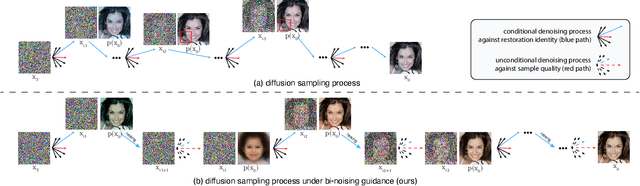
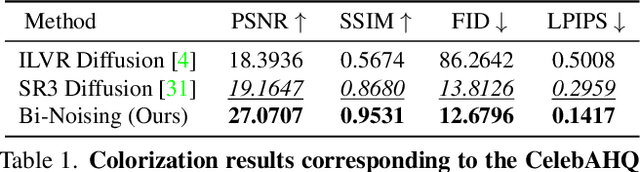
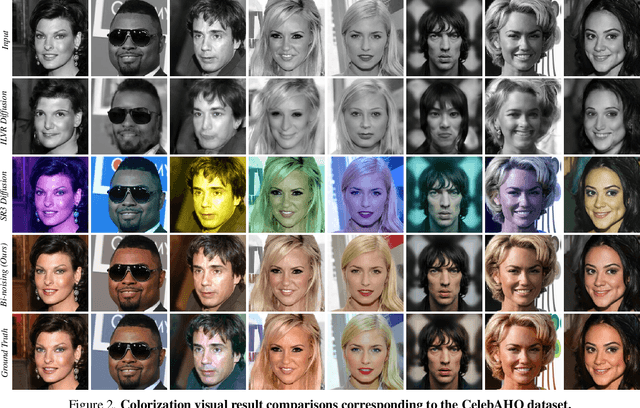
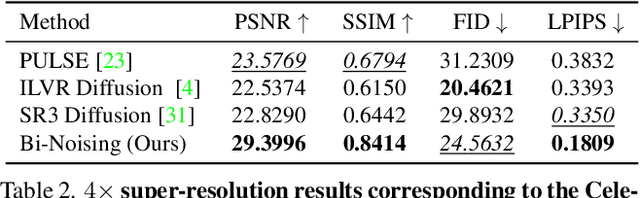
Conditional diffusion probabilistic models can model the distribution of natural images and can generate diverse and realistic samples based on given conditions. However, oftentimes their results can be unrealistic with observable color shifts and textures. We believe that this issue results from the divergence between the probabilistic distribution learned by the model and the distribution of natural images. The delicate conditions gradually enlarge the divergence during each sampling timestep. To address this issue, we introduce a new method that brings the predicted samples to the training data manifold using a pretrained unconditional diffusion model. The unconditional model acts as a regularizer and reduces the divergence introduced by the conditional model at each sampling step. We perform comprehensive experiments to demonstrate the effectiveness of our approach on super-resolution, colorization, turbulence removal, and image-deraining tasks. The improvements obtained by our method suggest that the priors can be incorporated as a general plugin for improving conditional diffusion models.