 Add to Chrome
 Add to Firefox
 Add to Edge
ConsisFormer: Compute-Efficient Transformer for Wireless Foundation Models Based on Channel Consistency
Jun 18, 2026
Wireless foundation models (WFMs) have recently emerged as a promising paradigm for AI-native 6G networks, enabling universal channel representations adaptable to diverse communication and sensing tasks. Existing WFMs are predominantly built upon the Transformer architecture, which delivers superior performance but incurs computational complexity proportional to the square of the input sequence length, posing a significant barrier to their deployment under stringent inference latency constraints. To address this issue, in this paper, we propose ConsisFormer, a compute-efficient Transformer design based on short-term consistency of wireless channels, as a WFM backbone. By utilizing the observation that adjacent time or frequency instances share similar clusters of scatterers and thus exhibit similar channel characteristics, we develop an adaptive token aggregation (ATA) module to dynamically merge neighboring channel state information (CSI) tokens, thereby reducing the length of the token sequence involved in self-attention calculations to lower the computational cost. Furthermore, we propose a feature sequence interpolation (FSI) method to recover the full CSI representation based on the sparse feature sequence outputted from the Transformer blocks, thus keeping the performance unaffected while ensuring low complexity. Moreover, we propose an aggregated auto-encoder (AAE) pre-training paradigm for WFMs, enabling robust channel representation learning from sparsified CSI tokens via compression and recovery. Simulation results show that the proposed design reduces the computational complexity of WFM by over $83\%$ with negligible performance loss on various tasks including channel prediction, LoS/NLOS classification, beam prediction, and localization.

A Unified Adaptive Feature Composition Framework for Multi-Task Generalization in Wireless Foundation Models
Jun 09, 2026Though wireless foundation models (WFMs) have shown strong potential in learning universal channel representations, their adaptation to various downstream tasks remains constrained by existing paradigms. Fine-tuning strategies introduces substantial computational and storage overhead, while frozen feature extraction leads to sub-optimal performance across diverse downstream tasks. To address this issue, we propose a unified adaptive feature composition framework for multitask generalization in WFMs, where the key component is the Routing Adapter for Feature Composition (RAFC). Instead of extracting only the final-layer output, this router treats the hidden states from different Transformer depths as a reusable pool of multi-level hidden features, and employs a lightweight task-driven feature composition network to generate layer-wise aggregation weights, then adaptively combine hierarchical representations through weighted summation. This design enables each downstream task to access suitable mixture of low-, mid-, and high-level wireless features without modifying the pretrained backbone. Extensive experiments on four representative wireless tasks demonstrate that RAFC consistently outperforms conventional adaptation baselines while introducing fewer than 50K additional parameters. Moreover, the learned routing weights provide interpretable evidence of task-specific layer preferences, making the proposed framework a low-complexity, scalable, and explainable interface for adapting WFMs to diverse downstream scenarios.
SpikeWFM: Spiking-Aided Wireless Foundation Model for Robust Channel Prediction
May 28, 2026This paper proposes SpikeWFM, a novel hybrid architecture that integrates spiking neural networks (SNNs) with conventional artificial neural network (ANN)-based transformers for wireless foundation models (WFMs). Inspired by the noise-robust and energy-efficient information processing in the human brain, SpikeWFM aims to enhance the resilience of WFMs against noise and interference while maintaining strong generalization capabilities across diverse wireless scenarios. Drawing from the success of large language models, WFMs leverage self-supervised pre-training on large-scale datasets spanning various wireless environments to learn a unified embedding that supports a wide range of downstream tasks, including channel prediction, channel estimation, beam predition, positioning and etc. Such models typically outperform task-specific designs and exhibit superior adaptability to unseen conditions. However, existing WFMs remain vulnerable to realistic noise and interference in practical wireless systems. To address this limitation, we incorporate spiking neurons into the transformer-based WFM architecture. We provide a brief theoretical analysis demonstrating how the SNN-ANN hybrid effectively mitigates noise and interference through temporal sparsity and event-driven processing. Experimental results show that SpikeWFM consistently outperforms conventional ANN-based WFMs in both pre-training convergence and channel prediction accuracy. Additional results on communication and sensing tasks will be presented in the full journal version of this work.
WirelessGPT: A Generative Pre-trained Multi-task Learning Framework for Wireless Communication
Feb 08, 2025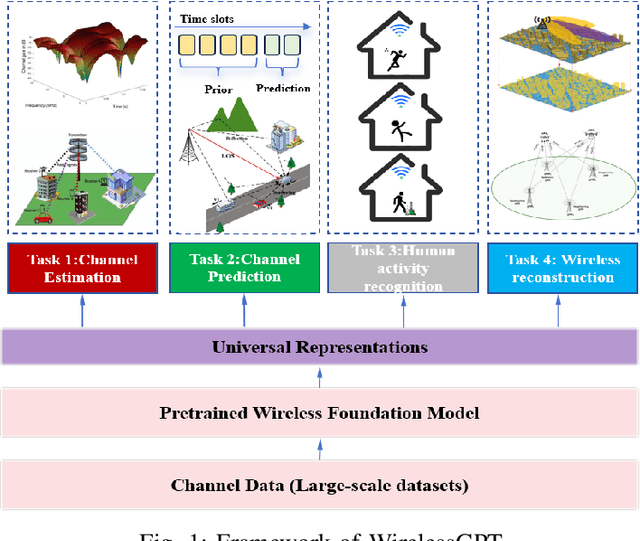
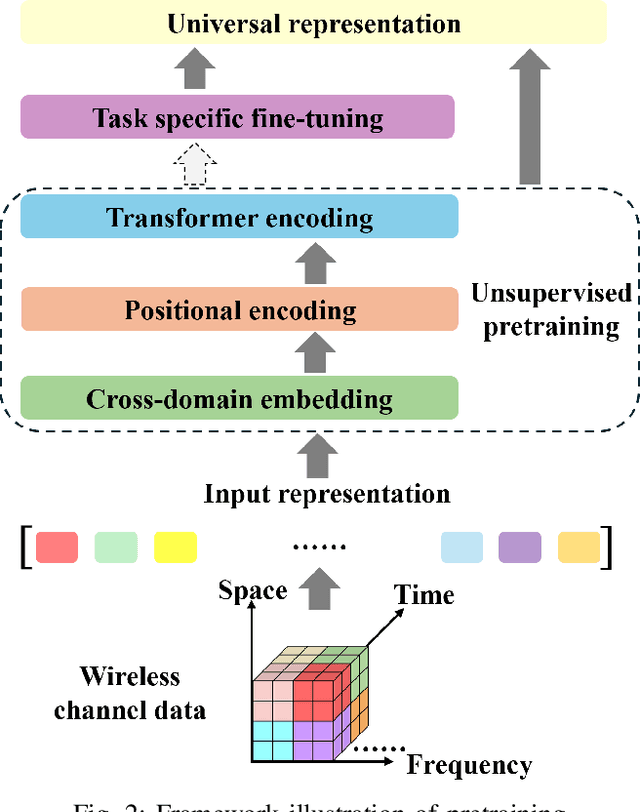
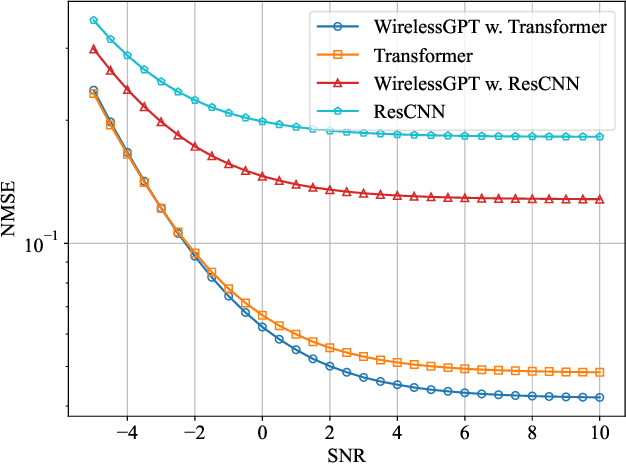

This paper introduces WirelessGPT, a pioneering foundation model specifically designed for multi-task learning in wireless communication and sensing. Specifically, WirelessGPT leverages large-scale wireless channel datasets for unsupervised pretraining and extracting universal channel representations, which captures complex spatiotemporal dependencies. In fact,this task-agnostic design adapts WirelessGPT seamlessly to a wide range of downstream tasks, using a unified representation with minimal fine-tuning. By unifying communication and sensing functionalities, WirelessGPT addresses the limitations of task-specific models, offering a scalable and efficient solution for integrated sensing and communication (ISAC). With an initial parameter size of around 80 million, WirelessGPT demonstrates significant improvements over conventional methods and smaller AI models, reducing reliance on large-scale labeled data. As the first foundation model capable of supporting diverse tasks across different domains, WirelessGPT establishes a new benchmark, paving the way for future advancements in multi-task wireless systems.
EDDA: A Encoder-Decoder Data Augmentation Framework for Zero-Shot Stance Detection
Mar 23, 2024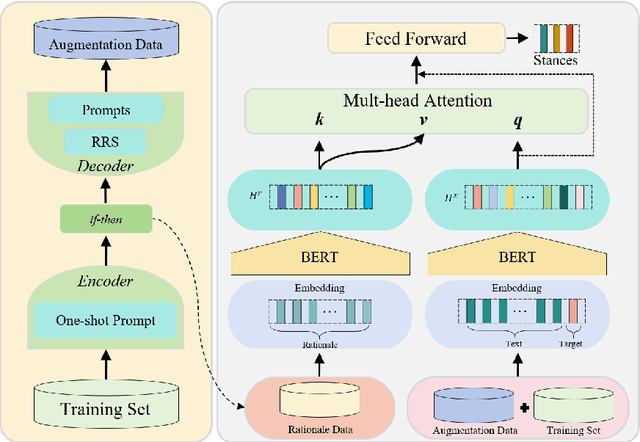
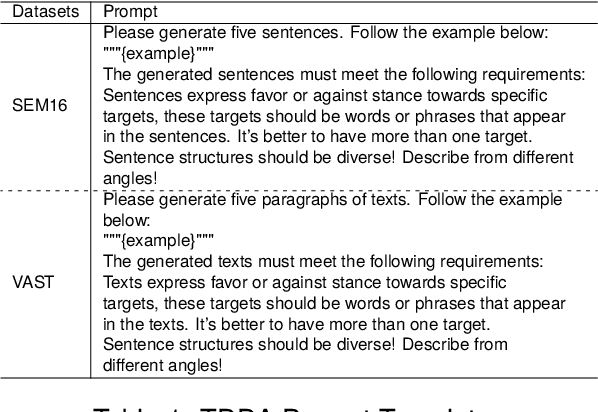
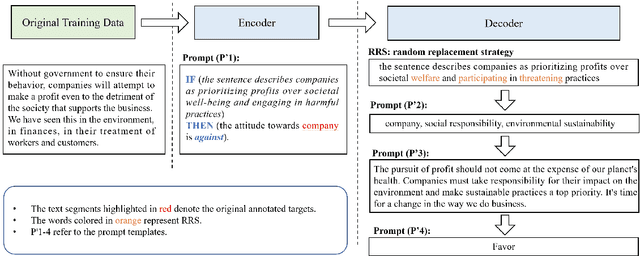
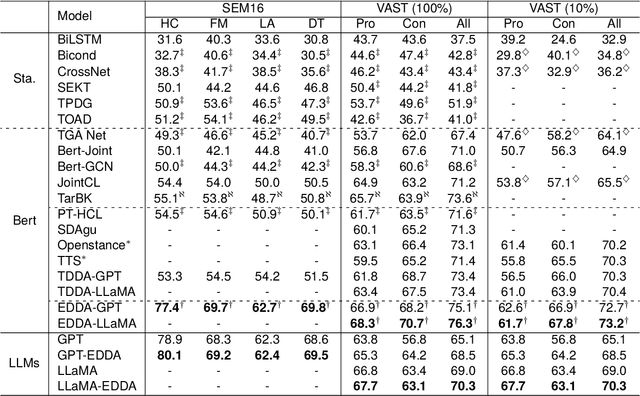
Stance detection aims to determine the attitude expressed in text towards a given target. Zero-shot stance detection (ZSSD) has emerged to classify stances towards unseen targets during inference. Recent data augmentation techniques for ZSSD increase transferable knowledge between targets through text or target augmentation. However, these methods exhibit limitations. Target augmentation lacks logical connections between generated targets and source text, while text augmentation relies solely on training data, resulting in insufficient generalization. To address these issues, we propose an encoder-decoder data augmentation (EDDA) framework. The encoder leverages large language models and chain-of-thought prompting to summarize texts into target-specific if-then rationales, establishing logical relationships. The decoder generates new samples based on these expressions using a semantic correlation word replacement strategy to increase syntactic diversity. We also analyze the generated expressions to develop a rationale-enhanced network that fully utilizes the augmented data. Experiments on benchmark datasets demonstrate our approach substantially improves over state-of-the-art ZSSD techniques. The proposed EDDA framework increases semantic relevance and syntactic variety in augmented texts while enabling interpretable rationale-based learning.
Vision Reimagined: AI-Powered Breakthroughs in WiFi Indoor Imaging
Jan 09, 2024Indoor imaging is a critical task for robotics and internet-of-things. WiFi as an omnipresent signal is a promising candidate for carrying out passive imaging and synchronizing the up-to-date information to all connected devices. This is the first research work to consider WiFi indoor imaging as a multi-modal image generation task that converts the measured WiFi power into a high-resolution indoor image. Our proposed WiFi-GEN network achieves a shape reconstruction accuracy that is 275% of that achieved by physical model-based inversion methods. Additionally, the Frechet Inception Distance score has been significantly reduced by 82%. To examine the effectiveness of models for this task, the first large-scale dataset is released containing 80,000 pairs of WiFi signal and imaging target. Our model absorbs challenges for the model-based methods including the non-linearity, ill-posedness and non-certainty into massive parameters of our generative AI network. The network is also designed to best fit measured WiFi signals and the desired imaging output. For reproducibility, we will release the data and code upon acceptance.
Cross-target Stance Detection by Exploiting Target Analytical Perspectives
Jan 04, 2024
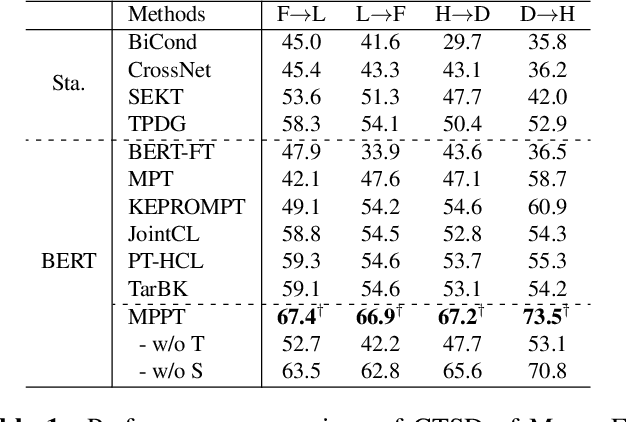
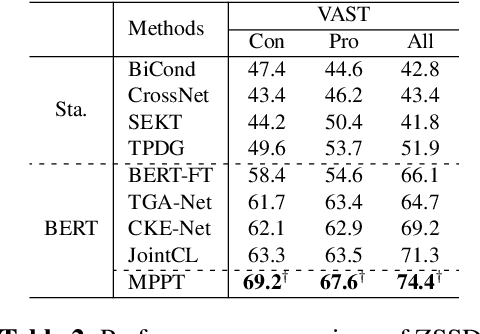
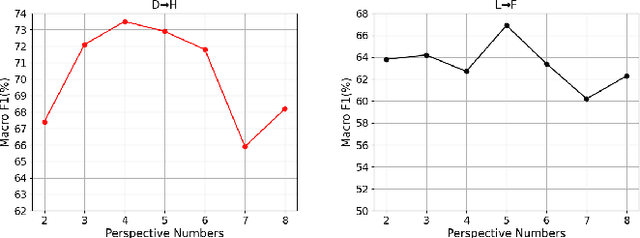
Cross-target stance detection (CTSD) is an important task, which infers the attitude of the destination target by utilizing annotated data derived from the source target. One important approach in CTSD is to extract domain-invariant features to bridge the knowledge gap between multiple targets. However, the analysis of informal and short text structure, and implicit expressions, complicate the extraction of domain-invariant knowledge. In this paper, we propose a Multi-Perspective Prompt-Tuning (MPPT) model for CTSD that uses the analysis perspective as a bridge to transfer knowledge. First, we develop a two-stage instruct-based chain-of-thought method (TsCoT) to elicit target analysis perspectives and provide natural language explanations (NLEs) from multiple viewpoints by formulating instructions based on large language model (LLM). Second, we propose a multi-perspective prompt-tuning framework (MultiPLN) to fuse the NLEs into the stance predictor. Extensive experiments results demonstrate the superiority of MPPT against the state-of-the-art baseline methods.
A Logically Consistent Chain-of-Thought Approach for Stance Detection
Dec 26, 2023Zero-shot stance detection (ZSSD) aims to detect stances toward unseen targets. Incorporating background knowledge to enhance transferability between seen and unseen targets constitutes the primary approach of ZSSD. However, these methods often struggle with a knowledge-task disconnect and lack logical consistency in their predictions. To address these issues, we introduce a novel approach named Logically Consistent Chain-of-Thought (LC-CoT) for ZSSD, which improves stance detection by ensuring relevant and logically sound knowledge extraction. LC-CoT employs a three-step process. Initially, it assesses whether supplementary external knowledge is necessary. Subsequently, it uses API calls to retrieve this knowledge, which can be processed by a separate LLM. Finally, a manual exemplar guides the LLM to infer stance categories, using an if-then logical structure to maintain relevance and logical coherence. This structured approach to eliciting background knowledge enhances the model's capability, outperforming traditional supervised methods without relying on labeled data.
Investigating Chain-of-thought with ChatGPT for Stance Detection on Social Media
Apr 06, 2023Stance detection predicts attitudes towards targets in texts and has gained attention with the rise of social media. Traditional approaches include conventional machine learning, early deep neural networks, and pre-trained fine-tuning models. However, with the evolution of very large pre-trained language models (VLPLMs) like ChatGPT (GPT-3.5), traditional methods face deployment challenges. The parameter-free Chain-of-Thought (CoT) approach, not requiring backpropagation training, has emerged as a promising alternative. This paper examines CoT's effectiveness in stance detection tasks, demonstrating its superior accuracy and discussing associated challenges.
How would Stance Detection Techniques Evolve after the Launch of ChatGPT?
Dec 30, 2022


Stance detection refers to the task of extracting the standpoint (Favor, Against or Neither) towards a target in given texts. Such research gains increasing attention with the proliferation of social media contents. The conventional framework of handling stance detection is converting it into text classification tasks. Deep learning models have already replaced rule-based models and traditional machine learning models in solving such problems. Current deep neural networks are facing two main challenges which are insufficient labeled data and information in social media posts and the unexplainable nature of deep learning models. A new pre-trained language model chatGPT was launched on Nov 30, 2022. For the stance detection tasks, our experiments show that ChatGPT can achieve SOTA or similar performance for commonly used datasets including SemEval-2016 and P-Stance. At the same time, ChatGPT can provide explanation for its own prediction, which is beyond the capability of any existing model. The explanations for the cases it cannot provide classification results are especially useful. ChatGPT has the potential to be the best AI model for stance detection tasks in NLP, or at least change the research paradigm of this field. ChatGPT also opens up the possibility of building explanatory AI for stance detection.