 Add to Chrome
 Add to Firefox
 Add to Edge
A Unified Adaptive Feature Composition Framework for Multi-Task Generalization in Wireless Foundation Models
Jun 09, 2026
Though wireless foundation models (WFMs) have shown strong potential in learning universal channel representations, their adaptation to various downstream tasks remains constrained by existing paradigms. Fine-tuning strategies introduces substantial computational and storage overhead, while frozen feature extraction leads to sub-optimal performance across diverse downstream tasks. To address this issue, we propose a unified adaptive feature composition framework for multitask generalization in WFMs, where the key component is the Routing Adapter for Feature Composition (RAFC). Instead of extracting only the final-layer output, this router treats the hidden states from different Transformer depths as a reusable pool of multi-level hidden features, and employs a lightweight task-driven feature composition network to generate layer-wise aggregation weights, then adaptively combine hierarchical representations through weighted summation. This design enables each downstream task to access suitable mixture of low-, mid-, and high-level wireless features without modifying the pretrained backbone. Extensive experiments on four representative wireless tasks demonstrate that RAFC consistently outperforms conventional adaptation baselines while introducing fewer than 50K additional parameters. Moreover, the learned routing weights provide interpretable evidence of task-specific layer preferences, making the proposed framework a low-complexity, scalable, and explainable interface for adapting WFMs to diverse downstream scenarios.

SpikeWFM: Spiking-Aided Wireless Foundation Model for Robust Channel Prediction
May 28, 2026This paper proposes SpikeWFM, a novel hybrid architecture that integrates spiking neural networks (SNNs) with conventional artificial neural network (ANN)-based transformers for wireless foundation models (WFMs). Inspired by the noise-robust and energy-efficient information processing in the human brain, SpikeWFM aims to enhance the resilience of WFMs against noise and interference while maintaining strong generalization capabilities across diverse wireless scenarios. Drawing from the success of large language models, WFMs leverage self-supervised pre-training on large-scale datasets spanning various wireless environments to learn a unified embedding that supports a wide range of downstream tasks, including channel prediction, channel estimation, beam predition, positioning and etc. Such models typically outperform task-specific designs and exhibit superior adaptability to unseen conditions. However, existing WFMs remain vulnerable to realistic noise and interference in practical wireless systems. To address this limitation, we incorporate spiking neurons into the transformer-based WFM architecture. We provide a brief theoretical analysis demonstrating how the SNN-ANN hybrid effectively mitigates noise and interference through temporal sparsity and event-driven processing. Experimental results show that SpikeWFM consistently outperforms conventional ANN-based WFMs in both pre-training convergence and channel prediction accuracy. Additional results on communication and sensing tasks will be presented in the full journal version of this work.
WirelessGPT: A Generative Pre-trained Multi-task Learning Framework for Wireless Communication
Feb 08, 2025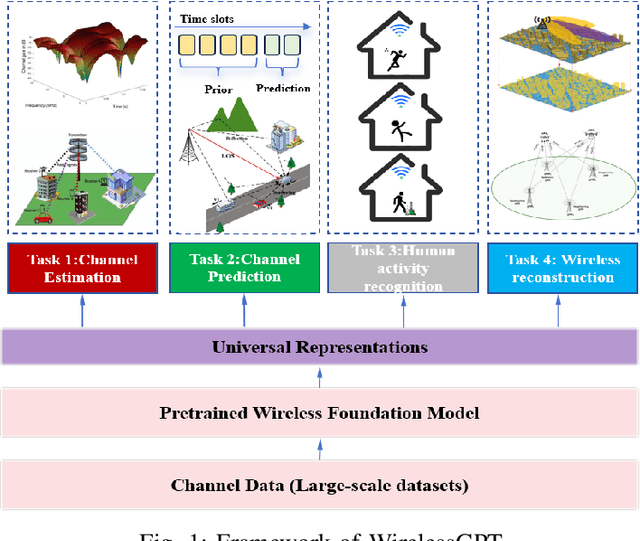
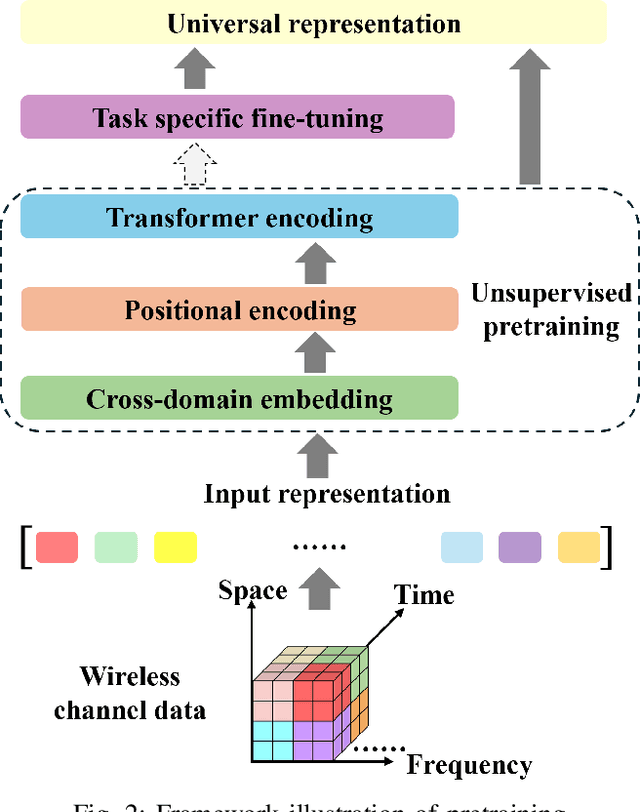
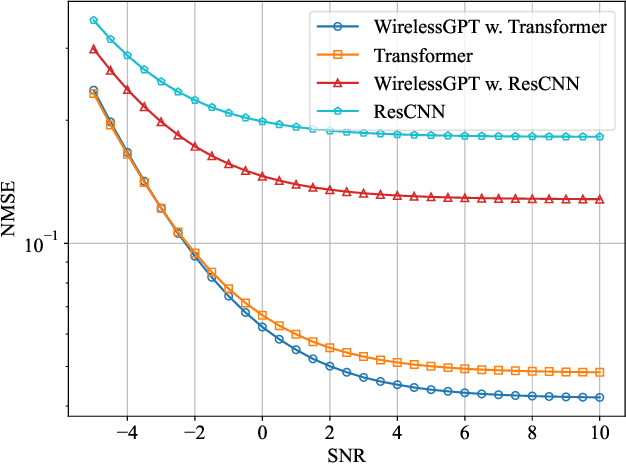

This paper introduces WirelessGPT, a pioneering foundation model specifically designed for multi-task learning in wireless communication and sensing. Specifically, WirelessGPT leverages large-scale wireless channel datasets for unsupervised pretraining and extracting universal channel representations, which captures complex spatiotemporal dependencies. In fact,this task-agnostic design adapts WirelessGPT seamlessly to a wide range of downstream tasks, using a unified representation with minimal fine-tuning. By unifying communication and sensing functionalities, WirelessGPT addresses the limitations of task-specific models, offering a scalable and efficient solution for integrated sensing and communication (ISAC). With an initial parameter size of around 80 million, WirelessGPT demonstrates significant improvements over conventional methods and smaller AI models, reducing reliance on large-scale labeled data. As the first foundation model capable of supporting diverse tasks across different domains, WirelessGPT establishes a new benchmark, paving the way for future advancements in multi-task wireless systems.
Joint Device Detection, Channel Estimation, and Data Decoding with Collision Resolution for MIMO Massive Unsourced Random Access
Dec 17, 2021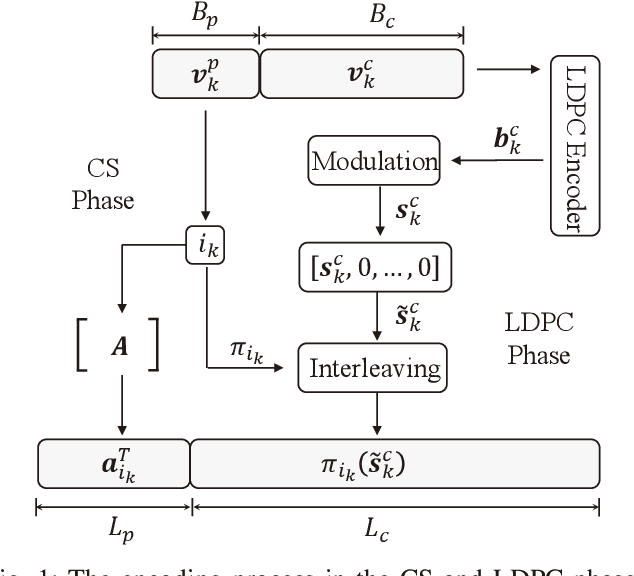
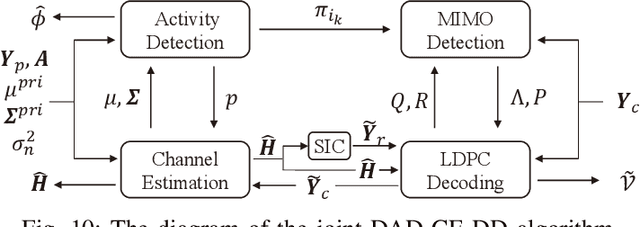
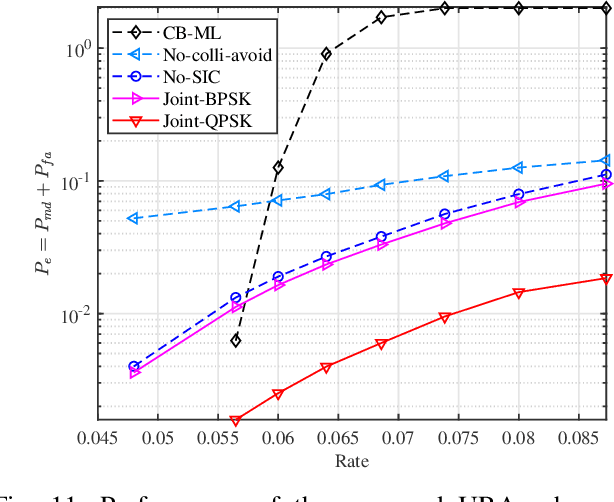
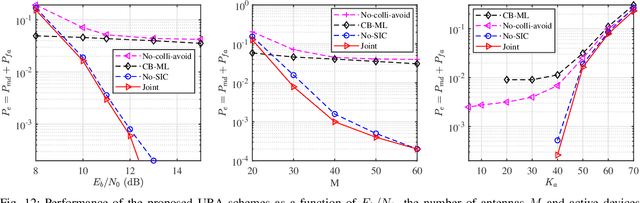
In this paper, we investigate a joint device activity detection (DAD), channel estimation (CE), and data decoding (DD) algorithm for multiple-input multiple-output (MIMO) massive unsourced random access (URA). Different from the state-of-the-art slotted transmission scheme, the data in the proposed framework is split into only two parts. A portion of the data is coded by compressed sensing (CS) and the rest is low-density-parity-check (LDPC) coded. In addition to being part of the data, information bits in the CS phase also undertake the task of interleaving pattern design and channel estimation (CE). The principle of interleave-division multiple access (IDMA) is exploited to reduce the interference among devices in the LDPC phase. Based on the belief propagation (BP) algorithm, a low-complexity iterative message passing (MP) algorithm is utilized to decode the data embedded in these two phases separately. Moreover, combined with successive interference cancellation (SIC), the proposed joint DAD-CE-DD algorithm is performed to further improve performance by utilizing the belief of each other. Additionally, based on the energy detection (ED) and sliding window protocol (SWP), we develop a collision resolution protocol to handle the codeword collision, a common issue in the URA system. In addition to the complexity reduction, the proposed algorithm exhibits a substantial performance enhancement compared to the state-of-the-art in terms of efficiency and accuracy.