 Add to Chrome
 Add to Firefox
 Add to Edge
Glance, Scrutinize, and Think: Advancing Video Anomaly Detection from Training-Free to Agentic Reasoning
Aug 07, 2026
Video Anomaly Detection (VAD) aims to identify anomalous events and localize their temporal intervals. Existing approaches exhibit a "when-what" dissociation: traditional DNN-based methods localize when anomalies occur but lack semantic understanding, whereas LLM-based methods explain what happens but neglect precise temporal grounding. We attribute this to the absence of a unified reasoning paradigm. Inspired by how humans inspect surveillance videos - glancing globally to form temporal hypotheses, scrutinizing suspicious segments, and thinking iteratively to correct errors - we study this global-to-local paradigm from two perspectives. We first propose Glance then Scrutinize (GtS), a training-free framework using static and dynamic textual guidance for coarse-to-fine anomaly grounding and understanding, balancing accuracy and speed. To break the ceiling imposed by frozen external modules, we further propose a tool-augmented agentic VAD method, where a multimodal large language model learns to invoke a video cropping tool, inspect densely resampled frames, and self-correct mislocalized hypotheses, via cold-start supervised fine-tuning followed by reinforcement learning with a joint answer-grounding reward. For training and evaluation, we extend our prior VAGU benchmark into VAGU-T (Video Anomaly Grounding, Understanding, and Thinking), comprising 7,567 real-world videos over 21 anomaly categories with human-validated grounding, explanations, QA pairs, and chain-of-thought tool-calling traces. We further introduce JeAUG, a metric jointly evaluating semantic interpretability and temporal precision. Experiments show that GtS substantially surpasses training-free baselines, while the agentic model delivers both higher accuracy and faster inference.

I Seek You in Videos: Identity-Conditioned Queries for Person-Centric Video Reasoning
Aug 07, 2026Real-world video reasoning often involves multimodal, multi-source inputs, whereas existing video reasoning tasks typically assume a simplified video-text setting, limiting identity matching and person-centric reasoning. To bridge this gap, we introduce the Identity-conditioned Queries (ICQ) task, in which models are required to jointly associate and interpret an input video and a reference image of a person, and leverage this conditioning to address identity grounding, behavior understanding, and temporal reasoning, among other challenges. Building on ICQ, we present ISYV (I Seek You in Videos), a systematic solution comprising three components: (1) ISYV-Bench, a challenging evaluation benchmark with 1,377 real-world complex videos and 1,377 question-answer pairs, organized into six difficulty levels spanning capabilities from identity recognition to causal reasoning; (2) ISYV-75K, a large-scale training set of 75K high-quality samples constructed via automated annotation, multi-stage verification, and manual review; and (3) ISYV-Framework, containing an ICQ-oriented model and training strategy for learning to exploit informative video shots without additional shot-level annotations. Extensive experiments show that both mainstream closed-source and open-source MLLMs struggle on ISYV-Bench, especially in cross-domain identity matching and long-horizon tracking. ISYV-Model outperforms strong baselines and in some aspects approaches closed-source performance. Overall, ISYV provides a unified task definition, scalable datasets/benchmarks, and modeling insights for person-centric video reasoning.
ECG-Chat: A Large ECG-Language Model for Cardiac Disease Diagnosis
Aug 16, 2024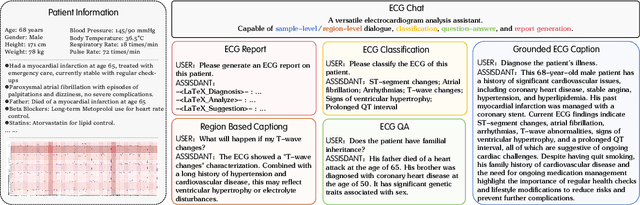
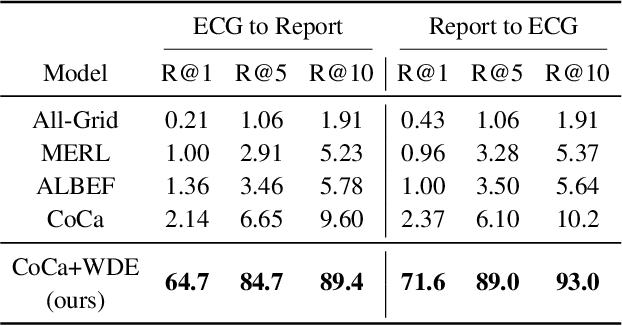
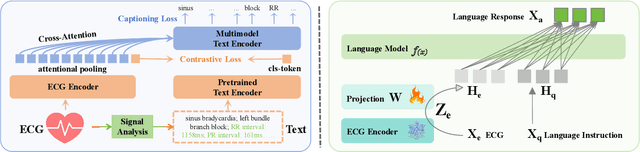
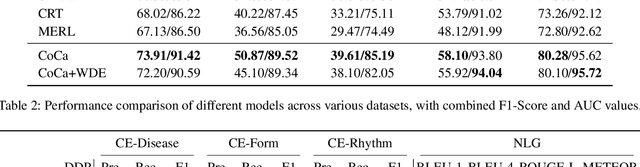
The success of Multimodal Large Language Models (MLLMs) in the medical auxiliary field shows great potential, allowing patients to engage in conversations using physiological signal data. However, general MLLMs perform poorly in cardiac disease diagnosis, particularly in the integration of ECG data analysis and long-text medical report generation, mainly due to the complexity of ECG data analysis and the gap between text and ECG signal modalities. Additionally, models often exhibit severe stability deficiencies in long-text generation due to the lack of precise knowledge strongly related to user queries. To address these issues, we propose ECG-Chat, the first multitask MLLMs focused on ECG medical report generation, providing multimodal conversational capabilities based on cardiology knowledge. We propose a contrastive learning approach that integrates ECG waveform data with text reports, aligning ECG features with reports in a fine-grained manner. This method also results in an ECG encoder that excels in zero-shot report retrieval tasks. Additionally, expanding existing datasets, we constructed a 19k ECG diagnosis dataset and a 25k multi-turn dialogue dataset for training and fine-tuning ECG-Chat, which provides professional diagnostic and conversational capabilities. Furthermore, ECG-Chat can generate comprehensive ECG analysis reports through an automated LaTeX generation pipeline. We established a benchmark for the ECG report generation task and tested our model on multiple baselines. ECG-Chat achieved the best performance in classification, retrieval, multimodal dialogue, and medical report generation tasks. Our report template design has also been widely recognized by medical practitioners.
DoctorGLM: Fine-tuning your Chinese Doctor is not a Herculean Task
Apr 17, 2023


The recent progress of large language models (LLMs), including ChatGPT and GPT-4, in comprehending and responding to human instructions has been remarkable. Nevertheless, these models typically perform better in English and have not been explicitly trained for the medical domain, resulting in suboptimal precision in diagnoses, drug recommendations, and other medical advice. Additionally, training and deploying a dialogue model is still believed to be impossible for hospitals, hindering the promotion of LLMs. To tackle these challenges, we have collected databases of medical dialogues in Chinese with ChatGPT's help and adopted several techniques to train an easy-deploy LLM. Remarkably, we were able to fine-tune the ChatGLM-6B on a single A100 80G in 13 hours, which means having a healthcare-purpose LLM can be very affordable. DoctorGLM is currently an early-stage engineering attempt and contain various mistakes. We are sharing it with the broader community to invite feedback and suggestions to improve its healthcare-focused capabilities: https://github.com/xionghonglin/DoctorGLM.
PGDP5K: A Diagram Parsing Dataset for Plane Geometry Problems
May 20, 2022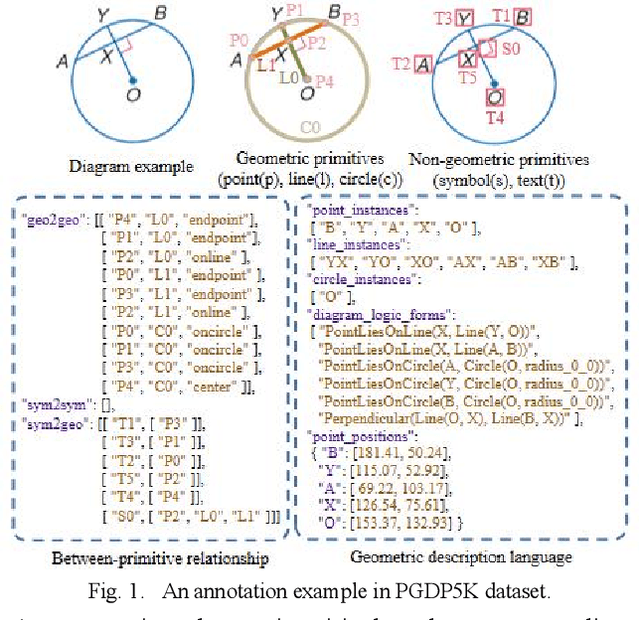
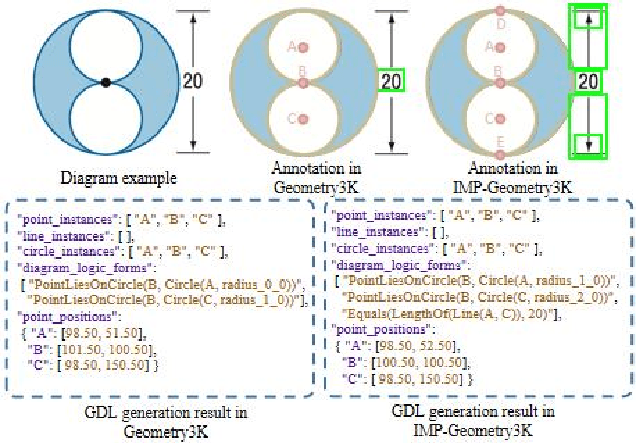
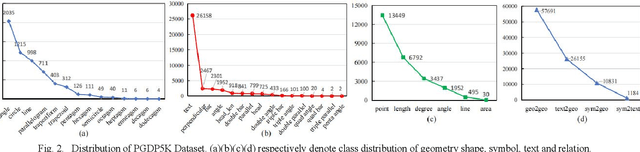

Diagram parsing is an important foundation for geometry problem solving, attracting increasing attention in the field of intelligent education and document image understanding. Due to the complex layout and between-primitive relationship, plane geometry diagram parsing (PGDP) is still a challenging task deserving further research and exploration. An appropriate dataset is critical for the research of PGDP. Although some datasets with rough annotations have been proposed to solve geometric problems, they are either small in scale or not publicly available. The rough annotations also make them not very useful. Thus, we propose a new large-scale geometry diagram dataset named PGDP5K and a novel annotation method. Our dataset consists of 5000 diagram samples composed of 16 shapes, covering 5 positional relations, 22 symbol types and 6 text types. Different from previous datasets, our PGDP5K dataset is labeled with more fine-grained annotations at primitive level, including primitive classes, locations and relationships. What is more, combined with above annotations and geometric prior knowledge, it can generate intelligible geometric propositions automatically and uniquely. We performed experiments on PGDP5K and IMP-Geometry3K datasets reveal that the state-of-the-art (SOTA) method achieves only 66.07% F1 value. This shows that PGDP5K presents a challenge for future research. Our dataset is available at http://www.nlpr.ia.ac.cn/databases/CASIA-PGDP5K/.