 Add to Chrome
 Add to Firefox
 Add to Edge
D3D-GEN: Robot-Aware Domain-Grounded Interactive 3D World Generation for Social Robotics
Aug 12, 2026
Training and validation of Embodied AI for social navigation critically depends on realistic simulation environments, yet many current approaches fail to find a balance between realism and simulability. We propose D3D-GEN, a novel world generation system that combines a domain agent with a retrieval-augmented generation (RAG) pipeline grounded in that domain. Our system enables users to rapidly generate domain-grounded, fully interactive 3D worlds by automating both the collection of domain knowledge and the synthesis of realistic floorplans and object placements, without dependence on any fixed 3D model database. Given a domain description prompt, the research agent collects publicly accessible domain-specific data and constructs a persistent domain database. Using this database, our RAG pipeline generates plausible floorplans and object placements by dynamically querying a user-provided semantic database, which can be easily extended or modified. The output is a fully interactive 3D world loadable by the popular simulators Isaac Sim and Gazebo. With our approach, we have built databases for several common domains (indoor residential, hospital, office) and generated dozens of distinct, plausible simulation environments for each domain. We present D3D-GEN with a local web frontend that facilitates rapid, interactive world generation for robot simulation.

GROVE: Grounded Pedestrian Simulation via Natural Language for Interactive Social Robot Navigation
Jun 24, 2026Pedestrian simulation is a critical component for training and deploying social robot navigation approaches, yet it remains a largely rigid system that repeatedly requires manual data generation to define even simple scenarios. We propose GROVE, a text-to-scenario pedestrian simulation framework that combines state-of-the-art approaches to produce realistic, socially challenging scenarios for social robot navigation. Our framework allows users to customize one of several common presets (emergency, queuing, normal) or even enter a fully independent prompt to generate a highly customizable pedestrian simulation. Multiple modules separately ensure the realism and soundness of long-horizon human behavior, medium-horizon pedestrian navigation, and short-horizon robot/social interactions. Each module is tuned by the prompt in a way that reflects the user intent across all aspects of pedestrian simulation. By dynamically selecting one of several state-of-the-art (SotA) approaches in our modules based on the scenario, we capture many situational nuances of pedestrian behavior in order to narrow the simulation-to-real (sim2real) gap. The human simulation is directly integrated into Isaac Sim, Gazebo, and RViz simulators for robot deployment in highly social environments. We validate our approach through qualitative comparison against existing pedestrian simulation baselines across scenarios of varying complexity in residential, hospital, and office environments. The result is a high-fidelity pedestrian simulation that challenges social robot navigation with complex, diverse, realistic human behaviors.
Change-Robust Online Spatial-Semantic Topological Mapping
May 04, 2026Autonomous robots require change-robust spatial-semantic reasoning: using spatial and semantic knowledge to decide where to go, how to get there, and where the robot is despite environmental change. Existing approaches typically attach semantics to SLAM-built metric maps, but these pipelines are brittle under appearance shifts and scene dynamics, where data association and relocalization degrade. We propose a Change-Robust Online Spatial-Semantic (CROSS) representation that replaces a globally consistent metric substrate with an online, pose-aware topological graph of RGB-D keyframes. The system explicitly reasons over perceptual ambiguity using sequential hypothesis testing in continuous SE(3). Our estimator maintains a bounded Gaussian-mixture belief over poses, enabling principled handling of loop closures and kidnapped-robot events. Experiments under severe appearance change, including real-robot object-goal navigation with lighting shifts and furniture rearrangement, demonstrate improved robustness over SLAM-based and topological baselines while remaining safe under perceptual aliasing.
Arena 3.0: Advancing Social Navigation in Collaborative and Highly Dynamic Environments
Jun 02, 2024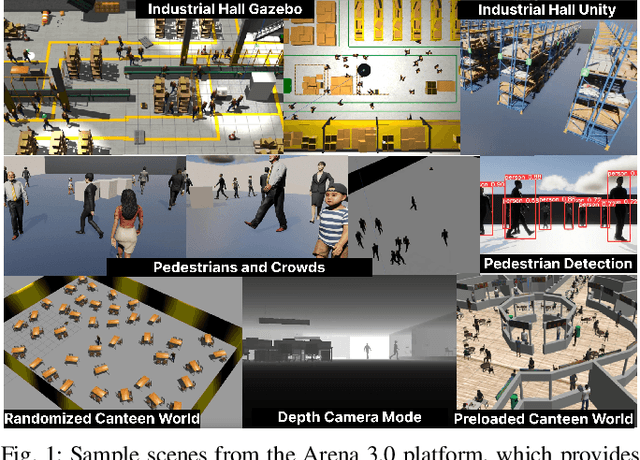
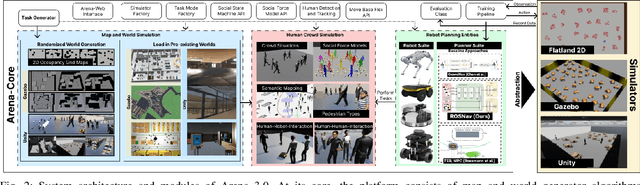
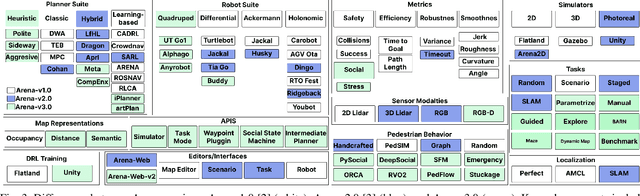
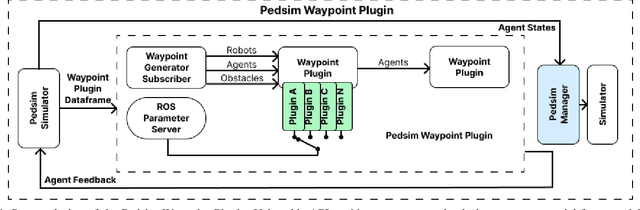
Building upon our previous contributions, this paper introduces Arena 3.0, an extension of Arena-Bench, Arena 1.0, and Arena 2.0. Arena 3.0 is a comprehensive software stack containing multiple modules and simulation environments focusing on the development, simulation, and benchmarking of social navigation approaches in collaborative environments. We significantly enhance the realism of human behavior simulation by incorporating a diverse array of new social force models and interaction patterns, encompassing both human-human and human-robot dynamics. The platform provides a comprehensive set of new task modes, designed for extensive benchmarking and testing and is capable of generating realistic and human-centric environments dynamically, catering to a broad spectrum of social navigation scenarios. In addition, the platform's functionalities have been abstracted across three widely used simulators, each tailored for specific training and testing purposes. The platform's efficacy has been validated through an extensive benchmark and user evaluations of the platform by a global community of researchers and students, which noted the substantial improvement compared to previous versions and expressed interests to utilize the platform for future research and development. Arena 3.0 is openly available at https://github.com/Arena-Rosnav.
* 11 pages, 6 figures
Mono Video-Based AI Corridor for Model-Free Detection of Collision-Relevant Obstacles
Apr 24, 2023The detection of previously unseen, unexpected obstacles on the road is a major challenge for automated driving systems. Different from the detection of ordinary objects with pre-definable classes, detecting unexpected obstacles on the road cannot be resolved by upscaling the sensor technology alone (e.g., high resolution video imagers / radar antennas, denser LiDAR scan lines). This is due to the fact, that there is a wide variety in the types of unexpected obstacles that also do not share a common appearance (e.g., lost cargo as a suitcase or bicycle, tire fragments, a tree stem). Also adding object classes or adding \enquote{all} of these objects to a common \enquote{unexpected obstacle} class does not scale. In this contribution, we study the feasibility of using a deep learning video-based lane corridor (called \enquote{AI ego-corridor}) to ease the challenge by inverting the problem: Instead of detecting a previously unseen object, the AI ego-corridor detects that the ego-lane ahead ends. A smart ground-truth definition enables an easy feature-based classification of an abrupt end of the ego-lane. We propose two neural network designs and research among other things the potential of training with synthetic data. We evaluate our approach on a test vehicle platform. It is shown that the approach is able to detect numerous previously unseen obstacles at a distance of up to 300 m with a detection rate of 95 %.
HabitatDyn Dataset: Dynamic Object Detection to Kinematics Estimation
Apr 21, 2023The advancement of computer vision and machine learning has made datasets a crucial element for further research and applications. However, the creation and development of robots with advanced recognition capabilities are hindered by the lack of appropriate datasets. Existing image or video processing datasets are unable to accurately depict observations from a moving robot, and they do not contain the kinematics information necessary for robotic tasks. Synthetic data, on the other hand, are cost-effective to create and offer greater flexibility for adapting to various applications. Hence, they are widely utilized in both research and industry. In this paper, we propose the dataset HabitatDyn, which contains both synthetic RGB videos, semantic labels, and depth information, as well as kinetics information. HabitatDyn was created from the perspective of a mobile robot with a moving camera, and contains 30 scenes featuring six different types of moving objects with varying velocities. To demonstrate the usability of our dataset, two existing algorithms are used for evaluation and an approach to estimate the distance between the object and camera is implemented based on these segmentation methods and evaluated through the dataset. With the availability of this dataset, we aspire to foster further advancements in the field of mobile robotics, leading to more capable and intelligent robots that can navigate and interact with their environments more effectively. The code is publicly available at https://github.com/ignc-research/HabitatDyn.
Arena-Rosnav 2.0: A Development and Benchmarking Platform for Robot Navigation in Highly Dynamic Environments
Feb 20, 2023Following up on our previous works, in this paper, we present Arena-Rosnav 2.0 an extension to our previous works Arena-Bench and Arena-Rosnav, which adds a variety of additional modules for developing and benchmarking robotic navigation approaches. The platform is fundamentally restructured and provides unified APIs to add additional functionalities such as planning algorithms, simulators, or evaluation functionalities. We have included more realistic simulation and pedestrian behavior and provide a profound documentation to lower the entry barrier. We evaluated our system by first, conducting a user study in which we asked experienced researchers as well as new practitioners and students to test our system. The feedback was mostly positive and a high number of participants are utilizing our system for other research endeavors. Finally, we demonstrate the feasibility of our system by integrating two new simulators and a variety of state of the art navigation approaches and benchmark them against one another. The platform is openly available at https://github.com/Arena-Rosnav.
Arena-Web -- A Web-based Development and Benchmarking Platform for Autonomous Navigation Approaches
Feb 06, 2023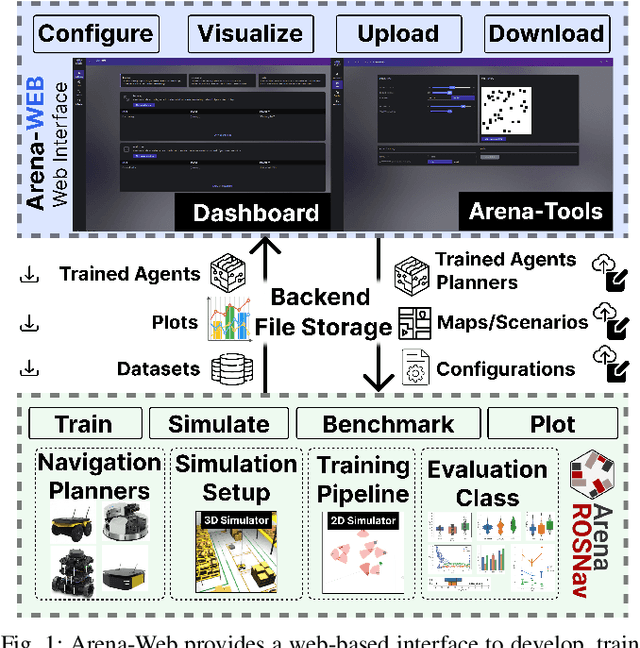
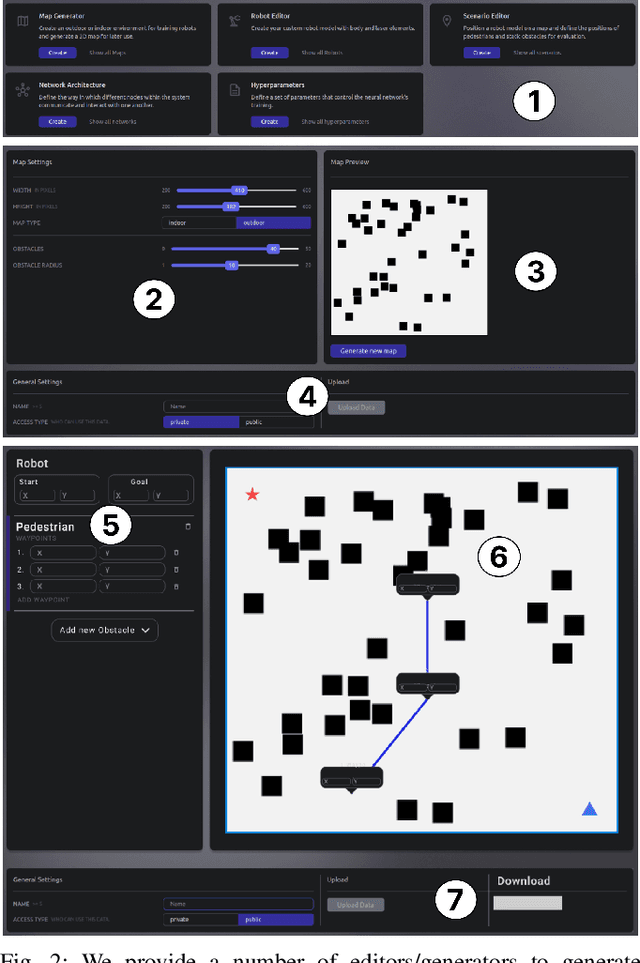
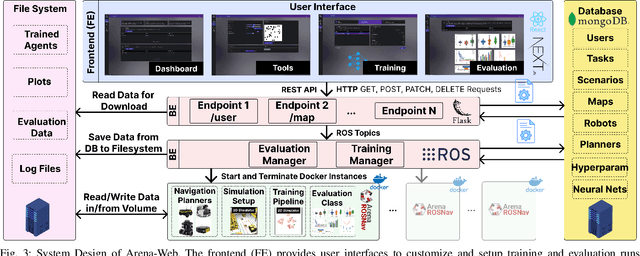
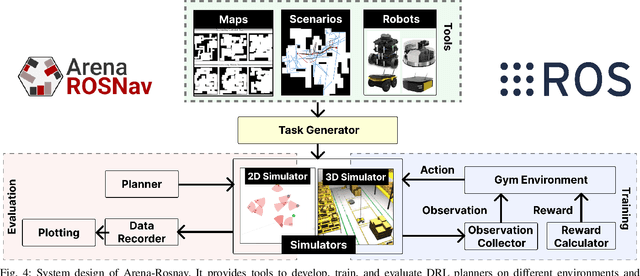
In recent years, mobile robot navigation approaches have become increasingly important due to various application areas ranging from healthcare to warehouse logistics. In particular, Deep Reinforcement Learning approaches have gained popularity for robot navigation but are not easily accessible to non-experts and complex to develop. In recent years, efforts have been made to make these sophisticated approaches accessible to a wider audience. In this paper, we present Arena-Web, a web-based development and evaluation suite for developing, training, and testing DRL-based navigation planners for various robotic platforms and scenarios. The interface is designed to be intuitive and engaging to appeal to non-experts and make the technology accessible to a wider audience. With Arena-Web and its interface, training and developing Deep Reinforcement Learning agents is simplified and made easy without a single line of code. The web-app is free to use and openly available under the link stated in the supplementary materials.
Holistic Deep-Reinforcement-Learning-based Training of Autonomous Navigation Systems
Feb 06, 2023


In recent years, Deep Reinforcement Learning emerged as a promising approach for autonomous navigation of ground vehicles and has been utilized in various areas of navigation such as cruise control, lane changing, or obstacle avoidance. However, most research works either focus on providing an end-to-end solution training the whole system using Deep Reinforcement Learning or focus on one specific aspect such as local motion planning. This however, comes along with a number of problems such as catastrophic forgetfulness, inefficient navigation behavior, and non-optimal synchronization between different entities of the navigation stack. In this paper, we propose a holistic Deep Reinforcement Learning training approach in which the training procedure is involving all entities of the navigation stack. This should enhance the synchronization between- and understanding of all entities of the navigation stack and as a result, improve navigational performance. We trained several agents with a number of different observation spaces to study the impact of different input on the navigation behavior of the agent. In profound evaluations against multiple learning-based and classic model-based navigation approaches, our proposed agent could outperform the baselines in terms of efficiency and safety attaining shorter path lengths, less roundabout paths, and less collisions.
Deep-Reinforcement-Learning-based Path Planning for Industrial Robots using Distance Sensors as Observation
Jan 14, 2023Industrial robots are widely used in various manufacturing environments due to their efficiency in doing repetitive tasks such as assembly or welding. A common problem for these applications is to reach a destination without colliding with obstacles or other robot arms. Commonly used sampling-based path planning approaches such as RRT require long computation times, especially in complex environments. Furthermore, the environment in which they are employed needs to be known beforehand. When utilizing the approaches in new environments, a tedious engineering effort in setting hyperparameters needs to be conducted, which is time- and cost-intensive. On the other hand, Deep Reinforcement Learning has shown remarkable results in dealing with unknown environments, generalizing new problem instances, and solving motion planning problems efficiently. On that account, this paper proposes a Deep-Reinforcement-Learning-based motion planner for robotic manipulators. We evaluated our model against state-of-the-art sampling-based planners in several experiments. The results show the superiority of our planner in terms of path length and execution time.