 Add to Chrome
 Add to Firefox
 Add to Edge
GROVE: Grounded Pedestrian Simulation via Natural Language for Interactive Social Robot Navigation
Jun 24, 2026
Pedestrian simulation is a critical component for training and deploying social robot navigation approaches, yet it remains a largely rigid system that repeatedly requires manual data generation to define even simple scenarios. We propose GROVE, a text-to-scenario pedestrian simulation framework that combines state-of-the-art approaches to produce realistic, socially challenging scenarios for social robot navigation. Our framework allows users to customize one of several common presets (emergency, queuing, normal) or even enter a fully independent prompt to generate a highly customizable pedestrian simulation. Multiple modules separately ensure the realism and soundness of long-horizon human behavior, medium-horizon pedestrian navigation, and short-horizon robot/social interactions. Each module is tuned by the prompt in a way that reflects the user intent across all aspects of pedestrian simulation. By dynamically selecting one of several state-of-the-art (SotA) approaches in our modules based on the scenario, we capture many situational nuances of pedestrian behavior in order to narrow the simulation-to-real (sim2real) gap. The human simulation is directly integrated into Isaac Sim, Gazebo, and RViz simulators for robot deployment in highly social environments. We validate our approach through qualitative comparison against existing pedestrian simulation baselines across scenarios of varying complexity in residential, hospital, and office environments. The result is a high-fidelity pedestrian simulation that challenges social robot navigation with complex, diverse, realistic human behaviors.

Arena-Web -- A Web-based Development and Benchmarking Platform for Autonomous Navigation Approaches
Feb 06, 2023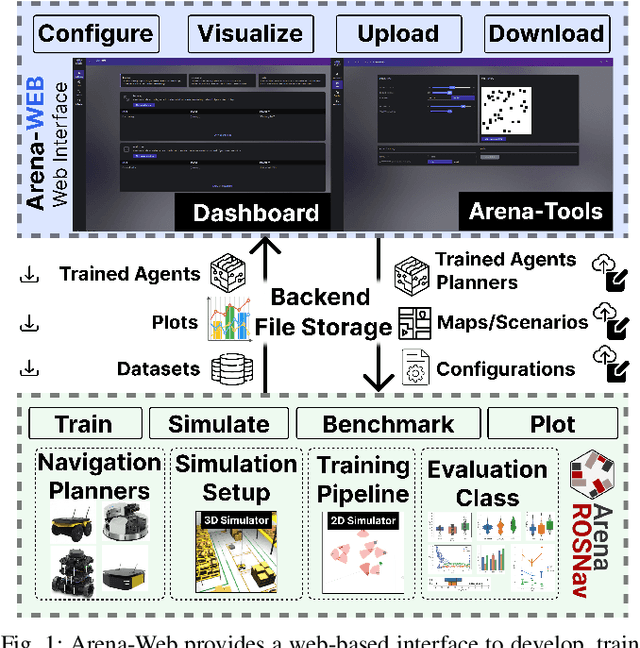
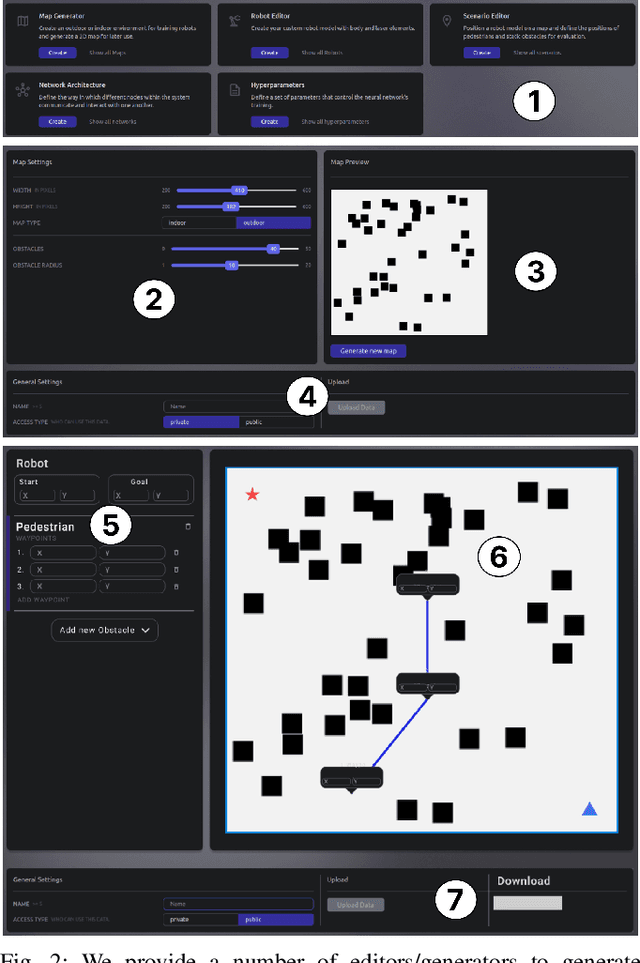
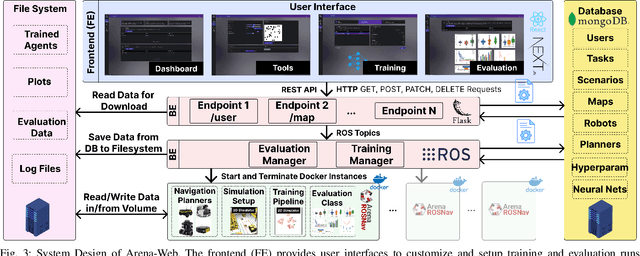
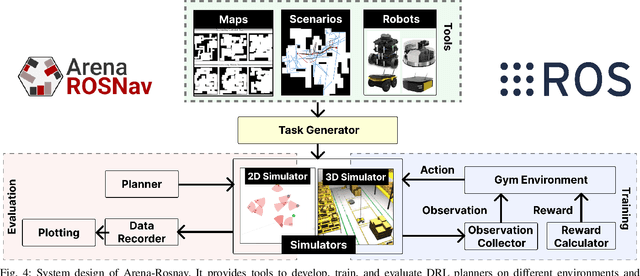
In recent years, mobile robot navigation approaches have become increasingly important due to various application areas ranging from healthcare to warehouse logistics. In particular, Deep Reinforcement Learning approaches have gained popularity for robot navigation but are not easily accessible to non-experts and complex to develop. In recent years, efforts have been made to make these sophisticated approaches accessible to a wider audience. In this paper, we present Arena-Web, a web-based development and evaluation suite for developing, training, and testing DRL-based navigation planners for various robotic platforms and scenarios. The interface is designed to be intuitive and engaging to appeal to non-experts and make the technology accessible to a wider audience. With Arena-Web and its interface, training and developing Deep Reinforcement Learning agents is simplified and made easy without a single line of code. The web-app is free to use and openly available under the link stated in the supplementary materials.