 Add to Chrome
 Add to Firefox
 Add to Edge
D3D-GEN: Robot-Aware Domain-Grounded Interactive 3D World Generation for Social Robotics
Aug 12, 2026
Training and validation of Embodied AI for social navigation critically depends on realistic simulation environments, yet many current approaches fail to find a balance between realism and simulability. We propose D3D-GEN, a novel world generation system that combines a domain agent with a retrieval-augmented generation (RAG) pipeline grounded in that domain. Our system enables users to rapidly generate domain-grounded, fully interactive 3D worlds by automating both the collection of domain knowledge and the synthesis of realistic floorplans and object placements, without dependence on any fixed 3D model database. Given a domain description prompt, the research agent collects publicly accessible domain-specific data and constructs a persistent domain database. Using this database, our RAG pipeline generates plausible floorplans and object placements by dynamically querying a user-provided semantic database, which can be easily extended or modified. The output is a fully interactive 3D world loadable by the popular simulators Isaac Sim and Gazebo. With our approach, we have built databases for several common domains (indoor residential, hospital, office) and generated dozens of distinct, plausible simulation environments for each domain. We present D3D-GEN with a local web frontend that facilitates rapid, interactive world generation for robot simulation.

GROVE: Grounded Pedestrian Simulation via Natural Language for Interactive Social Robot Navigation
Jun 24, 2026Pedestrian simulation is a critical component for training and deploying social robot navigation approaches, yet it remains a largely rigid system that repeatedly requires manual data generation to define even simple scenarios. We propose GROVE, a text-to-scenario pedestrian simulation framework that combines state-of-the-art approaches to produce realistic, socially challenging scenarios for social robot navigation. Our framework allows users to customize one of several common presets (emergency, queuing, normal) or even enter a fully independent prompt to generate a highly customizable pedestrian simulation. Multiple modules separately ensure the realism and soundness of long-horizon human behavior, medium-horizon pedestrian navigation, and short-horizon robot/social interactions. Each module is tuned by the prompt in a way that reflects the user intent across all aspects of pedestrian simulation. By dynamically selecting one of several state-of-the-art (SotA) approaches in our modules based on the scenario, we capture many situational nuances of pedestrian behavior in order to narrow the simulation-to-real (sim2real) gap. The human simulation is directly integrated into Isaac Sim, Gazebo, and RViz simulators for robot deployment in highly social environments. We validate our approach through qualitative comparison against existing pedestrian simulation baselines across scenarios of varying complexity in residential, hospital, and office environments. The result is a high-fidelity pedestrian simulation that challenges social robot navigation with complex, diverse, realistic human behaviors.
All-in-One: A DRL-based Control Switch Combining State-of-the-art Navigation Planners
Sep 23, 2021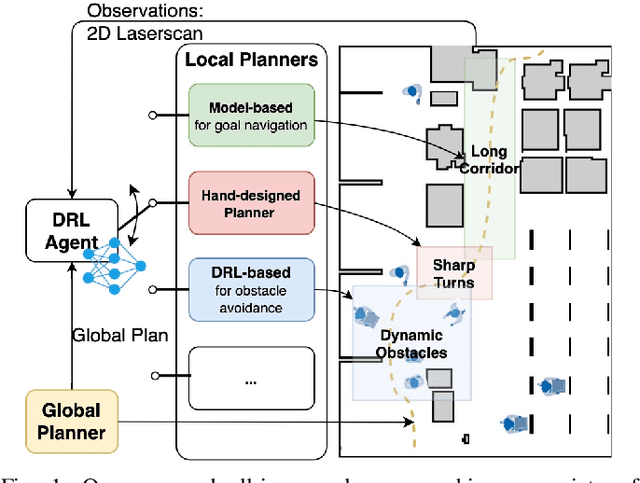
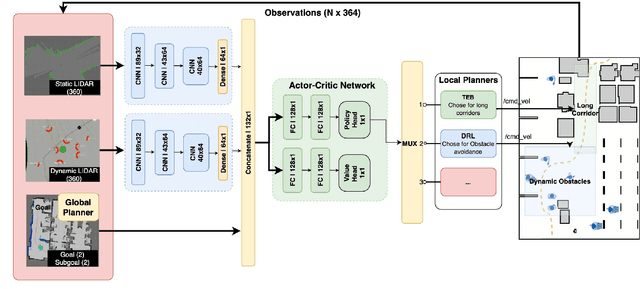
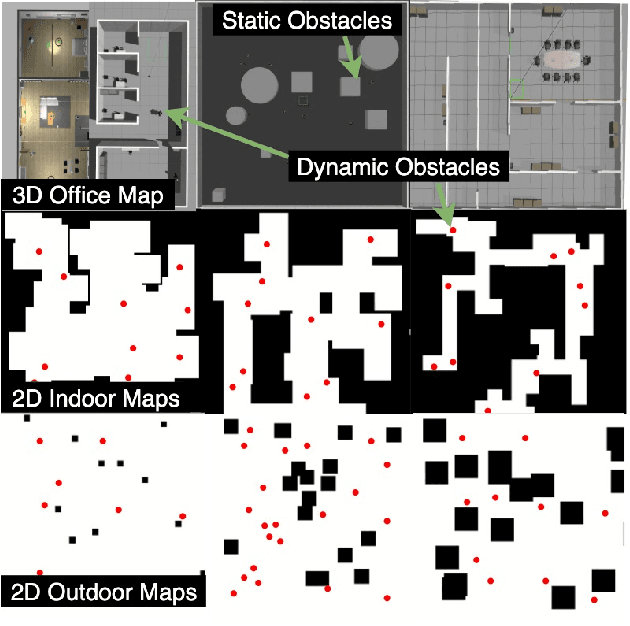
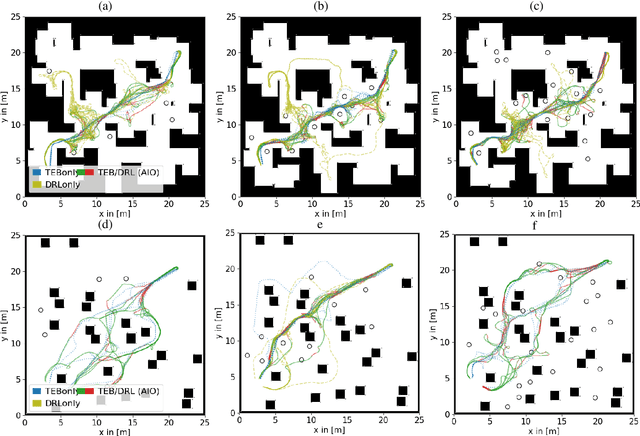
Autonomous navigation of mobile robots is an essential aspect in use cases such as delivery, assistance or logistics. Although traditional planning methods are well integrated into existing navigation systems, they struggle in highly dynamic environments. On the other hand, Deep-Reinforcement-Learning-based methods show superior performance in dynamic obstacle avoidance but are not suitable for long-range navigation and struggle with local minima. In this paper, we propose a Deep-Reinforcement-Learning-based control switch, which has the ability to select between different planning paradigms based solely on sensor data observations. Therefore, we develop an interface to efficiently operate multiple model-based, as well as learning-based local planners and integrate a variety of state-of-the-art planners to be selected by the control switch. Subsequently, we evaluate our approach against each planner individually and found improvements in navigation performance especially for highly dynamic scenarios. Our planner was able to prefer learning-based approaches in situations with a high number of obstacles while relying on the traditional model-based planners in long corridors or empty spaces.
Connecting Deep-Reinforcement-Learning-based Obstacle Avoidance with Conventional Global Planners using Waypoint Generators
Apr 08, 2021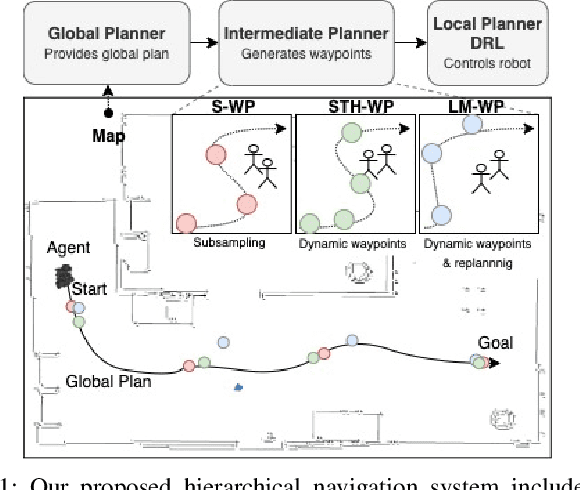
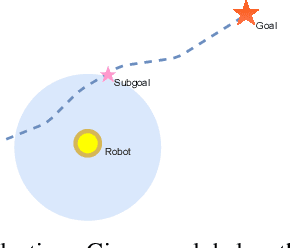
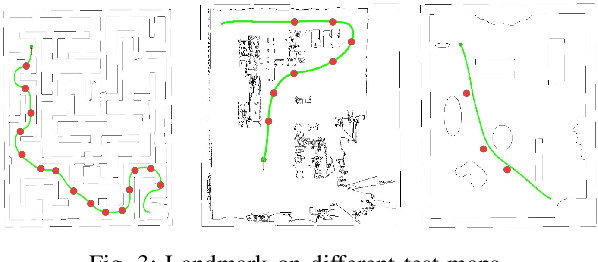
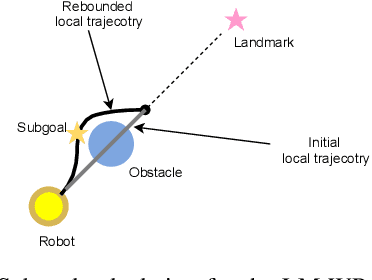
Deep Reinforcement Learning has emerged as an efficient dynamic obstacle avoidance method in highly dynamic environments. It has the potential to replace overly conservative or inefficient navigation approaches. However, the integration of Deep Reinforcement Learning into existing navigation systems is still an open frontier due to the myopic nature of Deep-Reinforcement-Learning-based navigation, which hinders its widespread integration into current navigation systems. In this paper, we propose the concept of an intermediate planner to interconnect novel Deep-Reinforcement-Learning-based obstacle avoidance with conventional global planning methods using waypoint generation. Therefore, we integrate different waypoint generators into existing navigation systems and compare the joint system against traditional ones. We found an increased performance in terms of safety, efficiency and path smoothness especially in highly dynamic environments.
Towards Deployment of Deep-Reinforcement-Learning-Based Obstacle Avoidance into Conventional Autonomous Navigation Systems
Apr 08, 2021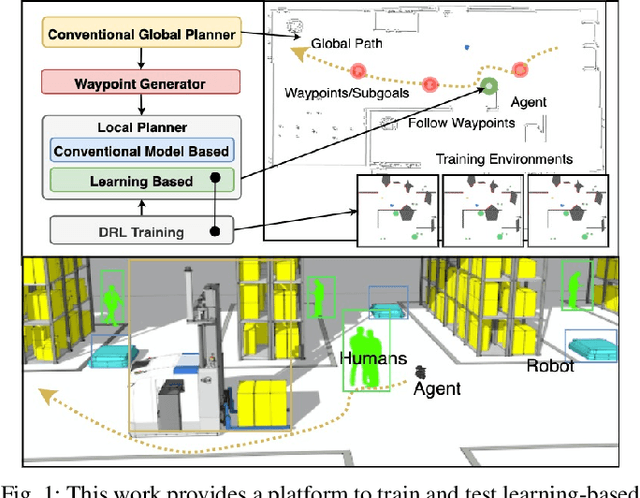
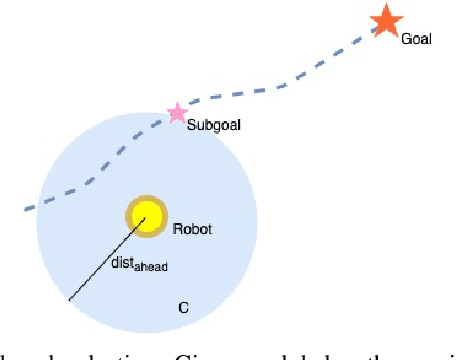
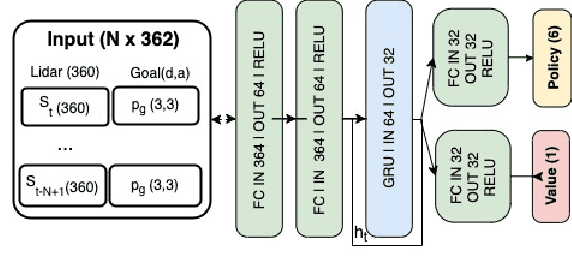
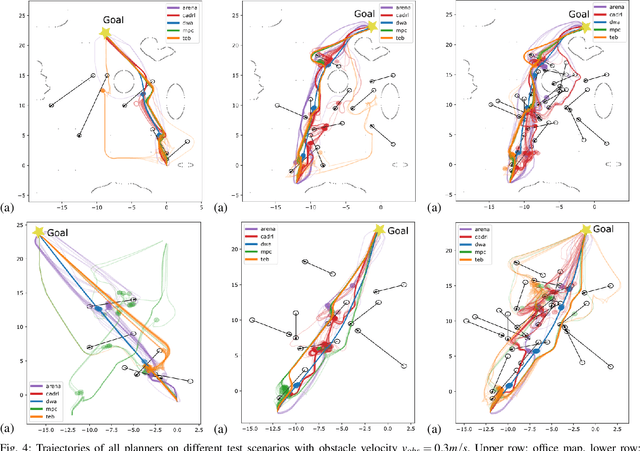
Recently, mobile robots have become important tools in various industries, especially in logistics. Deep reinforcement learning emerged as an alternative planning method to replace overly conservative approaches and promises more efficient and flexible navigation. However, deep reinforcement learning approaches are not suitable for long-range navigation due to their proneness to local minima and lack of long term memory, which hinders its widespread integration into industrial applications of mobile robotics. In this paper, we propose a navigation system incorporating deep-reinforcement-learning-based local planners into conventional navigation stacks for long-range navigation. Therefore, a framework for training and testing the deep reinforcement learning algorithms along with classic approaches is presented. We evaluated our deep-reinforcement-learning-enhanced navigation system against various conventional planners and found that our system outperforms them in terms of safety, efficiency and robustness.