 Add to Chrome
 Add to Firefox
 Add to Edge
Toward Scalable Terminal Task Synthesis via Skill Graphs
Apr 28, 2026
Terminal agents have demonstrated strong potential for autonomous command-line execution, yet their training remains constrained by the scarcity of high-quality and diverse execution trajectories. Existing approaches mitigate this bottleneck by synthesizing large-scale terminal task instances for trajectory sampling. However, they primarily focus on scaling the number of tasks while providing limited control over the diversity of execution trajectories that agents actually experience during training. In this paper, we present SkillSynth, an automated framework for terminal task synthesis built on a scenario-mediated skill graph. SkillSynth first constructs a large-scale skill graph, where scenarios serve as intermediate transition nodes that connect diverse command-line skills. It then samples paths from this graph as abstractions of real-world workflows, and uses a multi-agent harness to instantiate them into executable task instances. By grounding task synthesis in graph-sampled workflow paths, SkillSynth explicitly controls the diversity of minimal execution trajectories required to solve the synthesized tasks. Experiments on Terminal-Bench demonstrate the effectiveness of SkillSynth. Moreover, task instances synthesized by SkillSynth have been adopted to train Hy3 Preview, contributing to its enhanced agentic capabilities in terminal-based settings.

HY-World 2.0: A Multi-Modal World Model for Reconstructing, Generating, and Simulating 3D Worlds
Apr 15, 2026We introduce HY-World 2.0, a multi-modal world model framework that advances our prior project HY-World 1.0. HY-World 2.0 accommodates diverse input modalities, including text prompts, single-view images, multi-view images, and videos, and produces 3D world representations. With text or single-view image inputs, the model performs world generation, synthesizing high-fidelity, navigable 3D Gaussian Splatting (3DGS) scenes. This is achieved through a four-stage method: a) Panorama Generation with HY-Pano 2.0, b) Trajectory Planning with WorldNav, c) World Expansion with WorldStereo 2.0, and d) World Composition with WorldMirror 2.0. Specifically, we introduce key innovations to enhance panorama fidelity, enable 3D scene understanding and planning, and upgrade WorldStereo, our keyframe-based view generation model with consistent memory. We also upgrade WorldMirror, a feed-forward model for universal 3D prediction, by refining model architecture and learning strategy, enabling world reconstruction from multi-view images or videos. Also, we introduce WorldLens, a high-performance 3DGS rendering platform featuring a flexible engine-agnostic architecture, automatic IBL lighting, efficient collision detection, and training-rendering co-design, enabling interactive exploration of 3D worlds with character support. Extensive experiments demonstrate that HY-World 2.0 achieves state-of-the-art performance on several benchmarks among open-source approaches, delivering results comparable to the closed-source model Marble. We release all model weights, code, and technical details to facilitate reproducibility and support further research on 3D world models.
SWE-Bench++: A Framework for the Scalable Generation of Software Engineering Benchmarks from Open-Source Repositories
Dec 19, 2025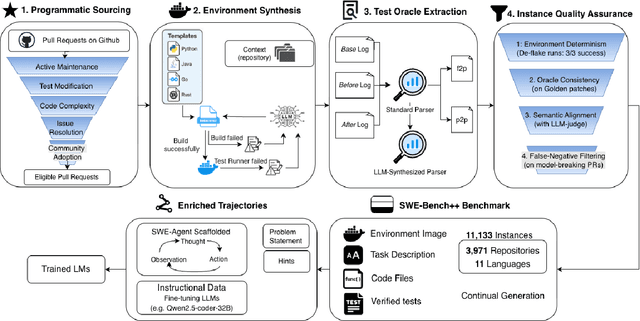
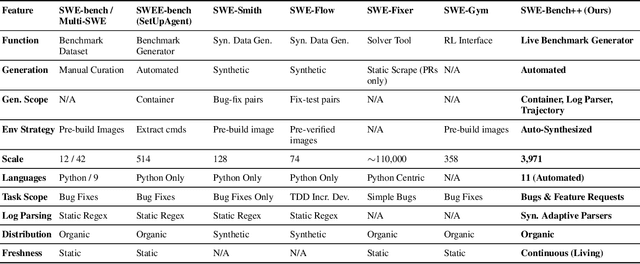

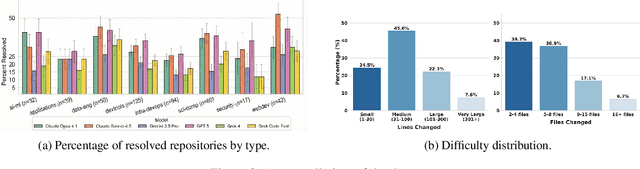
Benchmarks like SWE-bench have standardized the evaluation of Large Language Models (LLMs) on repository-level software engineering tasks. However, these efforts remain limited by manual curation, static datasets, and a focus on Python-based bug fixes. We introduce SWE-Bench++, an automated framework that generates repository-level coding tasks from open-source GitHub projects. Unlike synthetic approaches, our pipeline harvests live pull requests to cover both bug fixes and feature requests across 11 languages. SWE-Bench++ turns GitHub pull requests (PRs) into reproducible, execution-based tasks via four stages: programmatic sourcing, environment synthesis, test oracle extraction, and quality assurance. A final hint-guided trajectory synthesis step converts instances that strong models fail on into training trajectories. Our initial benchmark consists of 11,133 instances from 3,971 repositories across 11 languages. On a subset of 1,782 instances of this benchmark, today's strongest models perform as follows: claude-sonnet-4.5 achieves 36.20% pass@10, gpt-5-2025-08-07 34.57%, gemini/gemini-2.5-pro 24.92%, and gpt-4o 16.89%. We further demonstrate the utility of our dataset by showing that fine-tuning on SWE-Bench++ instances yields measurable improvements on the SWE-bench Multilingual benchmark. SWE-Bench++ provides a scalable, multilingual benchmark for evaluating and improving repository-level code generation.
Guardians of Discourse: Evaluating LLMs on Multilingual Offensive Language Detection
Oct 21, 2024


Identifying offensive language is essential for maintaining safety and sustainability in the social media era. Though large language models (LLMs) have demonstrated encouraging potential in social media analytics, they lack thorough evaluation when in offensive language detection, particularly in multilingual environments. We for the first time evaluate multilingual offensive language detection of LLMs in three languages: English, Spanish, and German with three LLMs, GPT-3.5, Flan-T5, and Mistral, in both monolingual and multilingual settings. We further examine the impact of different prompt languages and augmented translation data for the task in non-English contexts. Furthermore, we discuss the impact of the inherent bias in LLMs and the datasets in the mispredictions related to sensitive topics.