 Add to Chrome
 Add to Firefox
 Add to Edge
Faster-WAM: Do World Action Models Need Deep Action Modules?
Aug 03, 2026
World Action Models (WAMs) couple robot action prediction with video world models. Existing WAMs with shared-backbone and Mixture-of-Transformers designs generally tie the depth of the action module to that of the video backbone, resulting in substantial computational overhead and high inference latency. To address this limitation, we introduce Dock of Transformer (DoT), a video-centric design principle that treats a pretrained video Transformer as a representation hub and connects lightweight output-heads through docking interfaces. This enables flexible output-head design while providing direct access to representations from all layers of the backbone. We then introduce \textbf{Faster-WAM}, an instantiation of DoT for WAMs, which docks a single-layer action head onto a 30-layer video backbone. The docking interface fuses keys and values from all video layers and applies RoPE realignment. Without additional embodied pretraining, Faster-WAM achieves competitive performance on LIBERO and RoboTwin 2.0 while demonstrating strong out-of-distribution generalization on LIBERO-Plus. Faster-WAM also achieves the lowest end-to-end latency in our controlled comparison, requiring only 66.5 ms per inference --- a \(3.2\times\) speedup over Fast-WAM. Overall, these results demonstrate that the video-centric DoT architecture supports flexible task-specific head design while delivering low inference latency, strong action-prediction performance, and robust generalization.

FinSAgent: Corpus-Aligned Multi-Agent RAG Framework for Evidence-Grounded SEC Filing Question Answering
Jul 21, 2026Financial question answering over U.S. Securities and Exchange Commission (SEC) filings requires retrieving and synthesizing heterogeneous evidence dispersed across long, standardized, and highly redundant disclosures. Existing retrieval-augmented and multi-agent systems typically derive retrieval queries directly from the user's question and rank candidates by semantic similarity. Together, these choices create prior-corpus misalignment: a mismatch between model priors and the target filings' structure, terminology, and evidence standards. As a result, query generation misses corpus-specific evidence, while semantic reranking favors topically similar but evidentially invalid false-positive chunks. We propose FinSAgent, an evidence-grounded multi-agent framework that reframes SEC filing QA as corpus-aligned retrieval planning and corrects both ends with a single principle: inject corpus-side conditioning wherever model priors would otherwise dominate. FinSAgent combines (1) role-specialized agents anchored to the mandated 10-K item structure, (2) database-aware query decomposition that conditions each agent's sub-queries on a lightweight, summary-level view of the local corpus, and (3) multi-path retrieval with a learned feature-gated reranker that separates evidential validity from semantic similarity. Across five offline financial QA benchmarks, FinSAgent improves retrieval coverage and answer correctness over strong single-agent and multi-agent baselines; in a three-arm randomized online experiment with 1,000 anonymous user ratings, it also receives higher scores than baselines.
Anticipate Before Acting: Future-State-Conditioned Vision-Language Navigation
Jul 20, 2026End-to-end vision-language navigation (VLN) with causal vision-language models can map instructions and egocentric observations directly to actions, but standard behavior cloning supervises only the next action and does not explicitly train the policy state to be predictive of future visual outcomes. We first ask a diagnostic question: if the policy is given an expert-trajectory future image as privileged input at training and testing time, is that additional visual evidence useful for choosing the current action? (These expert-trajectory future images are unavailable at test time in real deployment, so we use this setting only as a privileged-input diagnostic.) The answer is yes; this sanity check shows that future observations can provide rich, actionable cues. We then ask a deployable question: without accessing future images at inference, can we still benefit from future information by using a compressed future visual latent only as training supervision? We propose Future-State-Conditioned VLN (FSC-VLN), which adds a future-query token and aligns its hidden state to a frozen visual embedding $Δ$ steps ahead via a training-only target branch that is removed after training. On R2R val-unseen, FSC-VLN improves SR/OSR/SPL over a StreamVLN-style baseline under two training-data regimes, with larger gains on long-horizon episodes; ablations further support the dual-query design (separating future and action queries).
Rethinking Groups in Critic-Free RLVR
Jun 15, 2026Reinforcement learning (RL) has become a central paradigm for post-training large language models. Existing critic-free RL methods typically generate a group of rollouts for the same question to estimate value baselines for advantage computation. However, this design suffers from data inefficiency, group synchronization barriers, and inflexibility with structured rollouts. In this work, we revisit the role of the ``group'' and show that its underlying function is not merely to estimate baselines but to prevent false penalties on negative samples. Building on this insight, we propose negative token filtering, a simple and effective strategy that enables stable single-rollout training. We apply it to two batch-level advantage methods, achieving comparable performance on reasoning tasks and stronger performance on agentic tasks relative to group-based RL techniques.
TrasMuon: Trust-Region Adaptive Scaling for Orthogonalized Momentum Optimizers
Feb 13, 2026Muon-style optimizers leverage Newton-Schulz (NS) iterations to orthogonalize updates, yielding update geometries that often outperform Adam-series methods. However, this orthogonalization discards magnitude information, rendering training sensitive to step-size hyperparameters and vulnerable to high-energy bursts. To mitigate this, we introduce TrasMuon (\textbf{T}rust \textbf{R}egion \textbf{A}daptive \textbf{S}caling \textbf{Muon}). TrasMuon preserves the near-isometric geometry of Muon while stabilizing magnitudes through (i) global RMS calibration and (ii) energy-based trust-region clipping. We demonstrate that while reintroducing adaptive scaling improves optimization efficiency, it typically exacerbates instability due to high-energy outliers. TrasMuon addresses this by defining a trust region based on relative energy ratios, confining updates to a stable zone. Empirical experiments on vision and language models demonstrate that TrasMuon converges faster than baselines. Furthermore, experiments without warmup stages confirm TrasMuon's superior stability and robustness.
Enhancing TableQA through Verifiable Reasoning Trace Reward
Jan 30, 2026A major challenge in training TableQA agents, compared to standard text- and image-based agents, is that answers cannot be inferred from a static input but must be reasoned through stepwise transformations of the table state, introducing multi-step reasoning complexity and environmental interaction. This leads to a research question: Can explicit feedback on table transformation action improve model reasoning capability? In this work, we introduce RE-Tab, a plug-and-play framework that architecturally enhances trajectory search via lightweight, training-free reward modeling by formulating the problem as a Partially Observable Markov Decision Process. We demonstrate that providing explicit verifiable rewards during State Transition (``What is the best action?'') and Simulative Reasoning (``Am I sure about the output?'') is crucial to steer the agent's navigation in table states. By enforcing stepwise reasoning with reward feedback in table transformations, RE-Tab achieves state-of-the-art performance in TableQA with almost 25\% drop in inference cost. Furthermore, a direct plug-and-play implementation of RE-Tab brings up to 41.77% improvement in QA accuracy and 33.33% drop in test-time inference samples for consistent answer. Consistent improvement pattern across various LLMs and state-of-the-art benchmarks further confirms RE-Tab's generalisability. The repository is available at https://github.com/ThomasK1018/RE_Tab .
Dynamic Quantization Error Propagation in Encoder-Decoder ASR Quantization
Jan 05, 2026Running Automatic Speech Recognition (ASR) models on memory-constrained edge devices requires efficient compression. While layer-wise post-training quantization is effective, it suffers from error accumulation, especially in encoder-decoder architectures. Existing solutions like Quantization Error Propagation (QEP) are suboptimal for ASR due to the model's heterogeneity, processing acoustic features in the encoder while generating text in the decoder. To address this, we propose Fine-grained Alpha for Dynamic Quantization Error Propagation (FADE), which adaptively controls the trade-off between cross-layer error correction and local quantization. Experiments show that FADE significantly improves stability by reducing performance variance across runs, while simultaneously surpassing baselines in mean WER.
GraphPPD: Posterior Predictive Modelling for Graph-Level Inference
Aug 23, 2025Accurate modelling and quantification of predictive uncertainty is crucial in deep learning since it allows a model to make safer decisions when the data is ambiguous and facilitates the users' understanding of the model's confidence in its predictions. Along with the tremendously increasing research focus on \emph{graph neural networks} (GNNs) in recent years, there have been numerous techniques which strive to capture the uncertainty in their predictions. However, most of these approaches are specifically designed for node or link-level tasks and cannot be directly applied to graph-level learning problems. In this paper, we propose a novel variational modelling framework for the \emph{posterior predictive distribution}~(PPD) to obtain uncertainty-aware prediction in graph-level learning tasks. Based on a graph-level embedding derived from one of the existing GNNs, our framework can learn the PPD in a data-adaptive fashion. Experimental results on several benchmark datasets exhibit the effectiveness of our approach.
An Entity Linking Agent for Question Answering
Aug 05, 2025Some Question Answering (QA) systems rely on knowledge bases (KBs) to provide accurate answers. Entity Linking (EL) plays a critical role in linking natural language mentions to KB entries. However, most existing EL methods are designed for long contexts and do not perform well on short, ambiguous user questions in QA tasks. We propose an entity linking agent for QA, based on a Large Language Model that simulates human cognitive workflows. The agent actively identifies entity mentions, retrieves candidate entities, and makes decision. To verify the effectiveness of our agent, we conduct two experiments: tool-based entity linking and QA task evaluation. The results confirm the robustness and effectiveness of our agent.
SKOLR: Structured Koopman Operator Linear RNN for Time-Series Forecasting
Jun 17, 2025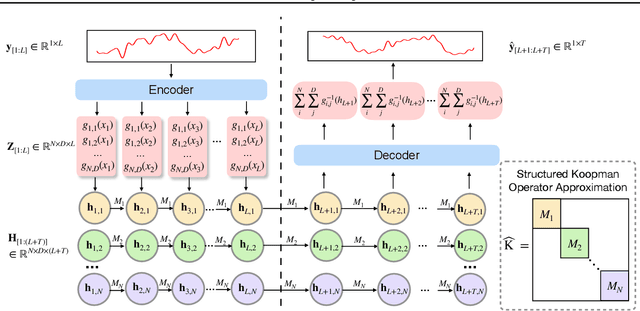
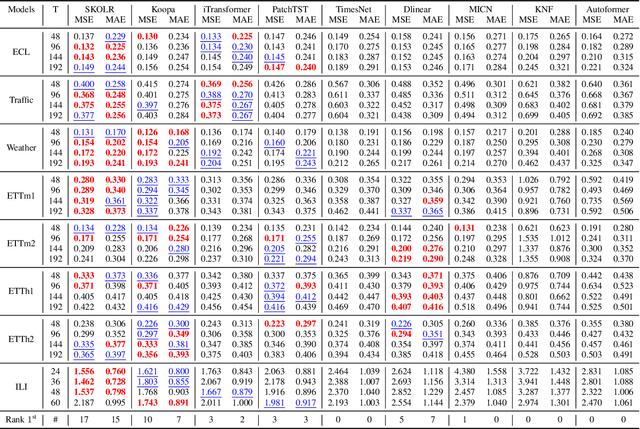
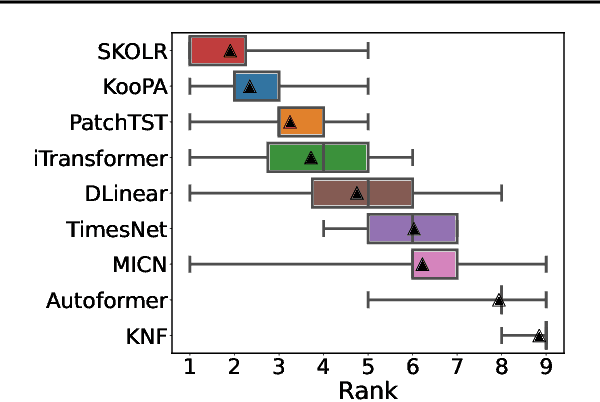

Koopman operator theory provides a framework for nonlinear dynamical system analysis and time-series forecasting by mapping dynamics to a space of real-valued measurement functions, enabling a linear operator representation. Despite the advantage of linearity, the operator is generally infinite-dimensional. Therefore, the objective is to learn measurement functions that yield a tractable finite-dimensional Koopman operator approximation. In this work, we establish a connection between Koopman operator approximation and linear Recurrent Neural Networks (RNNs), which have recently demonstrated remarkable success in sequence modeling. We show that by considering an extended state consisting of lagged observations, we can establish an equivalence between a structured Koopman operator and linear RNN updates. Building on this connection, we present SKOLR, which integrates a learnable spectral decomposition of the input signal with a multilayer perceptron (MLP) as the measurement functions and implements a structured Koopman operator via a highly parallel linear RNN stack. Numerical experiments on various forecasting benchmarks and dynamical systems show that this streamlined, Koopman-theory-based design delivers exceptional performance.