 Add to Chrome
 Add to Firefox
 Add to Edge
Faster-WAM: Do World Action Models Need Deep Action Modules?
Aug 03, 2026
World Action Models (WAMs) couple robot action prediction with video world models. Existing WAMs with shared-backbone and Mixture-of-Transformers designs generally tie the depth of the action module to that of the video backbone, resulting in substantial computational overhead and high inference latency. To address this limitation, we introduce Dock of Transformer (DoT), a video-centric design principle that treats a pretrained video Transformer as a representation hub and connects lightweight output-heads through docking interfaces. This enables flexible output-head design while providing direct access to representations from all layers of the backbone. We then introduce \textbf{Faster-WAM}, an instantiation of DoT for WAMs, which docks a single-layer action head onto a 30-layer video backbone. The docking interface fuses keys and values from all video layers and applies RoPE realignment. Without additional embodied pretraining, Faster-WAM achieves competitive performance on LIBERO and RoboTwin 2.0 while demonstrating strong out-of-distribution generalization on LIBERO-Plus. Faster-WAM also achieves the lowest end-to-end latency in our controlled comparison, requiring only 66.5 ms per inference --- a \(3.2\times\) speedup over Fast-WAM. Overall, these results demonstrate that the video-centric DoT architecture supports flexible task-specific head design while delivering low inference latency, strong action-prediction performance, and robust generalization.

Ergodic Generative Flows
May 06, 2025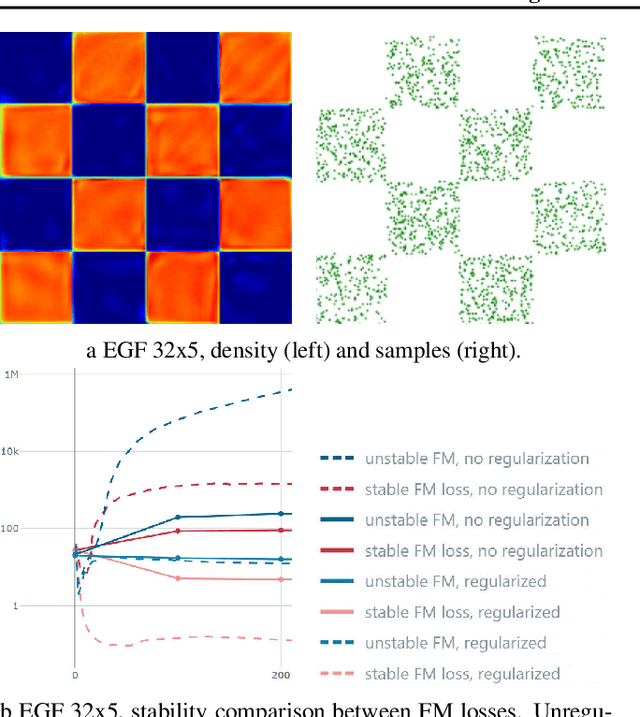
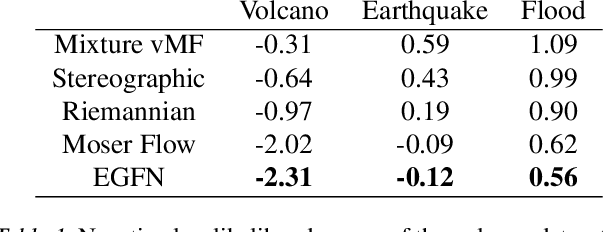
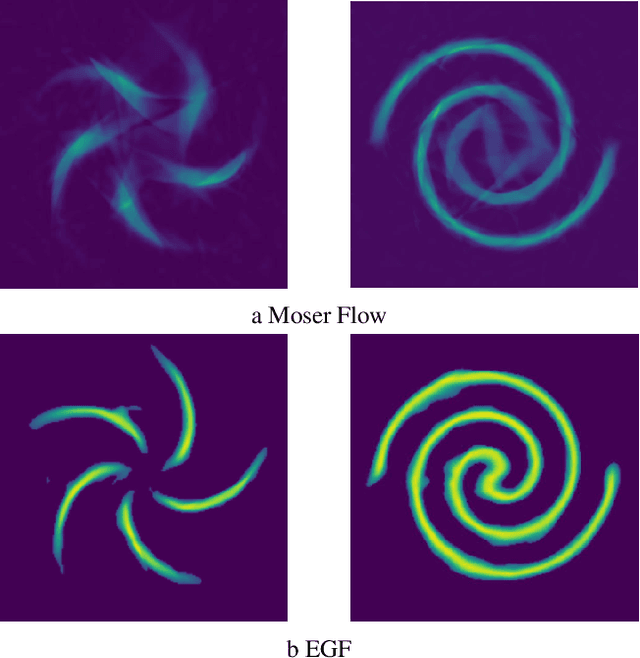
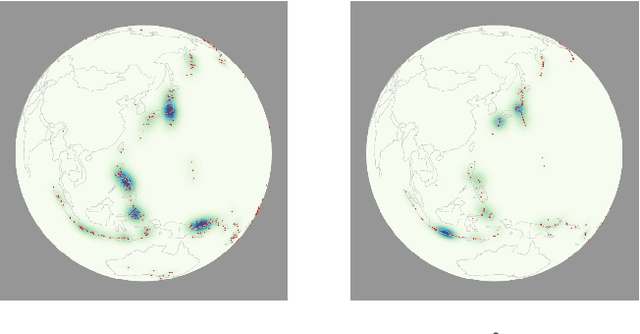
Generative Flow Networks (GFNs) were initially introduced on directed acyclic graphs to sample from an unnormalized distribution density. Recent works have extended the theoretical framework for generative methods allowing more flexibility and enhancing application range. However, many challenges remain in training GFNs in continuous settings and for imitation learning (IL), including intractability of flow-matching loss, limited tests of non-acyclic training, and the need for a separate reward model in imitation learning. The present work proposes a family of generative flows called Ergodic Generative Flows (EGFs) which are used to address the aforementioned issues. First, we leverage ergodicity to build simple generative flows with finitely many globally defined transformations (diffeomorphisms) with universality guarantees and tractable flow-matching loss (FM loss). Second, we introduce a new loss involving cross-entropy coupled to weak flow-matching control, coined KL-weakFM loss. It is designed for IL training without a separate reward model. We evaluate IL-EGFs on toy 2D tasks and real-world datasets from NASA on the sphere, using the KL-weakFM loss. Additionally, we conduct toy 2D reinforcement learning experiments with a target reward, using the FM loss.