 Add to Chrome
 Add to Firefox
 Add to Edge
Rethinking Groups in Critic-Free RLVR
Jun 15, 2026
Reinforcement learning (RL) has become a central paradigm for post-training large language models. Existing critic-free RL methods typically generate a group of rollouts for the same question to estimate value baselines for advantage computation. However, this design suffers from data inefficiency, group synchronization barriers, and inflexibility with structured rollouts. In this work, we revisit the role of the ``group'' and show that its underlying function is not merely to estimate baselines but to prevent false penalties on negative samples. Building on this insight, we propose negative token filtering, a simple and effective strategy that enables stable single-rollout training. We apply it to two batch-level advantage methods, achieving comparable performance on reasoning tasks and stronger performance on agentic tasks relative to group-based RL techniques.

MetaGPT: Meta Programming for Multi-Agent Collaborative Framework
Aug 17, 2023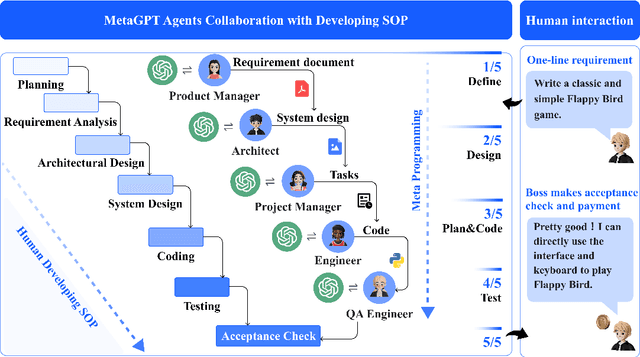
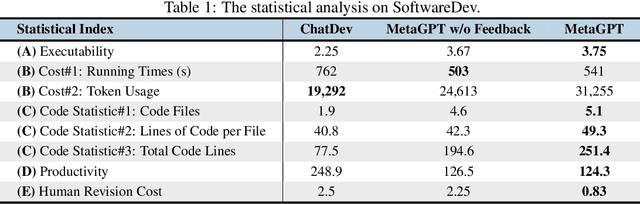
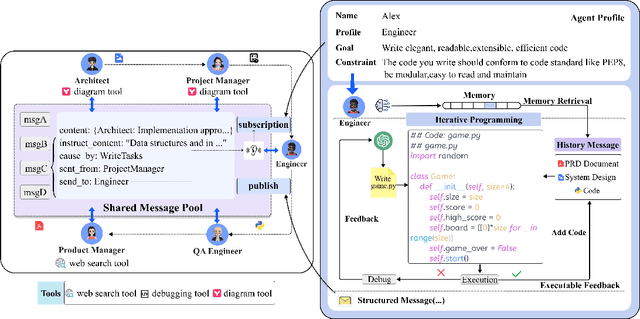
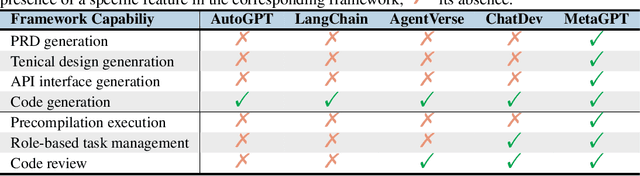
Recently, remarkable progress has been made in automated task-solving through the use of multi-agent driven by large language models (LLMs). However, existing LLM-based multi-agent works primarily focus on solving simple dialogue tasks, and complex tasks are rarely studied, mainly due to the LLM hallucination problem. This type of hallucination becomes cascading when naively chaining multiple intelligent agents, resulting in a failure to effectively address complex problems. Therefore, we introduce MetaGPT, an innovative framework that incorporates efficient human workflows as a meta programming approach into LLM-based multi-agent collaboration. Specifically, MetaGPT encodes Standardized Operating Procedures (SOPs) into prompts to enhance structured coordination. Subsequently, it mandates modular outputs, empowering agents with domain expertise comparable to human professionals, to validate outputs and minimize compounded errors. In this way, MetaGPT leverages the assembly line paradigm to assign diverse roles to various agents, thereby establishing a framework that can effectively and cohesively deconstruct complex multi-agent collaborative problems. Our experiments on collaborative software engineering benchmarks demonstrate that MetaGPT generates more coherent and correct solutions compared to existing chat-based multi-agent systems. This highlights the potential of integrating human domain knowledge into multi-agent systems, thereby creating new opportunities to tackle complex real-world challenges. The GitHub repository of this project is publicly available on:https://github.com/geekan/MetaGPT.