 Add to Chrome
 Add to Firefox
 Add to Edge
Learning During Detection: Continual Learning for Neural OFDM Receivers via DMRS
Feb 23, 2026
Deep neural networks (DNNs) have been increasingly explored for receiver design because they can handle complex environments without relying on explicit channel models. Nevertheless, because communication channels change rapidly, their distributions can shift over time, often making periodic retraining necessary. This paper proposes a zero-overhead online and continual learning framework for orthogonal frequency-division multiplexing (OFDM) neural receivers that directly detect the soft bits of received signals. Unlike conventional fine-tuning methods that rely on dedicated training intervals or full resource grids, our approach leverages existing demodulation reference signals (DMRS) to simultaneously enable signal demodulation and model adaptation. We introduce three pilot designs: fully randomized, hybrid, and additional pilots that flexibly support joint demodulation and learning. To accommodate these pilot designs, we develop two receiver architectures: (i) a parallel design that separates inference and fine-tuning for uninterrupted operation, and (ii) a forward-pass reusing design that reduces computational complexity. Simulation results show that the proposed method effectively tracks both slow and fast channel distribution variations without additional overhead, service interruption, or catastrophic performance degradation under distribution shift.

TrasMuon: Trust-Region Adaptive Scaling for Orthogonalized Momentum Optimizers
Feb 13, 2026Muon-style optimizers leverage Newton-Schulz (NS) iterations to orthogonalize updates, yielding update geometries that often outperform Adam-series methods. However, this orthogonalization discards magnitude information, rendering training sensitive to step-size hyperparameters and vulnerable to high-energy bursts. To mitigate this, we introduce TrasMuon (\textbf{T}rust \textbf{R}egion \textbf{A}daptive \textbf{S}caling \textbf{Muon}). TrasMuon preserves the near-isometric geometry of Muon while stabilizing magnitudes through (i) global RMS calibration and (ii) energy-based trust-region clipping. We demonstrate that while reintroducing adaptive scaling improves optimization efficiency, it typically exacerbates instability due to high-energy outliers. TrasMuon addresses this by defining a trust region based on relative energy ratios, confining updates to a stable zone. Empirical experiments on vision and language models demonstrate that TrasMuon converges faster than baselines. Furthermore, experiments without warmup stages confirm TrasMuon's superior stability and robustness.
CoDiPhy: A General Framework for Applying Denoising Diffusion Models to the Physical Layer of Wireless Communication Systems
Mar 13, 2025
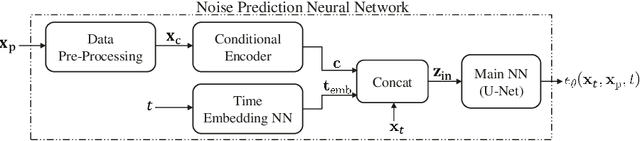
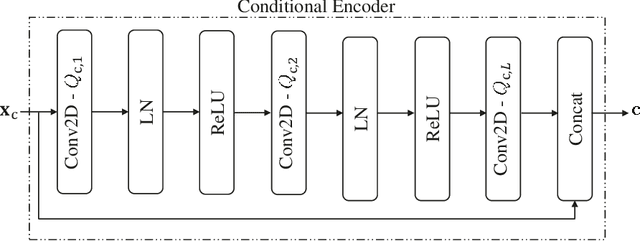
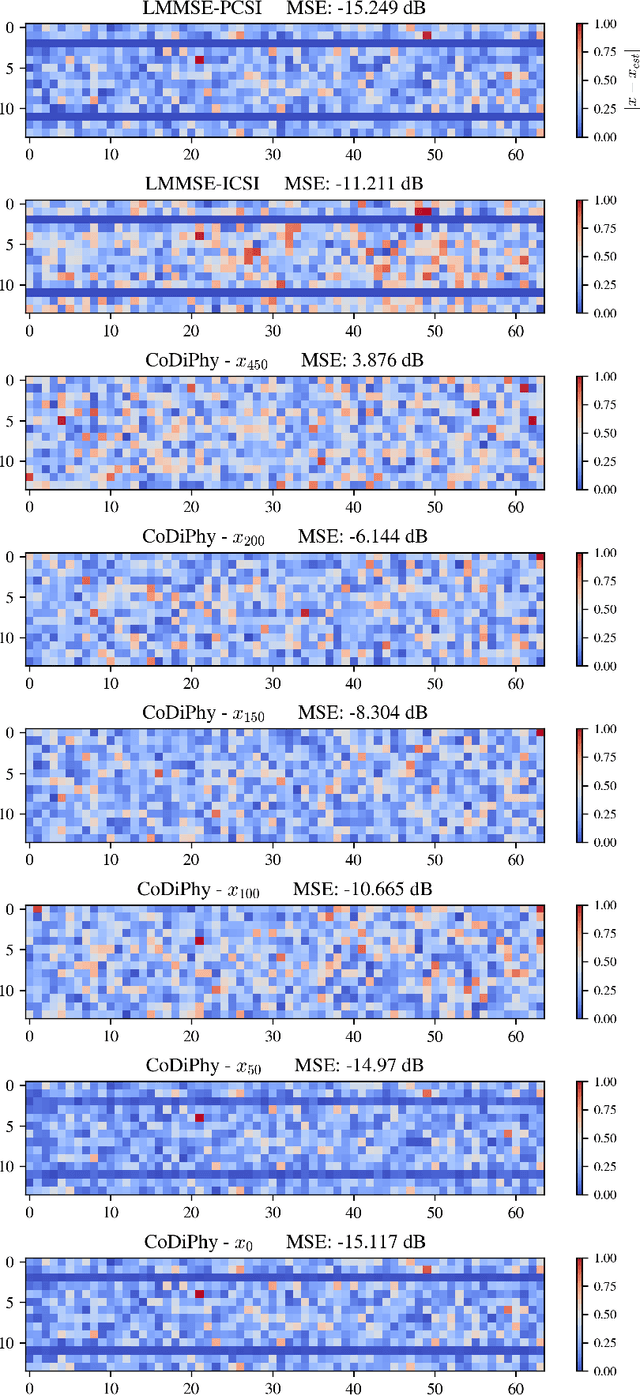
Generative models, including denoising diffusion models (DM), are gaining attention in wireless applications due to their ability to learn complex data distributions. In this paper, we propose CoDiPhy, a novel framework that leverages conditional denoising diffusion models to address a wide range of wireless physical layer problems. A key challenge of using DM is the need to assume or approximate Gaussian signal models. CoDiPhy addresses this by incorporating a conditional encoder as a guidance mechanism, mapping problem observations to a latent space and removing the Gaussian constraint. By combining conditional encoding, time embedding layers, and a U-Net-based main neural network, CoDiPhy introduces a noise prediction neural network, replacing the conventional approach used in DM. This adaptation enables CoDiPhy to serve as an effective solution for a wide range of detection, estimation, and predistortion tasks. We demonstrate CoDiPhy's adaptability through two case studies: an OFDM receiver for detection and phase noise compensation for estimation. In both cases, CoDiPhy outperforms conventional methods by a significant margin.
DynamicLip: Shape-Independent Continuous Authentication via Lip Articulator Dynamics
Jan 02, 2025Biometrics authentication has become increasingly popular due to its security and convenience; however, traditional biometrics are becoming less desirable in scenarios such as new mobile devices, Virtual Reality, and Smart Vehicles. For example, while face authentication is widely used, it suffers from significant privacy concerns. The collection of complete facial data makes it less desirable for privacy-sensitive applications. Lip authentication, on the other hand, has emerged as a promising biometrics method. However, existing lip-based authentication methods heavily depend on static lip shape when the mouth is closed, which can be less robust due to lip shape dynamic motion and can barely work when the user is speaking. In this paper, we revisit the nature of lip biometrics and extract shape-independent features from the lips. We study the dynamic characteristics of lip biometrics based on articulator motion. Building on the knowledge, we propose a system for shape-independent continuous authentication via lip articulator dynamics. This system enables robust, shape-independent and continuous authentication, making it particularly suitable for scenarios with high security and privacy requirements. We conducted comprehensive experiments in different environments and attack scenarios and collected a dataset of 50 subjects. The results indicate that our system achieves an overall accuracy of 99.06% and demonstrates robustness under advanced mimic attacks and AI deepfake attacks, making it a viable solution for continuous biometric authentication in various applications.