 Add to Chrome
 Add to Firefox
 Add to Edge
Characterizing initial human-AI proof formalization workflows
Jun 02, 2026
For centuries, human mathematicians have written proofs to substantiate their mathematical arguments; yet, the ability to automatically verify the validity of proofs has long been a challenge. Advances in AI systems' ability to generate code and engage in increasingly high-level mathematical reasoning promise to transform people's ability to formalize and thereby verify proofs. While many works focus on benchmarking the current frontier, we instead study how people use these tools. We conduct a mixed-methods analysis into the initial impact of AI on people's formalization workflows: what people claim they want, what they see as the barriers to those visions, and how they actually use and adapt AI in practice. A qualitative survey shows that people's preferences are diverse, but with a general desire for AI assistance in formalization that preserves high-level human control over the proof discovery process. To assess how people actually engage with AI for formalization under such limitations, we conduct a controlled user study in which participants formalize informal math problems and their proofs, with and without AI, across a range of mathematical problems at varying levels of difficulty and domains. Despite limitations of the tools at the time for autoformalization, participants tend to attain higher formalization accuracy when allowed access to AI tools than when formalizing on their own, with most participants flexibly choosing to use multiple different AI tools. Taken together, our work sheds light on the early stages of AI integration into formalization workflows, involving an intimate interplay of human and AI engagement.

Social-R1: Towards Human-like Social Reasoning in LLMs
Mar 10, 2026While large language models demonstrate remarkable capabilities across numerous domains, social intelligence - the capacity to perceive social cues, infer mental states, and generate appropriate responses - remains a critical challenge, particularly for enabling effective human-AI collaboration and developing AI that truly serves human needs. Current models often rely on superficial patterns rather than genuine social reasoning. We argue that cultivating human-like social intelligence requires training with challenging cases that resist shortcut solutions. To this end, we introduce ToMBench-Hard, an adversarial benchmark designed to provide hard training examples for social reasoning. Building on this, we propose Social-R1, a reinforcement learning framework that aligns model reasoning with human cognition through multi-dimensional rewards. Unlike outcome-based RL, Social-R1 supervises the entire reasoning process, enforcing structural alignment, logical integrity, and information density. Results show that our approach enables a 4B parameter model to surpass much larger counterparts and generalize robustly across eight diverse benchmarks. These findings demonstrate that challenging training cases with trajectory-level alignment offer a path toward efficient and reliable social intelligence.
Breaking Training Bottlenecks: Effective and Stable Reinforcement Learning for Coding Models
Mar 08, 2026Modern code generation models exhibit longer outputs, accelerated capability growth, and changed training dynamics, rendering traditional training methodologies, algorithms, and datasets ineffective for improving their performance. To address these training bottlenecks, we propose MicroCoder-GRPO, an improved Group Relative Policy Optimization approach with three innovations: conditional truncation masking to improve long output potential while maintaining training stability, diversity-determined temperature selection to maintain and encourage output diversity, and removal of KL loss with high clipping ratios to facilitate solution diversity. MicroCoder-GRPO achieves up to 17.6% relative improvement over strong baselines on LiveCodeBench v6, with more pronounced gains under extended context evaluation. Additionally, we release MicroCoder-Dataset, a more challenging training corpus that achieves 3x larger performance gains than mainstream datasets on LiveCodeBench v6 within 300 training steps, and MicroCoder-Evaluator, a robust framework with approximately 25% improved evaluation accuracy and around 40% faster execution. Through comprehensive analysis across more than thirty controlled experiments, we reveal 34 training insights across seven main aspects, demonstrating that properly trained models can achieve competitive performance with larger counterparts.
From Human-Level AI Tales to AI Leveling Human Scales
Feb 21, 2026Comparing AI models to "human level" is often misleading when benchmark scores are incommensurate or human baselines are drawn from a narrow population. To address this, we propose a framework that calibrates items against the 'world population' and report performance on a common, human-anchored scale. Concretely, we build on a set of multi-level scales for different capabilities where each level should represent a probability of success of the whole world population on a logarithmic scale with a base $B$. We calibrate each scale for each capability (reasoning, comprehension, knowledge, volume, etc.) by compiling publicly released human test data spanning education and reasoning benchmarks (PISA, TIMSS, ICAR, UKBioBank, and ReliabilityBench). The base $B$ is estimated by extrapolating between samples with two demographic profiles using LLMs, with the hypothesis that they condense rich information about human populations. We evaluate the quality of different mappings using group slicing and post-stratification. The new techniques allow for the recalibration and standardization of scales relative to the whole-world population.
General Scales Unlock AI Evaluation with Explanatory and Predictive Power
Mar 09, 2025Ensuring safe and effective use of AI requires understanding and anticipating its performance on novel tasks, from advanced scientific challenges to transformed workplace activities. So far, benchmarking has guided progress in AI, but it has offered limited explanatory and predictive power for general-purpose AI systems, given the low transferability across diverse tasks. In this paper, we introduce general scales for AI evaluation that can explain what common AI benchmarks really measure, extract ability profiles of AI systems, and predict their performance for new task instances, in- and out-of-distribution. Our fully-automated methodology builds on 18 newly-crafted rubrics that place instance demands on general scales that do not saturate. Illustrated for 15 large language models and 63 tasks, high explanatory power is unleashed from inspecting the demand and ability profiles, bringing insights on the sensitivity and specificity exhibited by different benchmarks, and how knowledge, metacognition and reasoning are affected by model size, chain-of-thought and distillation. Surprisingly, high predictive power at the instance level becomes possible using these demand levels, providing superior estimates over black-box baseline predictors based on embeddings or finetuning, especially in out-of-distribution settings (new tasks and new benchmarks). The scales, rubrics, battery, techniques and results presented here represent a major step for AI evaluation, underpinning the reliable deployment of AI in the years ahead.
PredictaBoard: Benchmarking LLM Score Predictability
Feb 20, 2025Despite possessing impressive skills, Large Language Models (LLMs) often fail unpredictably, demonstrating inconsistent success in even basic common sense reasoning tasks. This unpredictability poses a significant challenge to ensuring their safe deployment, as identifying and operating within a reliable "safe zone" is essential for mitigating risks. To address this, we present PredictaBoard, a novel collaborative benchmarking framework designed to evaluate the ability of score predictors (referred to as assessors) to anticipate LLM errors on specific task instances (i.e., prompts) from existing datasets. PredictaBoard evaluates pairs of LLMs and assessors by considering the rejection rate at different tolerance errors. As such, PredictaBoard stimulates research into developing better assessors and making LLMs more predictable, not only with a higher average performance. We conduct illustrative experiments using baseline assessors and state-of-the-art LLMs. PredictaBoard highlights the critical need to evaluate predictability alongside performance, paving the way for safer AI systems where errors are not only minimised but also anticipated and effectively mitigated. Code for our benchmark can be found at https://github.com/Kinds-of-Intelligence-CFI/PredictaBoard
An LLM Feature-based Framework for Dialogue Constructiveness Assessment
Jun 20, 2024
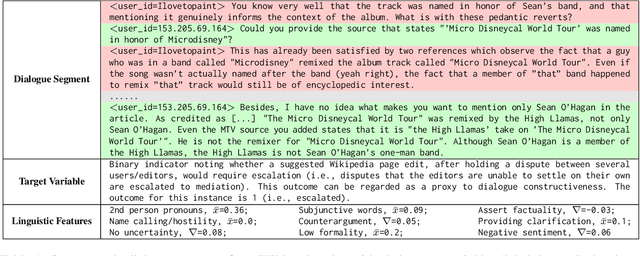
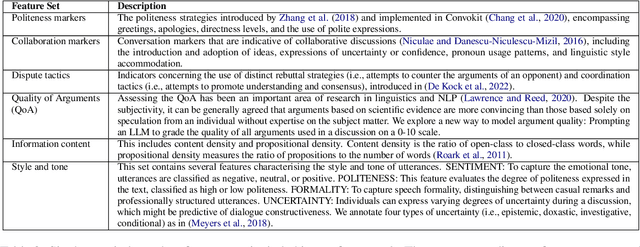
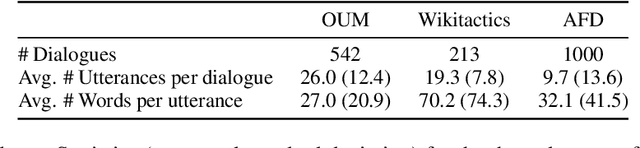
Research on dialogue constructiveness assessment focuses on (i) analysing conversational factors that influence individuals to take specific actions, win debates, change their perspectives or broaden their open-mindedness and (ii) predicting constructive outcomes following dialogues for such use cases. These objectives can be achieved by training either interpretable feature-based models (which often involve costly human annotations) or neural models such as pre-trained language models (which have empirically shown higher task accuracy but lack interpretability). We propose a novel LLM feature-based framework that combines the strengths of feature-based and neural approaches while mitigating their downsides, in assessing dialogue constructiveness. The framework first defines a set of dataset-independent and interpretable linguistic features, which can be extracted by both prompting an LLM and simple heuristics. Such features are then used to train LLM feature-based models. We apply this framework to three datasets of dialogue constructiveness and find that our LLM feature-based models significantly outperform standard feature-based models and neural models, and tend to learn more robust prediction rules instead of relying on superficial shortcuts (as seen with neural models). Further, we demonstrate that interpreting these LLM feature-based models can yield valuable insights into what makes a dialogue constructive.
Predictable Artificial Intelligence
Oct 09, 2023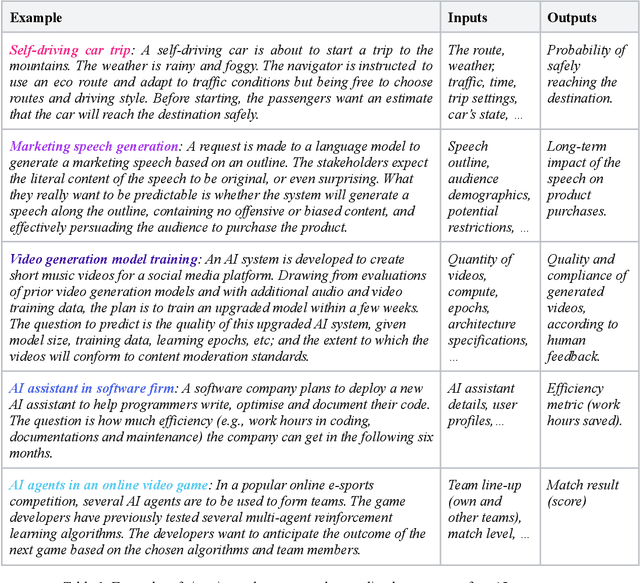
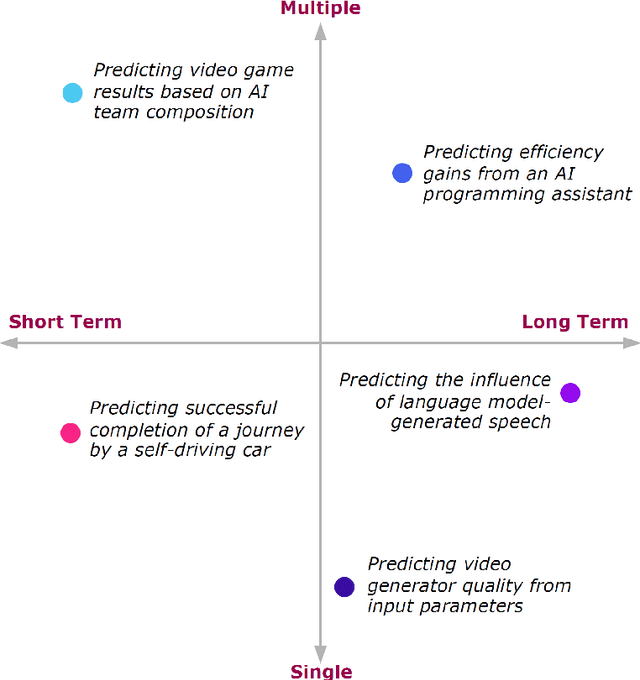
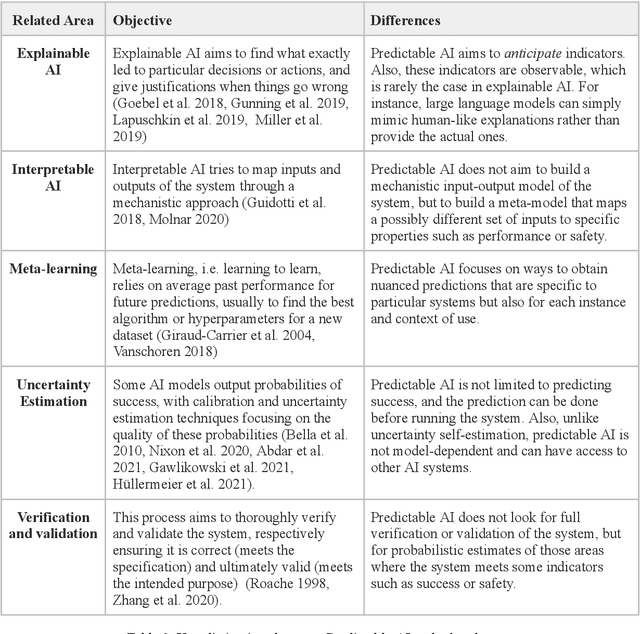

We introduce the fundamental ideas and challenges of Predictable AI, a nascent research area that explores the ways in which we can anticipate key indicators of present and future AI ecosystems. We argue that achieving predictability is crucial for fostering trust, liability, control, alignment and safety of AI ecosystems, and thus should be prioritised over performance. While distinctive from other areas of technical and non-technical AI research, the questions, hypotheses and challenges relevant to Predictable AI were yet to be clearly described. This paper aims to elucidate them, calls for identifying paths towards AI predictability and outlines the potential impact of this emergent field.