 Add to Chrome
 Add to Firefox
 Add to Edge
Reward Models Identify Consistency, Not Causality
Feb 20, 2025
Reward models (RMs) play a crucial role in aligning large language models (LLMs) with human preferences and enhancing reasoning quality. Traditionally, RMs are trained to rank candidate outputs based on their correctness and coherence. However, in this work, we present several surprising findings that challenge common assumptions about RM behavior. Our analysis reveals that state-of-the-art reward models prioritize structural consistency over causal correctness. Specifically, removing the problem statement has minimal impact on reward scores, whereas altering numerical values or disrupting the reasoning flow significantly affects RM outputs. Furthermore, RMs exhibit a strong dependence on complete reasoning trajectories truncated or incomplete steps lead to significant variations in reward assignments, indicating that RMs primarily rely on learned reasoning patterns rather than explicit problem comprehension. These findings hold across multiple architectures, datasets, and tasks, leading to three key insights: (1) RMs primarily assess coherence rather than true reasoning quality; (2) The role of explicit problem comprehension in reward assignment is overstated; (3) Current RMs may be more effective at ranking responses than verifying logical validity. Our results suggest a fundamental limitation in existing reward modeling approaches, emphasizing the need for a shift toward causality-aware reward models that go beyond consistency-driven evaluation.

PRIV-QA: Privacy-Preserving Question Answering for Cloud Large Language Models
Feb 19, 2025The rapid development of large language models (LLMs) is redefining the landscape of human-computer interaction, and their integration into various user-service applications is becoming increasingly prevalent. However, transmitting user data to cloud-based LLMs presents significant risks of data breaches and unauthorized access to personal identification information. In this paper, we propose a privacy preservation pipeline for protecting privacy and sensitive information during interactions between users and LLMs in practical LLM usage scenarios. We construct SensitiveQA, the first privacy open-ended question-answering dataset. It comprises 57k interactions in Chinese and English, encompassing a diverse range of user-sensitive information within the conversations. Our proposed solution employs a multi-stage strategy aimed at preemptively securing user information while simultaneously preserving the response quality of cloud-based LLMs. Experimental validation underscores our method's efficacy in balancing privacy protection with maintaining robust interaction quality. The code and dataset are available at https://github.com/ligw1998/PRIV-QA.
Investigating and Extending Homans' Social Exchange Theory with Large Language Model based Agents
Feb 18, 2025Homans' Social Exchange Theory (SET) is widely recognized as a basic framework for understanding the formation and emergence of human civilizations and social structures. In social science, this theory is typically studied based on simple simulation experiments or real-world human studies, both of which either lack realism or are too expensive to control. In artificial intelligence, recent advances in large language models (LLMs) have shown promising capabilities in simulating human behaviors. Inspired by these insights, we adopt an interdisciplinary research perspective and propose using LLM-based agents to study Homans' SET. Specifically, we construct a virtual society composed of three LLM agents and have them engage in a social exchange game to observe their behaviors. Through extensive experiments, we found that Homans' SET is well validated in our agent society, demonstrating the consistency between the agent and human behaviors. Building on this foundation, we intentionally alter the settings of the agent society to extend the traditional Homans' SET, making it more comprehensive and detailed. To the best of our knowledge, this paper marks the first step in studying Homans' SET with LLM-based agents. More importantly, it introduces a novel and feasible research paradigm that bridges the fields of social science and computer science through LLM-based agents. Code is available at https://github.com/Paitesanshi/SET.
A parametric non-negative coupled canonical polyadic decomposition algorithm for hyperspectral super-resolution
Jan 25, 2025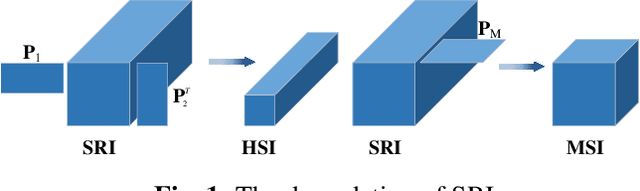
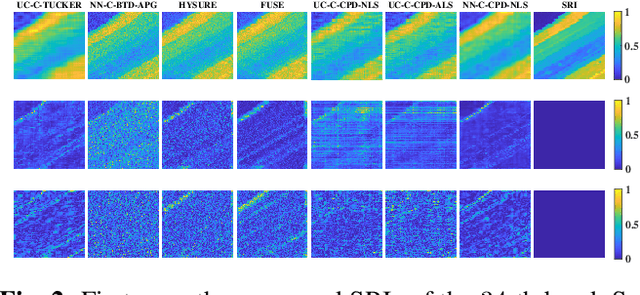
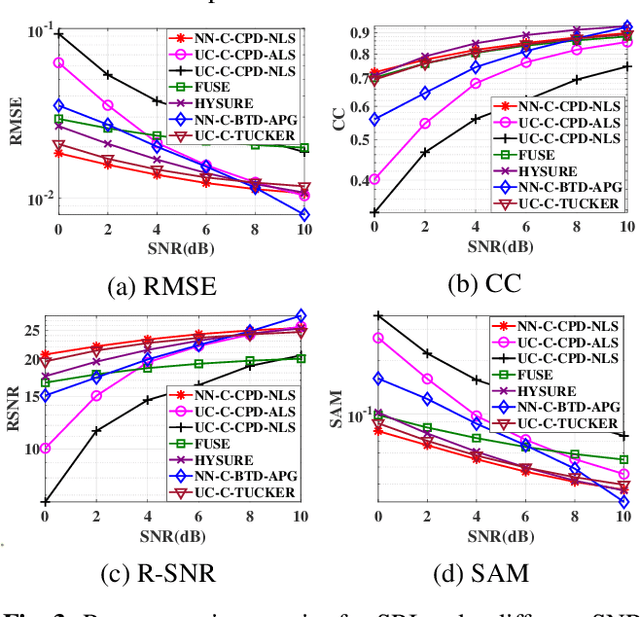
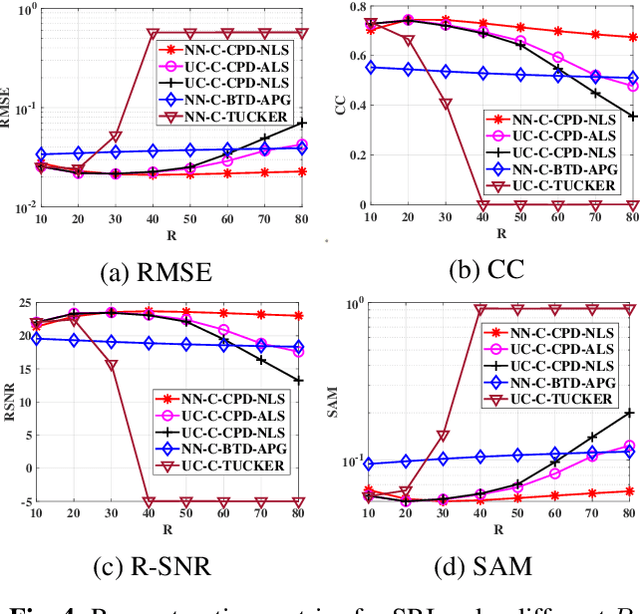
Recently, coupled tensor decomposition has been widely used in data fusion of a hyperspectral image (HSI) and a multispectral image (MSI) for hyperspectral super-resolution (HSR). However, exsiting works often ignore the inherent non-negative (NN) property of the image data, or impose the NN constraint via hard-thresholding which may interfere with the optimization procedure and cause the method to be sub-optimal. As such, we propose a novel NN coupled canonical polyadic decomposition (NN-C-CPD) algorithm, which makes use of the parametric method and nonlinear least squares (NLS) framework to impose the NN constraint into the C-CPD computation. More exactly, the NN constraint is converted into the squared relationship between the NN entries of the factor matrices and a set of latent parameters. Based on the chain rule for deriving the derivatives, the key entities such as gradient and Jacobian with regards to the latent parameters can be derived, thus the NN constraint is naturally integrated without interfering with the optimization procedure. Experimental results are provided to demonstrate the performance of the proposed NN-C-CPD algorithm in HSR applications.
A Block Term Decomposition Model Based Algorithm for Tensor Completion of Multidimensional Harmonic Signals
Jan 25, 2025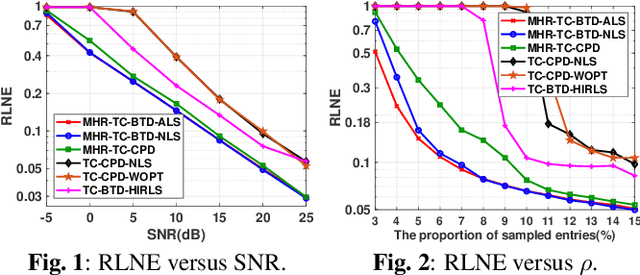
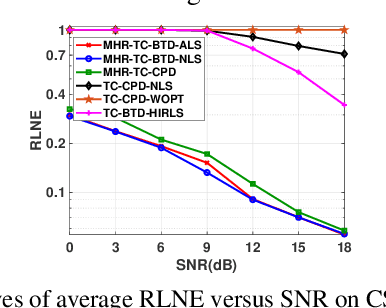
We consider tensor data completion of an incomplete observation of multidimensional harmonic (MH) signals. Unlike existing tensor-based techniques for MH retrieval (MHR), which mostly adopt the canonical polyadic decomposition (CPD) to model the simple "one-to-one" correspondence among harmonics across difference modes, we herein use the more flexible block term decomposition (BTD) model that can be used to describe the complex mutual correspondences among several groups of harmonics across different modes. An optimization principle that aims to fit the BTD model in the least squares sense, subject to rank minimization of hankelized MH components, is set up for the tensor completion task, and an algorithm based on alternating direction method of multipliers is proposed, of which the effectiveness and applicability are validated through both numerical simulations and an application in Sub-6GHz channel state information (CSI) completion.
DVM: Towards Controllable LLM Agents in Social Deduction Games
Jan 12, 2025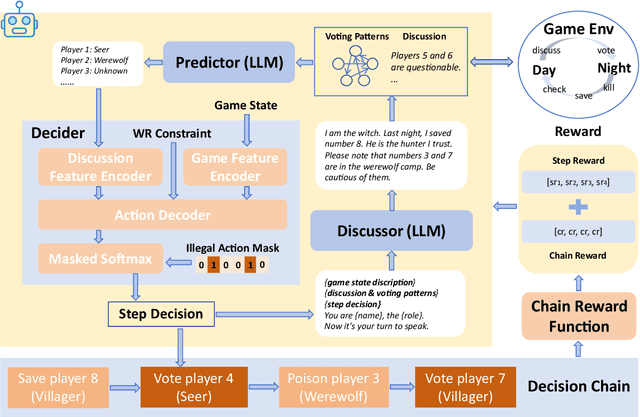
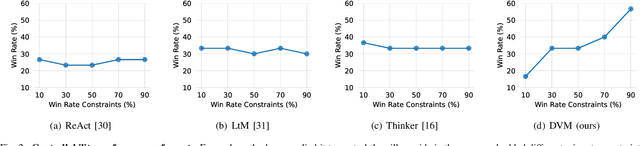
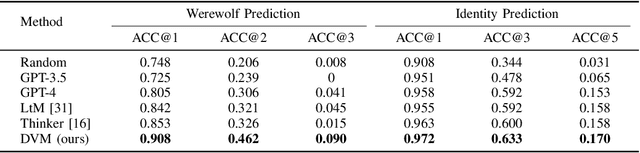
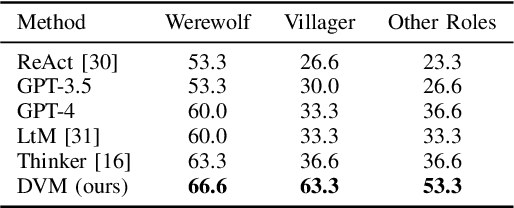
Large Language Models (LLMs) have advanced the capability of game agents in social deduction games (SDGs). These games rely heavily on conversation-driven interactions and require agents to infer, make decisions, and express based on such information. While this progress leads to more sophisticated and strategic non-player characters (NPCs) in SDGs, there exists a need to control the proficiency of these agents. This control not only ensures that NPCs can adapt to varying difficulty levels during gameplay, but also provides insights into the safety and fairness of LLM agents. In this paper, we present DVM, a novel framework for developing controllable LLM agents for SDGs, and demonstrate its implementation on one of the most popular SDGs, Werewolf. DVM comprises three main components: Predictor, Decider, and Discussor. By integrating reinforcement learning with a win rate-constrained decision chain reward mechanism, we enable agents to dynamically adjust their gameplay proficiency to achieve specified win rates. Experiments show that DVM not only outperforms existing methods in the Werewolf game, but also successfully modulates its performance levels to meet predefined win rate targets. These results pave the way for LLM agents' adaptive and balanced gameplay in SDGs, opening new avenues for research in controllable game agents.
RTLSquad: Multi-Agent Based Interpretable RTL Design
Jan 06, 2025Optimizing Register-Transfer Level (RTL) code is crucial for improving hardware PPA performance. Large Language Models (LLMs) offer new approaches for automatic RTL code generation and optimization. However, existing methods often lack decision interpretability (sufficient, understandable justification for decisions), making it difficult for hardware engineers to trust the generated results, thus preventing these methods from being integrated into the design process. To address this, we propose RTLSquad, a novel LLM-Based Multi-Agent system for interpretable RTL code generation. RTLSquad divides the design process into exploration, implementation, and verification & evaluation stages managed by specialized agent squads, generating optimized RTL code through inter-agent collaboration, and providing decision interpretability through the communication process. Experiments show that RTLSquad excels in generating functionally correct RTL code and optimizing PPA performance, while also having the capability to provide decision paths, demonstrating the practical value of our system.
Coarsened confounding for causal effects: a large-sample framework
Jan 06, 2025There has been widespread use of causal inference methods for the rigorous analysis of observational studies and to identify policy evaluations. In this article, we consider coarsened exact matching, developed in Iacus et al. (2011). While they developed some statistical properties, in this article, we study the approach using asymptotics based on a superpopulation inferential framework. This methodology is generalized to what we termed as coarsened confounding, for which we propose two new algorithms. We develop asymptotic results for the average causal effect estimator as well as providing conditions for consistency. In addition, we provide an asymptotic justification for the variance formulae in Iacus et al. (2011). A bias correction technique is proposed, and we apply the proposed methodology to data from two well-known observational studi
Evolving Skeletons: Motion Dynamics in Action Recognition
Jan 05, 2025Skeleton-based action recognition has gained significant attention for its ability to efficiently represent spatiotemporal information in a lightweight format. Most existing approaches use graph-based models to process skeleton sequences, where each pose is represented as a skeletal graph structured around human physical connectivity. Among these, the Spatiotemporal Graph Convolutional Network (ST-GCN) has become a widely used framework. Alternatively, hypergraph-based models, such as the Hyperformer, capture higher-order correlations, offering a more expressive representation of complex joint interactions. A recent advancement, termed Taylor Videos, introduces motion-enhanced skeleton sequences by embedding motion concepts, providing a fresh perspective on interpreting human actions in skeleton-based action recognition. In this paper, we conduct a comprehensive evaluation of both traditional skeleton sequences and Taylor-transformed skeletons using ST-GCN and Hyperformer models on the NTU-60 and NTU-120 datasets. We compare skeletal graph and hypergraph representations, analyzing static poses against motion-injected poses. Our findings highlight the strengths and limitations of Taylor-transformed skeletons, demonstrating their potential to enhance motion dynamics while exposing current challenges in fully using their benefits. This study underscores the need for innovative skeletal modelling techniques to effectively handle motion-rich data and advance the field of action recognition.
Quo Vadis, Anomaly Detection? LLMs and VLMs in the Spotlight
Dec 24, 2024Video anomaly detection (VAD) has witnessed significant advancements through the integration of large language models (LLMs) and vision-language models (VLMs), addressing critical challenges such as interpretability, temporal reasoning, and generalization in dynamic, open-world scenarios. This paper presents an in-depth review of cutting-edge LLM-/VLM-based methods in 2024, focusing on four key aspects: (i) enhancing interpretability through semantic insights and textual explanations, making visual anomalies more understandable; (ii) capturing intricate temporal relationships to detect and localize dynamic anomalies across video frames; (iii) enabling few-shot and zero-shot detection to minimize reliance on large, annotated datasets; and (iv) addressing open-world and class-agnostic anomalies by using semantic understanding and motion features for spatiotemporal coherence. We highlight their potential to redefine the landscape of VAD. Additionally, we explore the synergy between visual and textual modalities offered by LLMs and VLMs, highlighting their combined strengths and proposing future directions to fully exploit the potential in enhancing video anomaly detection.