 Add to Chrome
 Add to Firefox
 Add to Edge
READoc: A Unified Benchmark for Realistic Document Structured Extraction
Sep 08, 2024
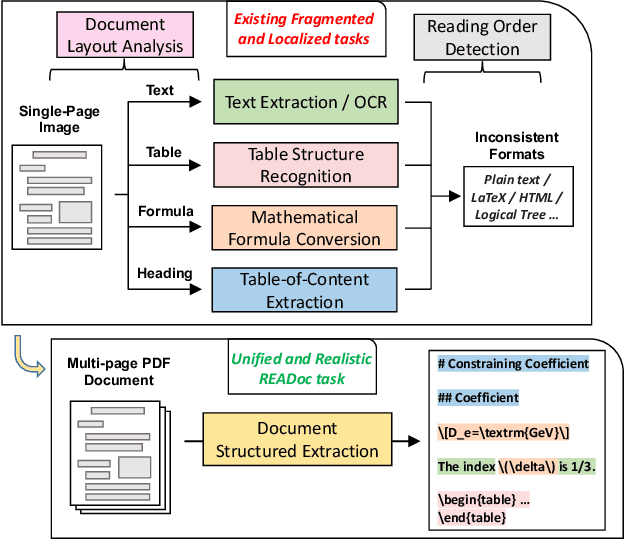
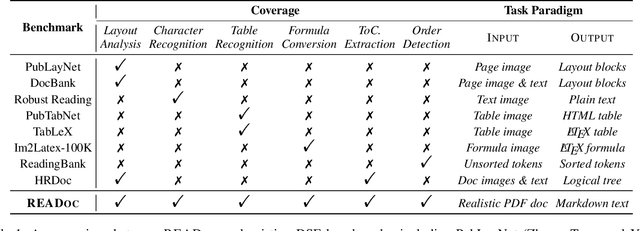

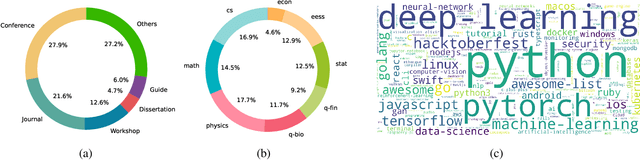
Document Structured Extraction (DSE) aims to extract structured content from raw documents. Despite the emergence of numerous DSE systems, their unified evaluation remains inadequate, significantly hindering the field's advancement. This problem is largely attributed to existing benchmark paradigms, which exhibit fragmented and localized characteristics. To address these limitations and offer a thorough evaluation of DSE systems, we introduce a novel benchmark named READoc, which defines DSE as a realistic task of converting unstructured PDFs into semantically rich Markdown. The READoc dataset is derived from 2,233 diverse and real-world documents from arXiv and GitHub. In addition, we develop a DSE Evaluation S$^3$uite comprising Standardization, Segmentation and Scoring modules, to conduct a unified evaluation of state-of-the-art DSE approaches. By evaluating a range of pipeline tools, expert visual models, and general VLMs, we identify the gap between current work and the unified, realistic DSE objective for the first time. We aspire that READoc will catalyze future research in DSE, fostering more comprehensive and practical solutions.

Critic-CoT: Boosting the reasoning abilities of large language model via Chain-of-thoughts Critic
Aug 29, 2024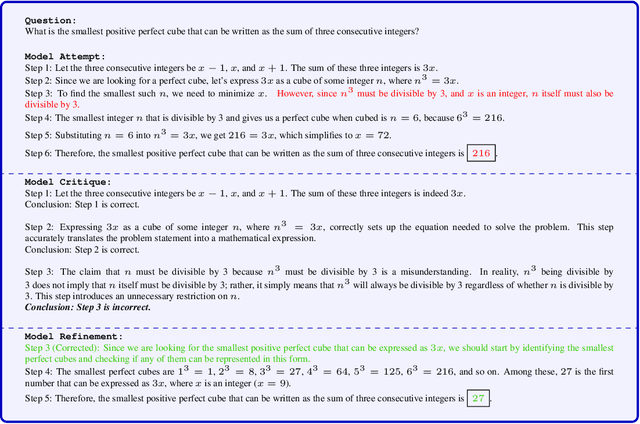
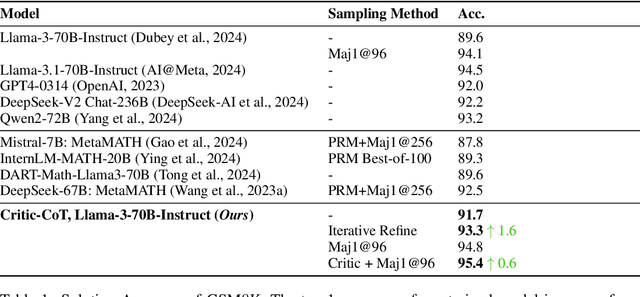
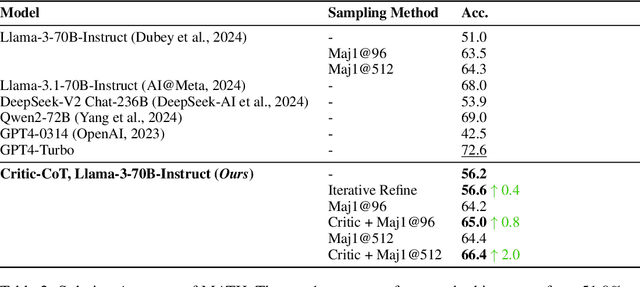
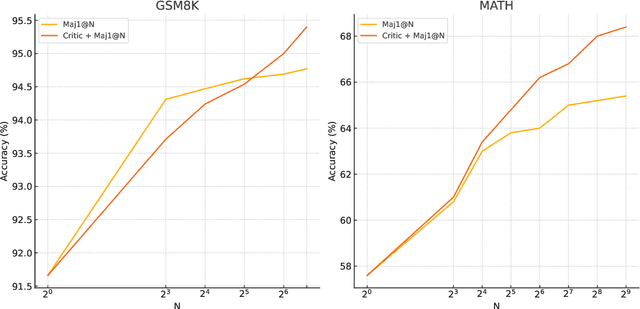
Self-critic has become an important mechanism for enhancing the reasoning performance of LLMs. However, current approaches mainly involve basic prompts without further training, which tend to be over-simplified, leading to limited accuracy.Moreover, there is a lack of in-depth investigation of the relationship between LLM's ability to criticism and its task-solving performance.To address these issues, we propose Critic-CoT, a novel framework that pushes LLMs toward System-2-like critic capability, via step-wise CoT reasoning format and distant-supervision data construction, without the need for human annotation. Experiments on GSM8K and MATH show that via filtering out invalid solutions or iterative refinement, our enhanced model boosts task-solving performance, which demonstrates the effectiveness of our method. Further, we find that training on critique and refinement alone improves the generation. We hope our work could shed light on future research on improving the reasoning and critic ability of LLMs.
CRUXEval-X: A Benchmark for Multilingual Code Reasoning, Understanding and Execution
Aug 23, 2024
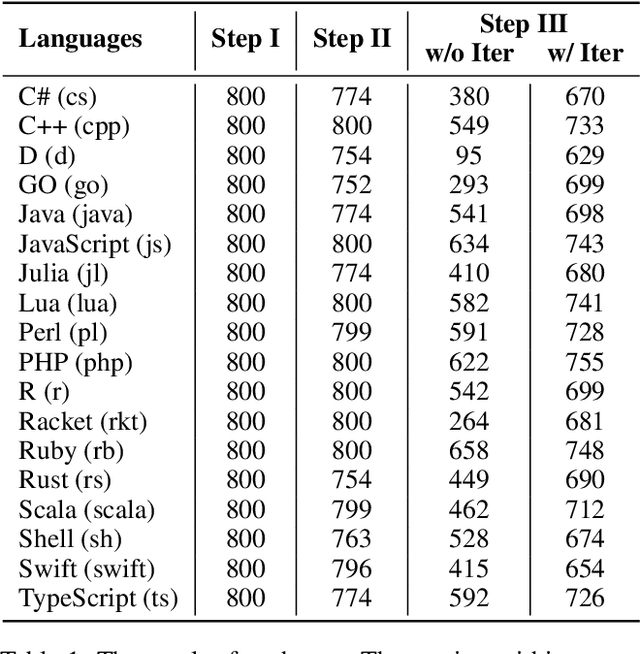


Code benchmarks such as HumanEval are widely adopted to evaluate Large Language Models' (LLMs) coding capabilities. However, there is an unignorable programming language bias in existing code benchmarks -- over 95% code generation benchmarks are dominated by Python, leaving the LLMs' capabilities in other programming languages such as Java and C/C++ unknown. Moreover, coding task bias is also crucial. Most benchmarks focus on code generation capability, while benchmarks for code reasoning (given input, reasoning output; and given output, reasoning input), an essential coding capability, are insufficient. Yet, constructing multi-lingual benchmarks can be expensive and labor-intensive, and codes in contest websites such as Leetcode suffer from data contamination during training. To fill this gap, we propose CRUXEVAL-X, a multi-lingual code reasoning benchmark that contains 19 programming languages. It comprises at least 600 subjects for each language, along with 19K content-consistent tests in total. In particular, the construction pipeline of CRUXEVAL-X works in a fully automated and test-guided manner, which iteratively generates and repairs based on execution feedback. Also, to cross language barriers (e.g., dynamic/static type systems in Python/C++), we formulated various transition rules between language pairs to facilitate translation. Our intensive evaluation of 24 representative LLMs reveals the correlation between language pairs. For example, TypeScript and JavaScript show a significant positive correlation, while Racket has less correlation with other languages. More interestingly, even a model trained solely on Python can achieve at most 34.4% Pass@1 in other languages, revealing the cross-language generalization of LLMs.
DOMAINEVAL: An Auto-Constructed Benchmark for Multi-Domain Code Generation
Aug 23, 2024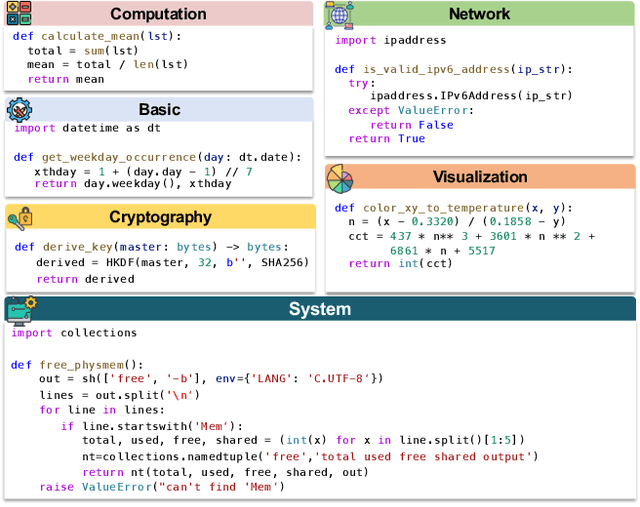
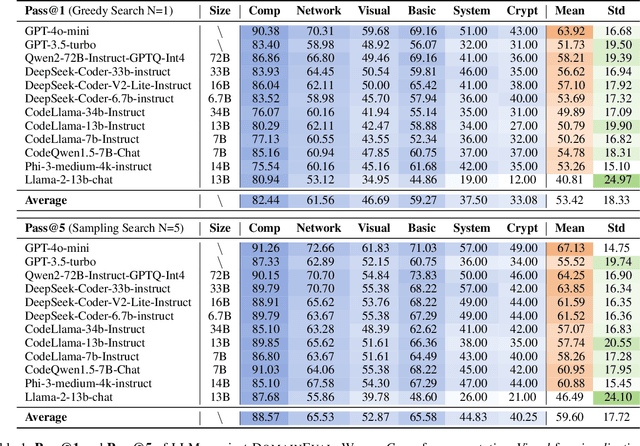
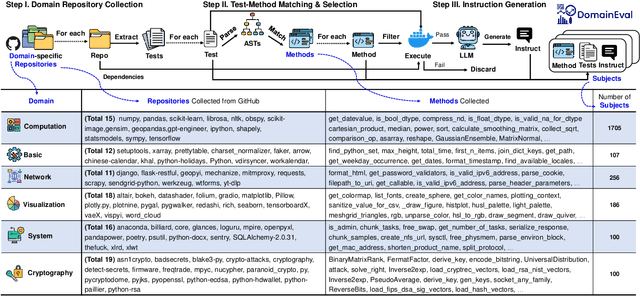
Code benchmarks such as HumanEval are widely adopted to evaluate the capabilities of Large Language Models (LLMs), providing insights into their strengths and weaknesses. However, current benchmarks primarily exercise LLMs' capability on common coding tasks (e.g., bubble sort, greatest common divisor), leaving domain-specific coding tasks (e.g., computation, system, cryptography) unexplored. To fill this gap, we propose a multi-domain code benchmark, DOMAINEVAL, designed to evaluate LLMs' coding capabilities thoroughly. Our pipeline works in a fully automated manner, enabling a push-bottom construction from code repositories into formatted subjects under study. Interesting findings are observed by evaluating 12 representative LLMs against DOMAINEVAL. We notice that LLMs are generally good at computation tasks while falling short on cryptography and system coding tasks. The performance gap can be as much as 68.94% (80.94% - 12.0%) in some LLMs. We also observe that generating more samples can increase the overall performance of LLMs, while the domain bias may even increase. The contributions of this study include a code generation benchmark dataset DOMAINEVAL, encompassing six popular domains, a fully automated pipeline for constructing code benchmarks, and an identification of the limitations of LLMs in code generation tasks based on their performance on DOMAINEVAL, providing directions for future research improvements. The leaderboard is available at https://domaineval.github.io/.
REInstruct: Building Instruction Data from Unlabeled Corpus
Aug 20, 2024

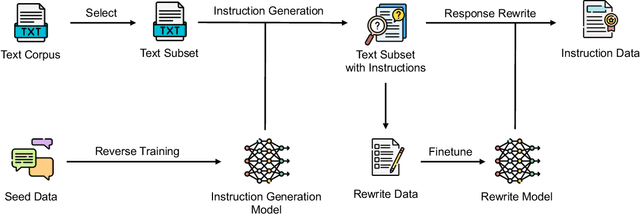

Manually annotating instruction data for large language models is difficult, costly, and hard to scale. Meanwhile, current automatic annotation methods typically rely on distilling synthetic data from proprietary LLMs, which not only limits the upper bound of the quality of the instruction data but also raises potential copyright issues. In this paper, we propose REInstruct, a simple and scalable method to automatically build instruction data from an unlabeled corpus without heavy reliance on proprietary LLMs and human annotation. Specifically, REInstruct first selects a subset of unlabeled texts that potentially contain well-structured helpful and insightful content and then generates instructions for these texts. To generate accurate and relevant responses for effective and robust training, REInstruct further proposes a rewriting-based approach to improve the quality of the generated instruction data. By training Llama-7b on a combination of 3k seed data and 32k synthetic data from REInstruct, fine-tuned model achieves a 65.41\% win rate on AlpacaEval leaderboard against text-davinci-003, outperforming other open-source, non-distilled instruction data construction methods. The code is publicly available at \url{https://github.com/cs32963/REInstruct}.
StructEval: Deepen and Broaden Large Language Model Assessment via Structured Evaluation
Aug 07, 2024Evaluation is the baton for the development of large language models. Current evaluations typically employ a single-item assessment paradigm for each atomic test objective, which struggles to discern whether a model genuinely possesses the required capabilities or merely memorizes/guesses the answers to specific questions. To this end, we propose a novel evaluation framework referred to as StructEval. Starting from an atomic test objective, StructEval deepens and broadens the evaluation by conducting a structured assessment across multiple cognitive levels and critical concepts, and therefore offers a comprehensive, robust and consistent evaluation for LLMs. Experiments on three widely-used benchmarks demonstrate that StructEval serves as a reliable tool for resisting the risk of data contamination and reducing the interference of potential biases, thereby providing more reliable and consistent conclusions regarding model capabilities. Our framework also sheds light on the design of future principled and trustworthy LLM evaluation protocols.
Beyond Correctness: Benchmarking Multi-dimensional Code Generation for Large Language Models
Jul 16, 2024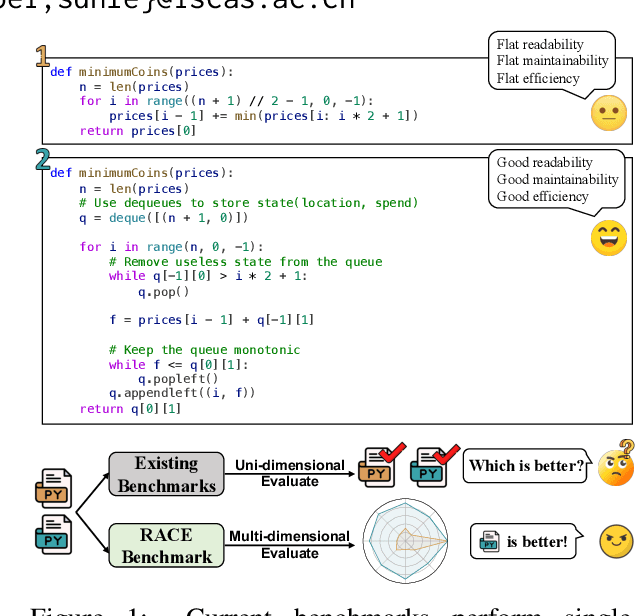


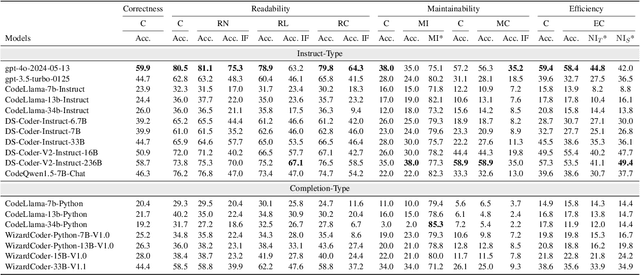
In recent years, researchers have proposed numerous benchmarks to evaluate the impressive coding capabilities of large language models (LLMs). However, existing benchmarks primarily focus on assessing the correctness of code generated by LLMs, while neglecting other critical dimensions that also significantly impact code quality. Therefore, this paper proposes the RACE benchmark, which comprehensively evaluates the quality of code generated by LLMs across 4 dimensions: Readability, mAintainability, Correctness, and Efficiency. Specifically, considering the demand-dependent nature of dimensions beyond correctness, we design various types of user requirements for each dimension to assess the model's ability to generate correct code that also meets user demands. We evaluate 18 representative LLMs on RACE and find that: 1) the current LLMs' ability to generate high-quality code on demand does not yet meet the requirements of software development; 2) readability serves as a critical indicator of the overall quality of generated code; 3) most LLMs exhibit an inherent preference for specific coding style. These findings can help researchers gain a deeper understanding of the coding capabilities of current LLMs and shed light on future directions for model improvement.
On-Policy Fine-grained Knowledge Feedback for Hallucination Mitigation
Jun 18, 2024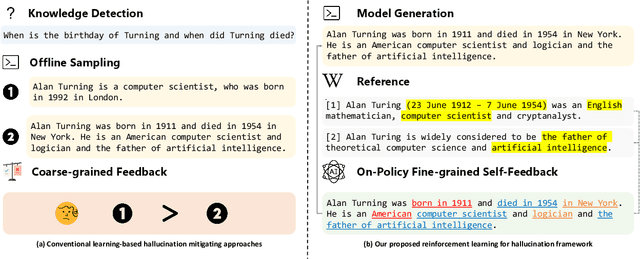
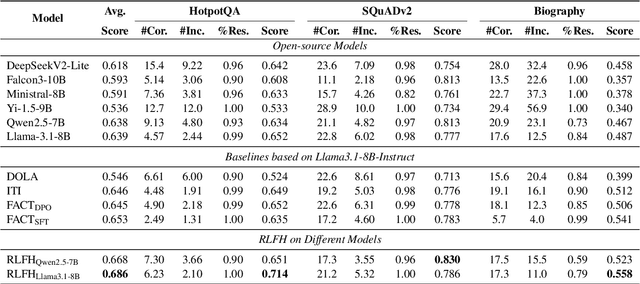

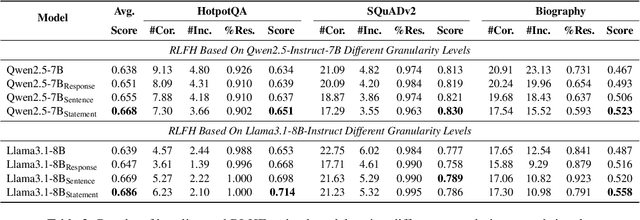
Hallucination occurs when large language models (LLMs) exhibit behavior that deviates from the boundaries of their knowledge during the response generation process. Previous learning-based methods focus on detecting knowledge boundaries and finetuning models with instance-level feedback, but they suffer from inaccurate signals due to off-policy data sampling and coarse-grained feedback. In this paper, we introduce \textit{\b{R}einforcement \b{L}earning \b{f}or \b{H}allucination} (RLFH), a fine-grained feedback-based online reinforcement learning method for hallucination mitigation. Unlike previous learning-based methods, RLFH enables LLMs to explore the boundaries of their internal knowledge and provide on-policy, fine-grained feedback on these explorations. To construct fine-grained feedback for learning reliable generation behavior, RLFH decomposes the outcomes of large models into atomic facts, provides statement-level evaluation signals, and traces back the signals to the tokens of the original responses. Finally, RLFH adopts the online reinforcement algorithm with these token-level rewards to adjust model behavior for hallucination mitigation. For effective on-policy optimization, RLFH also introduces an LLM-based fact assessment framework to verify the truthfulness and helpfulness of atomic facts without human intervention. Experiments on HotpotQA, SQuADv2, and Biography benchmarks demonstrate that RLFH can balance their usage of internal knowledge during the generation process to eliminate the hallucination behavior of LLMs.
Navigating the Shadows: Unveiling Effective Disturbances for Modern AI Content Detectors
Jun 13, 2024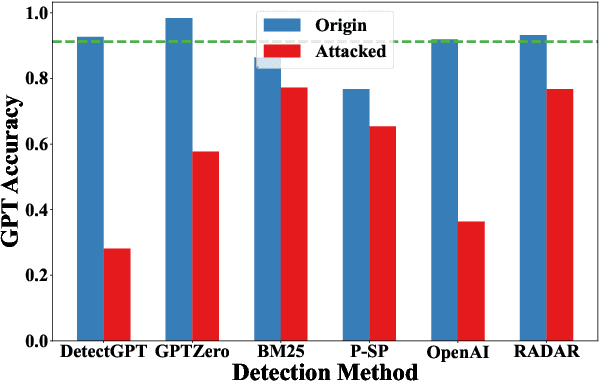
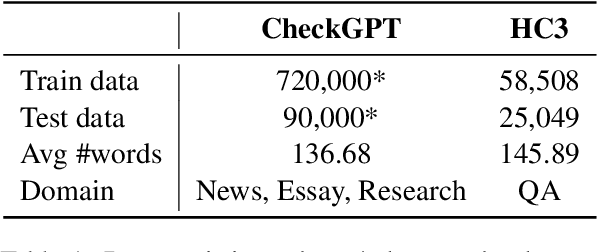
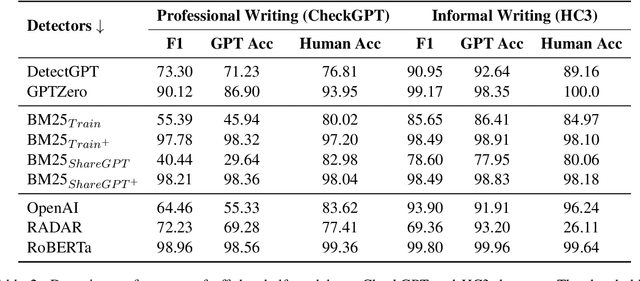
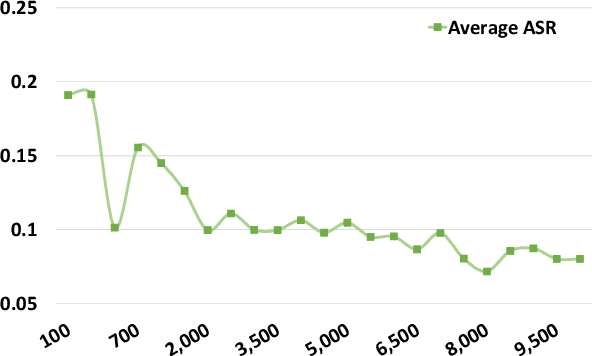
With the launch of ChatGPT, large language models (LLMs) have attracted global attention. In the realm of article writing, LLMs have witnessed extensive utilization, giving rise to concerns related to intellectual property protection, personal privacy, and academic integrity. In response, AI-text detection has emerged to distinguish between human and machine-generated content. However, recent research indicates that these detection systems often lack robustness and struggle to effectively differentiate perturbed texts. Currently, there is a lack of systematic evaluations regarding detection performance in real-world applications, and a comprehensive examination of perturbation techniques and detector robustness is also absent. To bridge this gap, our work simulates real-world scenarios in both informal and professional writing, exploring the out-of-the-box performance of current detectors. Additionally, we have constructed 12 black-box text perturbation methods to assess the robustness of current detection models across various perturbation granularities. Furthermore, through adversarial learning experiments, we investigate the impact of perturbation data augmentation on the robustness of AI-text detectors. We have released our code and data at https://github.com/zhouying20/ai-text-detector-evaluation.
Open Grounded Planning: Challenges and Benchmark Construction
Jun 05, 2024The emergence of large language models (LLMs) has increasingly drawn attention to the use of LLMs for human-like planning. Existing work on LLM-based planning either focuses on leveraging the inherent language generation capabilities of LLMs to produce free-style plans, or employs reinforcement learning approaches to learn decision-making for a limited set of actions within restricted environments. However, both approaches exhibit significant discrepancies from the open and executable requirements in real-world planning. In this paper, we propose a new planning task--open grounded planning. The primary objective of open grounded planning is to ask the model to generate an executable plan based on a variable action set, thereby ensuring the executability of the produced plan. To this end, we establishes a benchmark for open grounded planning spanning a wide range of domains. Then we test current state-of-the-art LLMs along with five planning approaches, revealing that existing LLMs and methods still struggle to address the challenges posed by grounded planning in open domains. The outcomes of this paper define and establish a foundational dataset for open grounded planning, and shed light on the potential challenges and future directions of LLM-based planning.