 Add to Chrome
 Add to Firefox
 Add to Edge
Surg-R1: A Hierarchical Reasoning Foundation Model for Scalable and Interpretable Surgical Decision Support with Multi-Center Clinical Validation
Mar 12, 2026
Surgical scene understanding demands not only accurate predictions but also interpretable reasoning that surgeons can verify against clinical expertise. However, existing surgical vision-language models generate predictions without reasoning chains, and general-purpose reasoning models fail on compositional surgical tasks without domain-specific knowledge. We present Surg-R1, a surgical Vision-Language Model that addresses this gap through hierarchical reasoning trained via a four-stage pipeline. Our approach introduces three key contributions: (1) a three-level reasoning hierarchy decomposing surgical interpretation into perceptual grounding, relational understanding, and contextual reasoning; (2) the largest surgical chain-of-thought dataset with 320,000 reasoning pairs; and (3) a four-stage training pipeline progressing from supervised fine-tuning to group relative policy optimization and iterative self-improvement. Evaluation on SurgBench, comprising six public benchmarks and six multi-center external validation datasets from five institutions, demonstrates that Surg-R1 achieves the highest Arena Score (64.9%) on public benchmarks versus Gemini 3.0 Pro (46.1%) and GPT-5.1 (37.9%), outperforming both proprietary reasoning models and specialized surgical VLMs on the majority of tasks spanning instrument localization, triplet recognition, phase recognition, action recognition, and critical view of safety assessment, with a 15.2 percentage point improvement over the strongest surgical baseline on external validation.

Is Segment Anything Model 2 All You Need for Surgery Video Segmentation? A Systematic Evaluation
Dec 31, 2024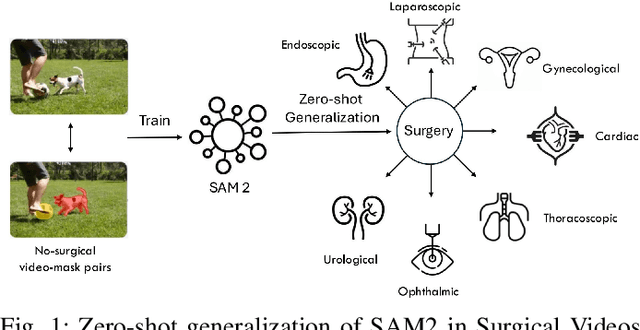


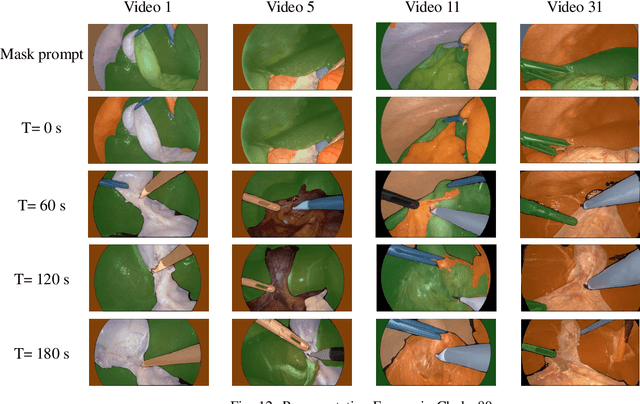
Surgery video segmentation is an important topic in the surgical AI field. It allows the AI model to understand the spatial information of a surgical scene. Meanwhile, due to the lack of annotated surgical data, surgery segmentation models suffer from limited performance. With the emergence of SAM2 model, a large foundation model for video segmentation trained on natural videos, zero-shot surgical video segmentation became more realistic but meanwhile remains to be explored. In this paper, we systematically evaluate the performance of SAM2 model in zero-shot surgery video segmentation task. We conducted experiments under different configurations, including different prompting strategies, robustness, etc. Moreover, we conducted an empirical evaluation over the performance, including 9 datasets with 17 different types of surgeries.