 Add to Chrome
 Add to Firefox
 Add to Edge
SCISSR: Scribble-Conditioned Interactive Surgical Segmentation and Refinement
Mar 19, 2026
Accurate segmentation of tissues and instruments in surgical scenes is annotation-intensive due to irregular shapes, thin structures, specularities, and frequent occlusions. While SAM models support point, box, and mask prompts, points are often too sparse and boxes too coarse to localize such challenging targets. We present SCISSR, a scribble-promptable framework for interactive surgical scene segmentation. It introduces a lightweight Scribble Encoder that converts freehand scribbles into dense prompt embeddings compatible with the mask decoder, enabling iterative refinement for a target object by drawing corrective strokes on error regions. Because all added modules (the Scribble Encoder, Spatial Gated Fusion, and LoRA adapters) interact with the backbone only through its standard embedding interfaces, the framework is not tied to a single model: we build on SAM 2 in this work, yet the same components transfer to other prompt-driven segmentation architectures such as SAM 3 without structural modification. To preserve pre-trained capabilities, we train only these lightweight additions while keeping the remaining backbone frozen. Experiments on EndoVis 2018 demonstrate strong in-domain performance, while evaluation on the out-of-distribution CholecSeg8k further confirms robustness across surgical domains. SCISSR achieves 95.41% Dice on EndoVis 2018 with five interaction rounds and 96.30% Dice on CholecSeg8k with three interaction rounds, outperforming iterative point prompting on both benchmarks.

Is Segment Anything Model 2 All You Need for Surgery Video Segmentation? A Systematic Evaluation
Dec 31, 2024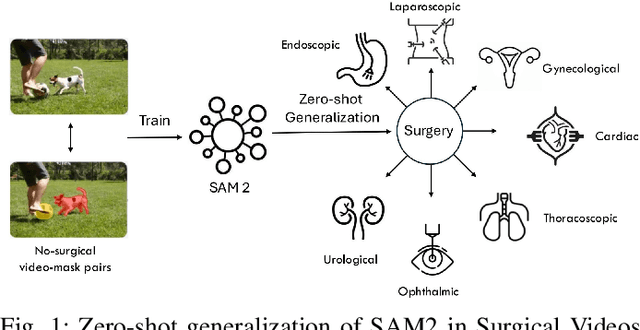


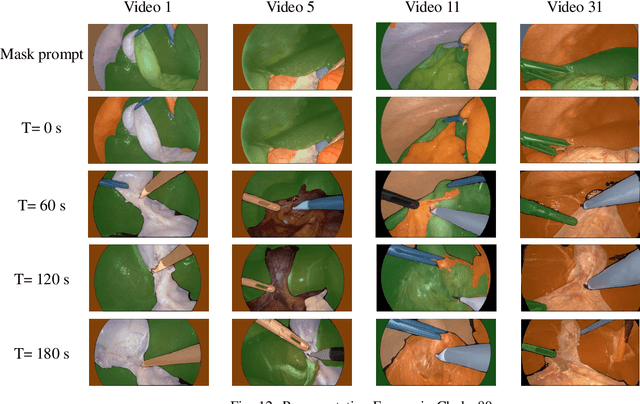
Surgery video segmentation is an important topic in the surgical AI field. It allows the AI model to understand the spatial information of a surgical scene. Meanwhile, due to the lack of annotated surgical data, surgery segmentation models suffer from limited performance. With the emergence of SAM2 model, a large foundation model for video segmentation trained on natural videos, zero-shot surgical video segmentation became more realistic but meanwhile remains to be explored. In this paper, we systematically evaluate the performance of SAM2 model in zero-shot surgery video segmentation task. We conducted experiments under different configurations, including different prompting strategies, robustness, etc. Moreover, we conducted an empirical evaluation over the performance, including 9 datasets with 17 different types of surgeries.