 Add to Chrome
 Add to Firefox
 Add to Edge
BehaviorBench: Benchmarking Foundation Models for Behavioral Science Tasks
Jun 23, 2026
Foundation models have been increasingly applied to behavioral science domains such as psychology, sociology, and economics. While these models show promise in individual tasks such as survey response prediction and human-subject experiment simulation, there remains no systematic understanding of how well they perform across diverse behavioral science tasks, contexts, and populations. We introduce BehaviorBench, a comprehensive benchmark that evaluates foundation models along four core capabilities: (1) behavior prediction and simulation, (2) strategic decision-making, (3) subject-trait inference, and (4) behavioral knowledge application. Crucially, BehaviorBench evaluates model outputs at both the individual and distributional levels, capturing not only per-subject accuracy but also population-level alignment, an essential requirement for behavioral validity. Leveraging the tasks in BehaviorBench, we further develop Be.FM-1.5, extending the Be.FM family of behavioral foundation models fine-tuned on behavioral data. Our results reveal a considerable gap: proprietary general-purpose models excel at individual-level prediction and knowledge-intensive tasks, whereas behavioral foundation models, fine-tuned on behavioral data, achieve substantially stronger distributional alignment. Notably, Be.FM-1.5 leads on distributional metrics and remains competitive on individual-level metrics, suggesting that proper behavioral adaptation can close the gap. Our results highlight the importance of distributional evaluation, establish BehaviorBench as a foundation for developing and assessing behaviorally aligned AI systems, and demonstrate Be.FM-1.5's potential for a broad range of behavioral science studies. Our BehaviorBench and Be.FM-1.5 models can be accessed via https://umich-foreseer.github.io/behaviorbench/.

SoccerRef-Agents: Multi-Agent System for Automated Soccer Refereeing
Apr 25, 2026Refereeing is vital in sports, where fair, accurate, and explainable decisions are fundamental. While intelligent assistant technologies are being widely adopted in soccer refereeing, current AI-assisted approaches remain preliminary. Existing research mostly focuses on isolated video perception tasks and lacks the ability to understand and reason about foul scenarios. To fill this gap, we propose SoccerRef-Agents, a holistic and explainable multi-agent decision-making framework for soccer refereeing. The main contributions are: (i) constructing the multimodal benchmark SoccerRefBench with over 1,200 referee theory questions and 600 foul video clips; (ii) building a vector-based knowledge base RefKnowledgeDB using the latest "Laws of the Game" and a classic case database for precise, knowledge-driven reasoning; (iii) designing a novel multi-agent architecture that collaborates via cross-modal RAG to bridge the semantic gap between visual content and regulatory texts. This work explores the technical capability of integrating MLLMs with refereeing expertise, and evaluations show our system significantly outperforms general-purpose MLLMs in decision accuracy and explanation quality. All databases, benchmarks, and code will be made available.
Is Segment Anything Model 2 All You Need for Surgery Video Segmentation? A Systematic Evaluation
Dec 31, 2024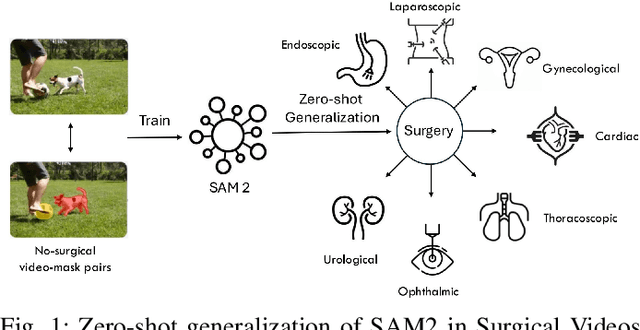


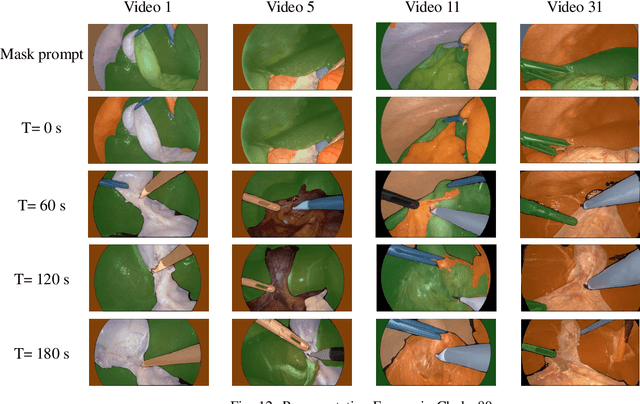
Surgery video segmentation is an important topic in the surgical AI field. It allows the AI model to understand the spatial information of a surgical scene. Meanwhile, due to the lack of annotated surgical data, surgery segmentation models suffer from limited performance. With the emergence of SAM2 model, a large foundation model for video segmentation trained on natural videos, zero-shot surgical video segmentation became more realistic but meanwhile remains to be explored. In this paper, we systematically evaluate the performance of SAM2 model in zero-shot surgery video segmentation task. We conducted experiments under different configurations, including different prompting strategies, robustness, etc. Moreover, we conducted an empirical evaluation over the performance, including 9 datasets with 17 different types of surgeries.